

Category Archives: Articles

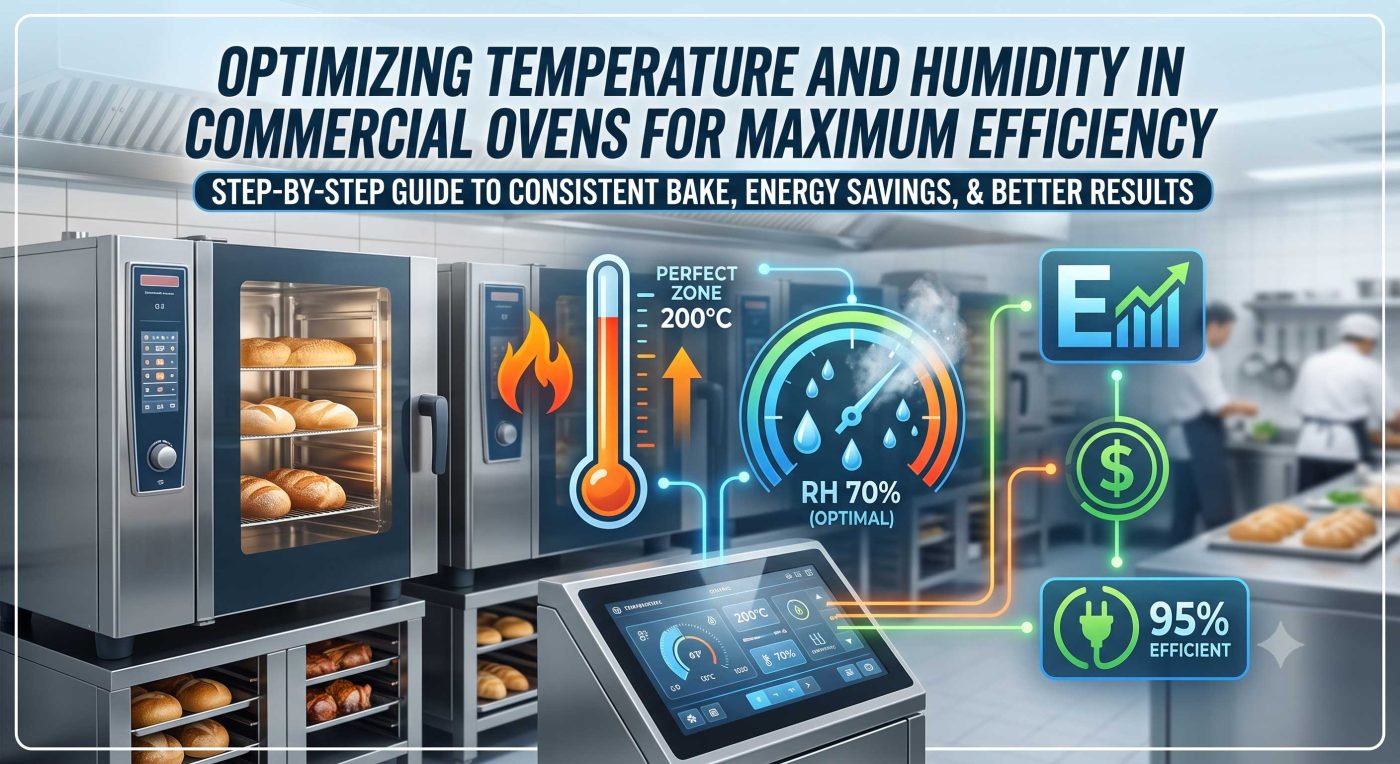
Optimizing Temperature and Humidity in Commercial Ovens for Maximum Efficiency

051111

Achieving the Perfect Balance of Heat and Moisture in Modern Baking Chambers

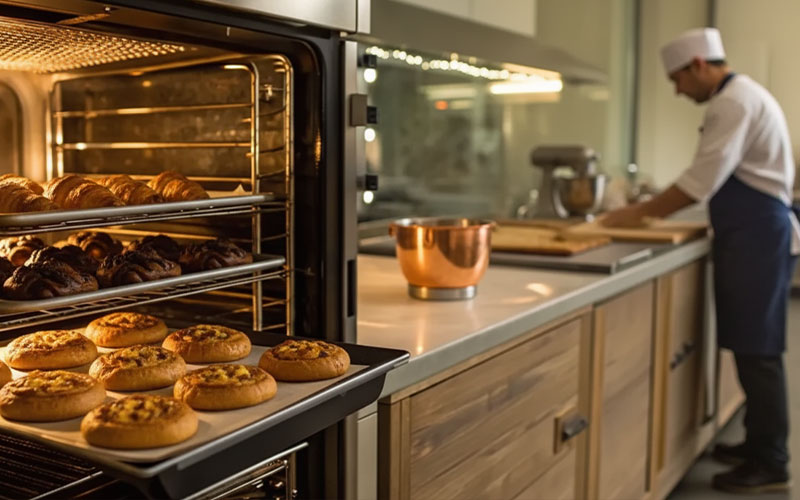
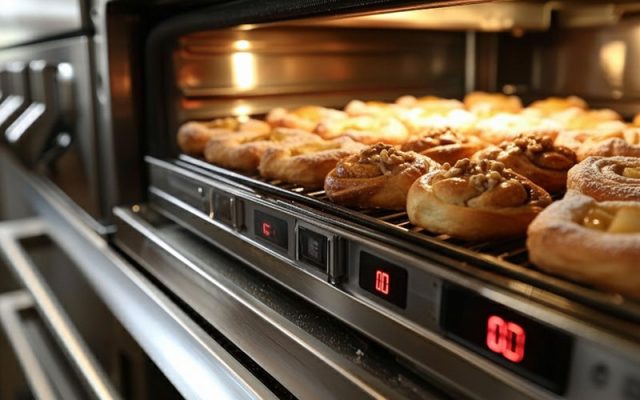
When you walk into a high-capacity bakery, the sensory symphony of baking bread is instantly captivating, yet behind that comforting aroma lies a complex web of thermodynamic equations. Every loaf of bread, every delicate pastry, and every batch of flatbread relies on a delicate dance between thermal energy and moisture. Managing these variables is not merely about setting a dial to a specific temperature; it is about managing the microclimate inside the baking chamber to achieve optimal volume, crust texture, and crumb structure. For commercial operators, achieving this balance is also a matter of financial survival, as inefficient thermal management directly translates to soaring fuel bills and wasted batches. At MBICO, we have spent decades studying how heat and steam interact with different dough formulations, and we understand that mastering this relationship is the key to scaling your production without sacrificing artisanal quality.

One of the most common challenges our customers face is transitioning from manual, small-scale baking to automated, industrial lines where even a one-degree variance in temperature or a five-percent drop in humidity can ruin thousands of loaves. Imagine the frustration of opening a state-of-the-art oven only to find that your signature sourdough has failed to rise, sporting a dull, thick, leathery crust instead of the glossy, blistered finish your customers love. This issue rarely stems from a poor recipe; instead, it is almost always a failure of thermodynamic calibration inside the baking chamber. By understanding the physics of heat transfer and moisture migration, you can transform your baking line from a source of unpredictable variance into a highly efficient, reliable engine of consistent product quality.

By the end of this guide, you will not only understand Optimizing Temperature and Humidity in Commercial Ovens for Maximum Efficiency, but also learn how to apply it effectively in your baking process.

The Science of Thermal Energy Transfer in Industrial Baking

To optimize any baking process, we must first dissect how heat travels from the oven’s heating elements into the core of the dough. Heat transfer inside a commercial oven occurs through three primary mechanisms: conduction, convection, and radiation. Conduction is the direct transfer of heat through physical contact, such as when the bottom of a loaf rests on a hot stone tile in MBICO deck ovens. Convection involves the movement of hot air currents over the surface of the dough, a process accelerated by fans in MBICO rotary ovens. Radiation is the transfer of electromagnetic energy directly from the hot walls and burners of the oven to the dough, penetrating the product without needing a physical medium. The balance of these three heat transfer modes forms the unique baking chamber thermal profile, which dictates how quickly the dough heats up from the outside in.

In our years of experience setting up industrial baking lines, we have seen how a misunderstanding of convection vs. radiation heat transfer can lead to severe baking defects. For instance, in a high-velocity convection oven, the rapid movement of hot air can dry out the surface of the dough too quickly, forming a skin before the interior gases have had time to expand. Conversely, radiation heat transfer penetrative properties are gentler, warming the interior of the loaf and encouraging a uniform rise. The ideal thermal profile depends heavily on the product: a delicate sponge cake requires gentle, radiant heat to rise evenly without collapsing, while a thin, crispy flatbread needs intense conductive heat from a solid deck to flash-bake the bottom and create large, rustic bubbles.

According to MBICO’s internal baking chamber trials, adjusting the ratio of convection to radiation heat is critical when scaling production. When we worked with a large industrial bakery in Mashhad that was struggling with dense, under-baked centers in their sandwich bread, our process engineers did not simply raise the oven temperature. Instead, we reconfigured the air baffles inside their rotary ovens to reduce direct convection airspeed while increasing the radiative heat from the chamber walls. This simple shift in the thermal profile allowed heat to penetrate deep into the loaf centers, reducing bake times by twelve percent and eliminating the soggy core issue entirely, all while keeping energy consumption flat.

021114 scaled

The Critical Role of Relative Humidity and Steam Injection

While temperature controls how fast the dough bakes, humidity controls *how* it bakes. The level of relative humidity (RH) in ovens during the initial stages of baking is the single most important factor determining oven spring, crust properties, and crumb elasticity. When raw dough enters the baking chamber, it is relatively cold, usually sitting between 20°C and 25°C. If the chamber is injected with high-pressure steam, the moisture immediately condenses on the cold surface of the dough. This condensation process is governed by a fundamental physical principle: the release of the latent heat of vaporization.

As water vapor transitions from a gas to a liquid on the dough’s surface, it releases a massive amount of thermal energy. This latent heat warms the outer layers of the dough far more rapidly than dry air ever could. Simultaneously, the thin layer of condensed water keeps the outer skin of the dough highly elastic. This moisture delays starch gelatinization and protein coagulation on the surface, allowing the carbon dioxide gases and water vapor trapped within the gluten matrix to expand freely. This is the secret to oven spring optimization. Without this initial burst of humidity, the crust would set almost instantly, trapping the gases inside and causing the loaf to either remain dense or rupture violently at its weakest points during the bake.
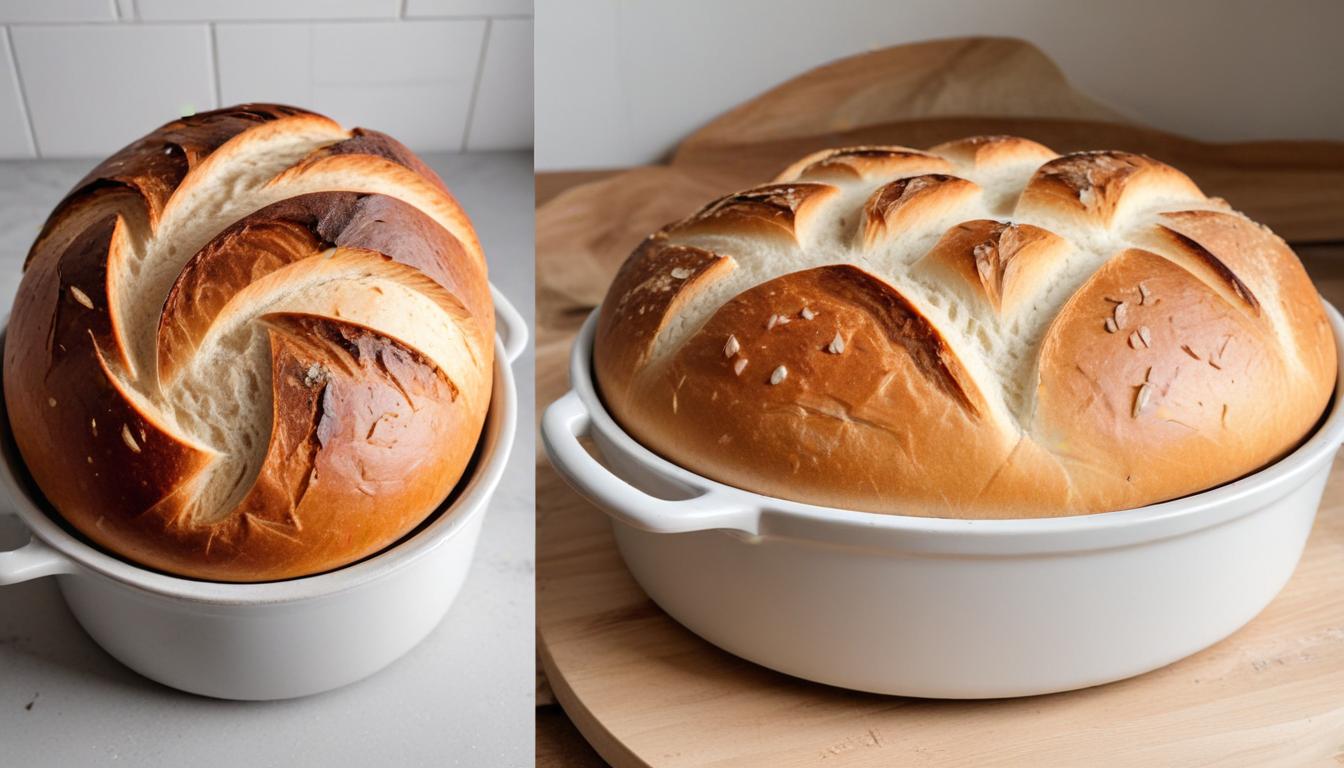
“Steam is not just moisture; it is a thermal vehicle. By mastering the dew point and steam condensation inside the chamber, a baker can control the exact millisecond the crust begins to form, unlocking unprecedented volume and shine.”
— MBICO R&D Thermal Engineering Team

The moisture on the dough’s surface also plays a vital chemical role in the development of flavor and color. As the water condenses, it dissolves the simple sugars and amino acids present on the surface of the dough. Once the steam phase ends and the oven atmosphere dries out, these dissolved compounds undergo the Maillard reaction and caramelization at high temperatures. This chemical reaction is what produces the deep golden-brown hues, glassy sheen, and complex, nutty aromas of a premium crust. Furthermore, because the surface starches have gelatinized in a wet environment, they dry down into a thin, crisp, brittle shell rather than a thick, tough, leathery skin. Understanding the dew point inside the baking chamber ensures that steam is injected only when the dough is cold enough to trigger condensation; injecting steam late in the bake, when the dough surface has already passed the dew point, is a waste of energy that only serves to soggy the crust.

A Step by Step Guide to Calibrating Temperature and Moisture Profiles

Achieving maximum efficiency and perfect product quality requires a structured approach to calibrating your commercial baking chamber. Below is the precise methodology developed by MBICO’s process engineers to synchronize heat and moisture cycles for optimal throughput.

  1. Establish the Baseline Thermal Profile of the ChamberBefore introducing any product, you must map the temperature distribution inside your empty oven. Use a multi-channel thermocouple datalogger to measure temperatures at various heights and depths across the baking chamber. This profile reveals any cold spots or heat concentrations caused by worn heating elements, faulty air circulation fans, or deteriorated door seals. Ensure the oven can hold a stable temperature within a margin of plus or minus two degrees Celsius before proceeding to wet testing.
  2. Calculate the Target Dew Point and Condensation WindowMeasure the core and surface temperature of your dough immediately before loading. To ensure effective steam condensation, the air inside the oven must be humidified to a level where its dew point is higher than the surface temperature of the incoming dough. For example, if your dough enters at 22°C, your steam injection systems must rapidly bring the chamber’s relative humidity to a level where moisture can condense instantly on the dough. If the oven walls are too hot and the air is dry, the steam will simply superheat and act as dry gas, failing to condense.
  3. Program the Steam Injection Timing and VolumeIncorporate steam at the very beginning of the baking cycle. For standard hearth breads, a steam duration of five to ten seconds immediately upon loading is usually sufficient. The steam must be high-pressure and saturated, containing minimal liquid water droplets to avoid spotting the dough. In MBICO deck ovens, the steam generators are engineered to deliver a precise volumetric burst that blankets the deck instantly, ensuring that every loaf receives an identical moisture profile from the first second of the bake.
  4. Manage the Transition Phase and Damper ControlsOnce the oven spring is complete—typically within the first third of the total baking time—the moisture inside the chamber must be evacuated. Keeping the oven humid for too long will result in a soft, rubbery crust and a dense crumb. Program the automated dampers to open at the precise moment the gluten structure has stabilized. This venting cycle rapidly drops the relative humidity, allowing the dry heat to initiate the Maillard reaction and bake the interior of the loaf to its target moisture content.
  5. Monitor and Adjust for Batch Loading DensityA common mistake in industrial operations is failing to adjust thermal and moisture profiles when changing the loading density of the oven. Loading a deck or rotary rack to one hundred percent capacity introduces a massive cold thermal mass and a huge amount of natural moisture from the raw dough itself. To compensate for this thermal drop, you must preheat the oven slightly higher than the target baking temperature and adjust the external steam injection downward, as the high density of dough will naturally release substantial moisture into the air during the early bake phase.

021113

Comparing Heat and Moisture Management Across Different Commercial Ovens

Not all commercial ovens manage thermal energy and moisture in the same manner. Selecting the right equipment for your product portfolio requires a deep understanding of how different oven architectures deliver heat and handle steam retention. Below, we compare the three major types of commercial baking ovens utilized in industrial and semi-industrial operations.

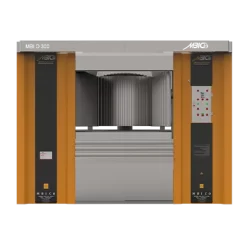
MBICO Deck Ovens
MBICO Rotary Ovens
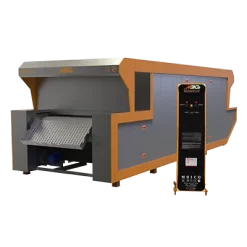
Tunnel Ovens

Oven Type Primary Heat Transfer Mode Steam Control & Retention Energy Efficiency Index Best Suited Products
Conduction and gentle radiation from stone or metal hearth plates. Exceptional. Sealed, low-profile chambers retain steam perfectly, minimizing water and energy waste. High, due to heavy thermal mass insulation and minimal air exchange. Artisanal hearth breads, baguettes, traditional flatbreads, and sourdoughs.
Forced convection with supplementary radiation from the rack structure. Good. Employs powerful integrated steam generators that spray water over heat exchangers during rotation. Moderate to High, requiring precise exhaust damper control to prevent heat loss. Sandwich loaves, sweet buns, pastries, cookies, and high-volume sheet cake pans.
Continuous combination of radiation, convection, and conduction zones. Complex. Requires zoned steam curtains at the entry zone, with progressive venting zones down the line. Excellent in continuous operation; highly inefficient for intermittent batch production. Mass-produced sliced bread, high-volume crackers, biscuits, and industrial pita production.

As illustrated in the comparison, deck ovens excel at moisture retention because their baking chambers are low-profile and tightly sealed. In an MBICO deck oven, when steam is injected, it remains trapped in a dense blanket directly around the dough, requiring less steam volume to achieve perfect condensation. Rotary ovens, on the other hand, rely on hot air movement, which naturally tends to sweep moisture away from the dough surface. To counteract this, our rotary models feature advanced steam synchronization software that temporarily pauses the convection fan during the steam injection phase, allowing the moisture to settle on the dough before the hot air circulation resumes.

Troubleshooting Thermal and Moisture Imbalances in the Baking Line

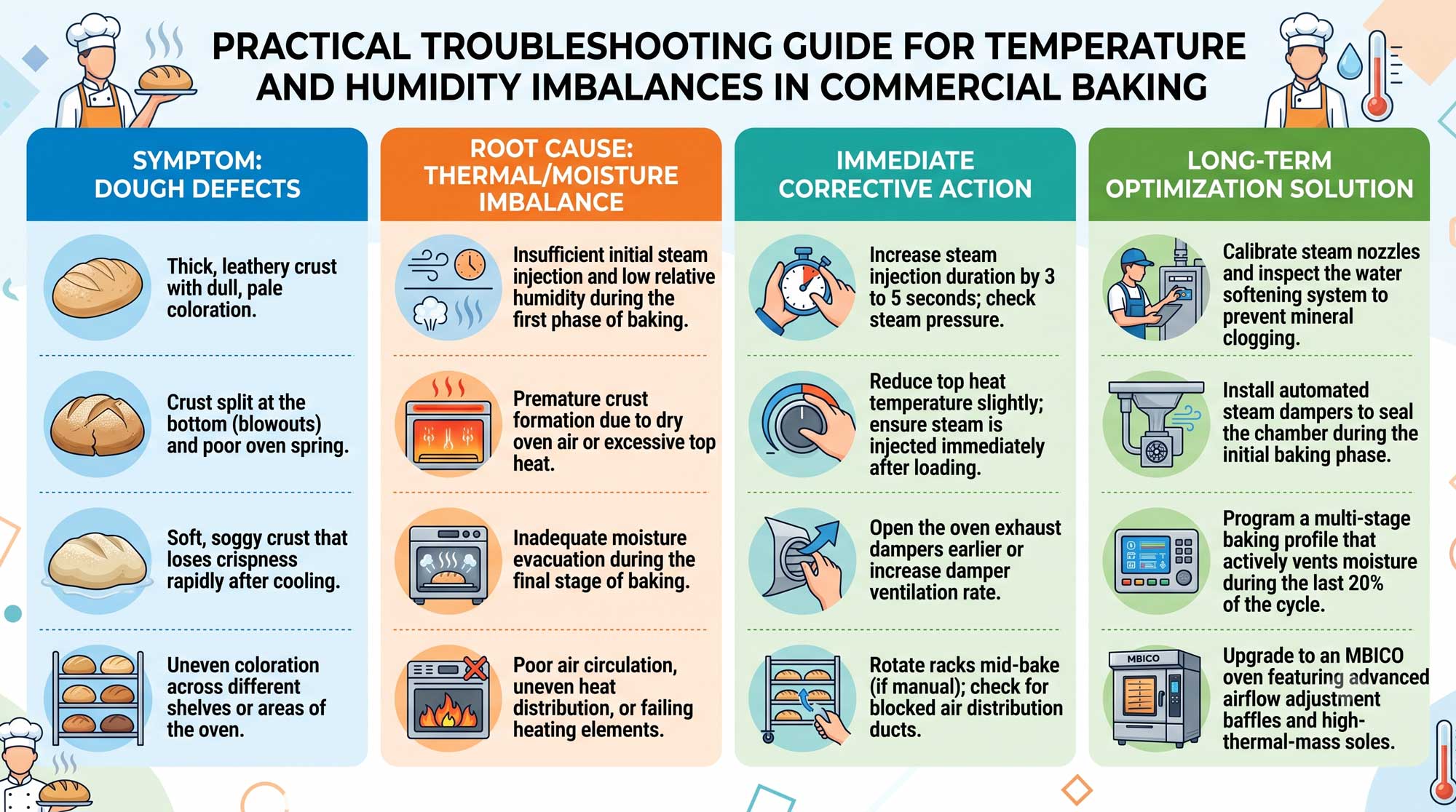
When something goes wrong with the baking profile, the physical characteristics of the finished product will tell you exactly where the imbalance lies. The following troubleshooting guide outlines the most common thermodynamic issues encountered on the production floor, their underlying causes, and how to resolve them.

Excessive venting leads to dry and pale crusts

If your exhaust dampers are opening too early, or if there is a mechanical leak in your oven’s door seals, the moisture injected at the start of the bake will escape before it can condense on the dough. The symptom of this issue is a loaf with poor volume, a matte or chalky appearance, and a thick, leathery crust that is difficult to chew. To solve this, inspect all physical gaskets and program your control panel to keep the dampers completely closed for at least the first eight to ten minutes of the baking cycle. Additionally, check the water pressure feeding your steam generators, as low water pressure prevents the system from creating the fine mist required for rapid vapor transition.

Uneven heat distribution causes structural collapsing in sandwich loaves

When loaves emerge from the oven looking perfect but collapse or cave in at the sides as they cool, the culprit is almost always an imbalance between convection heat and internal baking temperature. This occurs when the external crust bakes and colors too quickly due to high convective air temperatures, while the inner starch-and-protein matrix has not yet reached its gelatinization and coagulation threshold (typically 80°C to 85°C at the core). The weak internal structure cannot support the weight of the loaf once the hot air inside contracts during cooling. To resolve this, lower the overall baking temperature by 10°C to 15°C and extend the baking time slightly, allowing conductive heat to cook the core of the loaf before the crust becomes too rigid.

Insufficient steam injection limits the volume of hearth breads

If you notice that your baguettes or rustic boules are tearing violently along the sides rather than opening beautifully along your scores, your oven is setting the crust too early due to dry conditions. This lack of moisture prevents the dough from stretching during the oven spring phase. Increase the steam injection volume by extending the duration by three seconds, and ensure that the oven has fully recovered its target temperature before loading the next batch. Loading an oven too quickly after a previous bake prevents the steam generators from reheating to the temperature required to instantly vaporize the incoming water, resulting in wet droplets that spot the dough rather than a true gas phase steam blanket.

Maximizing Energy Efficiency and Reducing Operational Costs in Industrial Bakeries

In the modern industrial landscape, thermal optimization is as much an economic necessity as it is a quality control measure. Heating a massive baking chamber and generating high-pressure steam require substantial amounts of electrical energy or natural gas. Energy efficiency in industrial bakeries can be dramatically improved by analyzing your oven’s duty cycle and minimizing heat loss during loading and venting. Every time an oven door is opened, or a damper is left open unnecessarily, valuable thermal energy escapes into the bakery ventilation system, forcing the burners to work twice as hard to recover.

One of the primary areas of energy waste we observe during factory audits is the over-generation of steam. Generating steam requires heating water to its boiling point and then applying extra energy to convert it into gas. If your oven seals are worn or your dampers are poorly calibrated, you are essentially venting expensive energy straight up the exhaust stack. By upgrading to ovens with high-density mineral wool insulation and automated, precision-machined damper valves, industrial bakeries can reduce their fuel consumption by up to thirty percent. Furthermore, utilizing heat recovery systems to capture the hot exhaust air and use it to preheat incoming water for your steam systems creates a highly sustainable, closed-loop thermal cycle.

“During an energy audit for a high-volume pita bread facility, we discovered that their exhaust dampers were remaining open during the steam injection cycle. By synchronizing the damper solenoids with the steam valves, we slashed their gas consumption by twenty-two percent while improving product consistency across all shifts.”
— MBICO Technical Services Director

Another crucial factor is the scheduling of your bakes. Grouping products that require similar baking temperatures and moisture levels minimizes the energy spent heating up or cooling down the oven chambers between batches. For example, baking high-temperature, steam-intensive crusty breads first, followed by lower-temperature sweet pastries as the oven naturally cools down, maximizes the thermal efficiency of the entire production day. This disciplined approach to thermal scheduling, combined with MBICO’s high-efficiency combustion technology, ensures that your utility bills remain low even as your production volumes grow.

Summary of Key Takeaways for Commercial Baking Success

Mastering the thermodynamics of a commercial baking chamber requires a continuous balance of heat transfer modes, precise timing of moisture application, and disciplined equipment maintenance. Steam is not merely a styling agent for a glossy crust; it is a vital thermodynamic tool that delivers rapid latent heat, delays crust formation, and enables the dough to reach its maximum physical volume. Properly managing the transition from a highly humid environment to a bone-dry baking chamber is the secret to producing consistent, premium baked goods with an exceptional shelf life and a perfect structural crumb.

By implementing a systematic calibration process, upgrading to high-efficiency baking systems, and utilizing data-driven troubleshooting, you can eliminate production waste and significantly lower your operational energy costs. If you are ready to take your baking line’s thermal efficiency and product quality to the next level, contact the engineering and baking experts at MBICO today. Our team in Mashhad is ready to perform a comprehensive thermal analysis of your current systems and help you integrate the advanced deck, rotary, or tunnel oven technology your bakery needs to thrive in a competitive market.

Frequently Asked Questions about Optimizing Temperature and Humidity in Commercial Ovens for Maximum Efficiency

What is the ideal relative humidity level inside an oven for baking crusty artisan bread?

The ideal relative humidity during the first five to ten minutes of baking crusty artisan bread is between seventy-five and ninety percent. This high level of moisture must be achieved rapidly through pressurized steam injection immediately upon loading the cold dough. After the initial oven spring occurs, the relative humidity must be dropped to below twenty percent by opening the exhaust dampers, allowing the dry heat to bake the interior and color the crust.

Why does my bread develop a thick and leathery crust instead of a crispy one?

A thick, leathery crust is caused by a lack of moisture during the initial stage of the bake or by baking the bread for too long at too low a temperature. Without adequate steam condensation, the surface starches cannot gelatinize properly, resulting in a tough, dry skin. To fix this, ensure your steam injection system is operating correctly and increase the baking temperature slightly to shorten the overall baking time, which prevents the loaf from drying out excessively.
How does loading density affect the temperature and steam requirements of a rotary oven?

Loading an oven to its maximum capacity introduces a massive cold mass that causes the air temperature to drop rapidly. To compensate, you must preheat the oven ten to fifteen degrees Celsius higher than your target baking temperature. Additionally, because a dense load of wet dough naturally releases a large amount of moisture into the air as it heats up, you may need to reduce the volume of externally injected steam to prevent the oven chamber from becoming overly humid late in the bake.
Can I use low-pressure steam for crust development in high-volume commercial baking?

Low-pressure steam is generally ineffective for high-volume commercial baking because it contains too many liquid water droplets, which can pool on the dough and cause unsightly dark spots and uneven baking. High-pressure, dry saturated steam is required because it disperses evenly throughout the baking chamber and condenses as a uniform micro-thin film of water on the cold dough, ensuring consistent volume, gloss, and blister development across the entire batch.

bread Baking equipment list

021111

The Critical Importance of a Scientifically Aligned Bread Baking Equipment List

Setting up or upgrading a commercial bakery is similar to designing a high-precision chemical processing plant. Every machine, from the initial flour sifter to the final packaging line, plays a direct role in the biological and physical transformation of simple ingredients into premium baked goods. Whether you are scaling an artisanal sourdough micro-bakery or designing a fully automated baking production line, your choice of machinery dictates your bread’s final crumb structure, crust thickness, volume, and shelf life. Selecting mismatched machinery not only compromises product quality but also creates operational bottlenecks that erode profit margins.

In our years of experience setting up industrial baking lines, we have witnessed how even a minor imbalance in equipment capacity can disrupt the entire workflow. Imagine a high-performance spiral dough mixer delivering perfectly hydrated dough, only to have it sit and over-ferment because your dough divider cannot process it fast enough. This guide bridges the gap between mechanical engineering and baking science, drawing on decades of experience from MBICO Industrial Bakery Systems in Mashhad. We will dissect each piece of equipment through the lens of dough rheology, thermodynamics, and industrial efficiency. By the end of this guide, you will not only understand the complete bread baking equipment list, but also learn how to apply it effectively in your baking process.
041113

The Foundation of Flour Handling and Dough Mixing Technology

The baking process does not begin when the mixer starts; it begins when dry ingredients are prepared and conditioned. In industrial baking, flour behaves as a dynamic powder that is highly sensitive to compaction, moisture, and temperature. Proper handling before mixing is essential to achieve a homogenous dough matrix. Without uniform raw material preparation, even the most advanced commercial baking ovens cannot compensate for the resulting inconsistencies in the final bread.

The Role of Spiral Dough Mixers in Gluten Developmentfkn

Mixing is the most critical phase of dough development. During this stage, the two primary proteins in wheat flour—glutenin and gliadin—absorb water and align to form disulfide bonds, creating the viscoelastic gluten network. This network acts as a gas-retaining membrane, trapping the carbon dioxide produced by yeast during fermentation.

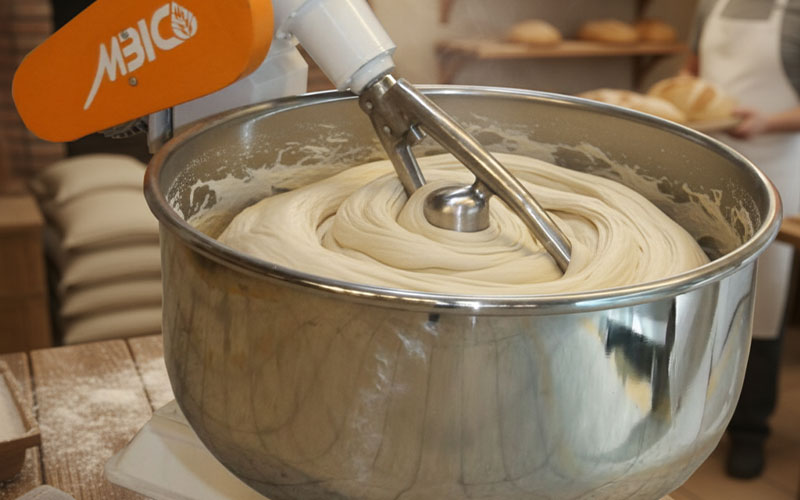
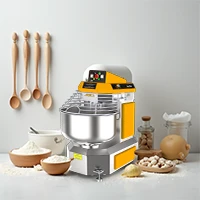
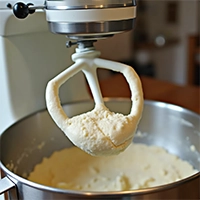
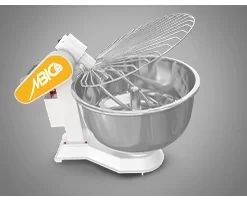
For most bread types, spiral dough mixers are the industry standard. Unlike planetary mixers, which move an agitator through a stationary bowl, a spiral mixer features a rotating bowl while the spiral hook kneads the dough. This dual-rotation system applies gentle, progressive shear forces to the dough. This action mimics hand-kneading on kneading table but operates on an industrial scale, minimizing mechanical friction and preventing the dough from overheating. Keeping the dough within its optimal temperature range (typically 24°C to 26°C) is vital to prevent premature yeast activation and maintain gluten strength.

041112

How Flour Sifters and Water Chillers Support Dough Hydration and Temperature Control

To support the mixing process, two auxiliary machines are critical in any professional bread baking equipment list: flour sifting machines and water chillers.

  • Flour Sifting Machines: Industrial flour sifters do more than just remove physical impurities. By passing flour through a vibrating or centrifugal mesh, they aerate the particles, breaking up clumps caused by compaction during transport or silo storage. This increased surface area allows for immediate, uniform water absorption during the first stage of mixing, preventing the formation of dry flour pockets (often called “fish eyes”) in the dough.
  • Water Chillers for Baking: Controlling dough temperature is one of the most common challenges our customers face, particularly in regions with hot summers. Because the mechanical action of mixing generates friction heat (known as the mixer’s friction factor), using tap water can easily push the dough temperature past 28°C, leading to wild, uncontrolled fermentation. Industrial water chillers maintain a constant supply of water at 2°C to 4°C, allowing bakers to offset friction heat and precisely control dough hydration and temperature.

“In our years of experience setting up industrial baking lines, we have found that installing a dedicated water chiller is the single most effective way to eliminate seasonal variations in bread volume and texture.”

Comparing Spiral Mixers and Horizontal Mixers for Commercial Production

Choosing the right mixing technology depends on your product range, dough hydration levels, and daily output requirements. While spiral mixers are highly versatile, horizontal mixers are often preferred for specific high-volume, highly standardized products.

Operational Feature Spiral Dough Mixers Horizontal Mixers
Mechanical Action Gentle stretching, folding, and kneading via a rotating bowl and hook. High-shear, aggressive blending using heavy-duty horizontal beaters.
Gluten Development Progressive and gentle, preserving the delicate carotenoid pigments in flour. Extremely rapid and intense, ideal for high-speed gluten development.
Friction Heat Generation Low to moderate; easily managed with chilled water. High; typically requires jacketed bowls cooled by glycol or direct ice addition.
Best Suited For Artisanal breads, baguettes, high-hydration sourdoughs, and croissants. Toast bread, sandwich loaves, hamburger buns, and high-volume, stiff doughs.
Batch Size Flexibility Highly flexible; can efficiently mix batches as small as 10% of maximum capacity. Requires at least 50% to 60% of maximum capacity to mix effectively.

In summary, if your bakery focuses on high-quality variety, artisanal hydration, and delicate crumb structures, a spiral mixer from the MBICO industrial systems line is the superior choice. If your goal is high-speed, continuous production of uniform sandwich loaves with minimal ingredient variation, a horizontal mixer may better suit your factory layout.

041114

The Mechanics of Dough Makeup Systems and Portioning Efficiency

Once the dough is fully developed and has undergone its initial bulk fermentation, it must be portioned and shaped. The transition from a single mass of dough to individual, precisely weighted pieces is called the dough makeup phase. At this stage, the dough is highly delicate; its gas-cell structure is easily damaged by excessive mechanical stress.

How Dough Dividers and Rounders Maintain Crumb Structure

A dough divider must portion dough with high weight accuracy while preserving its gas-retaining properties. There are three primary types of commercial dividers: volumetric, vacuum-assisted, and stress-free (extrusion) dividers.

  • Volumetric and Vacuum Dividers: These systems draw dough into a cylinder using suction or a piston, cutting it to a specific volume. While highly accurate and fast, they apply significant pressure to the dough. This pressure can degas highly hydrated doughs. They are best suited for traditional white pan breads and buns with a tight, uniform crumb structure.
  • Stress-Free Dividers: These modern systems sheet the dough into a continuous band of uniform thickness and cut it using rotating knives. This method avoids compressing the dough, making it essential for ciabatta, baguettes, and high-hydration sourdoughs where an open, irregular alveoli (gas cell) structure is desired.

Directly following the divider is the dough rounder (usually a conical or belt rounder). The rounder rolls the freshly cut dough piece against a spiral track, forming a smooth, spherical shape. This mechanical rolling action creates a thin, tense outer skin (the gluten cloak) over the dough ball. This skin seals the cut surfaces, prevents carbon dioxide from escaping, and ensures the dough rises uniformly during subsequent proofing and baking.

041115

The Importance of Intermediate Proofing and Shaping in Moulding Machines

Rounding stretches the gluten network, leaving the dough elastic but highly tense. If you try to shape a dough ball immediately after rounding, it will resist deformation, tear, or snap back. To prevent this, the dough must rest in an intermediate proofer.

An intermediate proofer is a mechanized cabinet containing moving pockets or trays. The dough balls travel through this temperature-controlled environment for 6 to 15 minutes. This brief rest allows the gluten proteins to relax and recover their extensibility, making the dough pliable enough for the next step: the Dough moulder.

The moulder takes the relaxed dough balls and processes them through a series of adjustable rollers and pressure boards. For sandwich loaves, the moulder sheets the dough into a flat disc, rolls it into a tight cylinder, and seals the seam. For baguettes, specialized multi-roller moulders progressively elongate the dough without tearing the delicate gluten skin. Proper moulding is crucial; if the roll is too loose, the baked bread will have large, uneven voids at the top; if it is too tight, the dough will tear during the final proof.

The Thermodynamic Science of Modern Proofer Chambers

After shaping, the dough pieces are placed into their final baking pans or onto loading peels and moved to the proofer chamber. This stage is where biology takes over. The primary goal of a proofer is to provide the optimal microclimate for yeast activity, allowing the dough to reach its final volume before entering the oven.

Yeast (Saccharomyces cerevisiae) is highly sensitive to its environmental conditions. The optimal temperature for commercial yeast fermentation ranges from 35°C to 38°C, while the relative humidity (RH) must be maintained between 80% and 85%. Maintaining these conditions requires a sophisticated control system.

“According to MBICO’s internal baking chamber trials, keeping relative humidity precisely at 82% prevents the formation of a dry skin on the dough surface, allowing the loaf to expand to its maximum potential during the initial oven spring.”

If the humidity drops too low, moisture quickly evaporates from the dough’s surface, creating a dry, inelastic skin. This skin resists expansion in the oven, leading to misshapen loaves and unsightly crust tears. Conversely, if the humidity is too high, condensation forms on the dough. This condenses surface sugars, resulting in a rubbery crust, excessive spotting, and a leathery texture after baking. Advanced proofer chambers use ultrasonic humidifiers and integrated air circulation systems to distribute heat and humidity evenly throughout the chamber, ensuring every loaf proofs at the exact same rate.

Commercial Baking Ovens and the Mechanisms of Heat Transfer

The baking oven is the heart of any bakery. It is where the complex physical, chemical, and biological changes of baking occur. When dough enters the oven, it undergoes three distinct phases: oven spring, starch gelatinization/protein denaturation, and crust coloration via the Maillard reaction and caramelization.

04111

Comparing Deck Ovens and Rotary Rack Ovens for Diverse Bread Types

The choice of commercial baking oven depends on your product mix. The two primary designs used in modern bakeries are deck ovens and rack ovens, each utilizing different primary heat transfer mechanisms.

Oven Type Primary Heat Transfer Mechanism Crust and Crumb Characteristics Best Applications
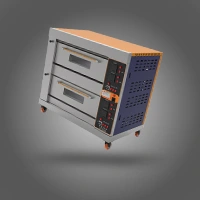
Deck Ovens Conduction (direct contact with ceramic or stone soles) and Radiation (infrared heat from top and bottom elements). Thick, crisp bottom crust; open, airy crumb structure; excellent volume expansion. Artisanal hearth breads, sourdoughs, traditional baguettes, and flatbreads.
Rotary Rack Ovens Convection (forced circulation of hot air through a rotating rack of trays). Thin, uniform crust; consistent crumb density; even color across all trays. Sweet buns, sandwich loaves, pastry, croissants, and high-volume pan breads.

Deck ovens excel at baking rustic, high-hydration breads. The intense conductive heat from the stone sole instantly vaporizes moisture at the base of the dough, creating a rapid upward surge of steam that maximizes “oven spring.” Rotary rack ovens, on the other hand, offer exceptional capacity and labor efficiency. The entire rack of dough is rolled directly into the baking chamber and rotates during the bake cycle, ensuring uniform exposure to the heated airflow.

The Role of Steam Injection in Crust and Crumb Development

Regardless of whether you use a deck oven or a rack oven, high-quality steam injection is essential for bread baking. When raw dough enters the hot baking chamber, a burst of low-pressure steam must be injected immediately.

This steam condenses on the cold dough surface, releasing latent heat. This condensation keeps the outer skin of the dough moist and flexible during the first few minutes of baking, allowing the loaf to expand fully without tearing. Furthermore, the moisture dissolves surface starches, turning them into a thin, liquid paste. As the bake continues and the surface temperature rises past 100°C, this starch paste dries out and gelatinizes, forming a thin, glassy, and exceptionally crispy crust. Without steam, bread crusts will be dull, thick, leathery, and pale.

Post-Bake Handling and Packaging Equipment

The baking process does not end when the bread leaves the oven. In fact, post-bake cooling and handling are just as critical to food safety, shelf life, and slice quality as the baking stage itself.

How Proper Cooling Systems Prevent Bread Spoilage

Freshly baked bread leaves the oven with an internal temperature of around 95°C to 98°C and a high moisture content. As the bread cools, moisture migrates from the hot crumb (interior) to the dry crust (exterior), while the starch molecules begin to realign and crystallize—a process known as starch retrogradation.

Bread must be cooled to an internal temperature of 30°C to 35°C before it can be sliced or packaged. If bread is packaged while still warm, the escaping moisture will condense on the inside of the plastic wrapping. This liquid water creates the perfect environment for mold spores to grow, drastically reducing the product’s shelf life. In industrial facilities, automated cooling spirals or clean-room cooling conveyors are used to lower the bread’s temperature under controlled humidity conditions, protecting it from airborne contaminants.

041116

Selecting Commercial Bread Slicers and Packaging Lines

Once cooled, sandwich loaves and specialty breads are sent to the slicing and packaging line. Slicing warm or poorly cooled bread can cause the crumb to tear and compress, ruining the loaf’s internal structure.

  • Reciprocating Blade Slicers: These machines use a series of high-speed, vertically oscillating blades to slice through loaves quickly. They are ideal for standard toast and sandwich breads.
  • Band Slicers: For high-volume industrial lines, continuous band slicers are preferred. These systems use endless, rotating loop blades mounted on drums, providing exceptionally clean cuts and high throughput with minimal maintenance.
  • Automated Packaging Lines: The sliced bread is immediately guided into a bagger and sealed using quick-twist ties, clips, or heat-seal bands. Modern packaging lines often inject a food-grade gas mixture (modified atmosphere packaging or MAP) to displace oxygen, further extending the bread’s mold-free shelf life.

View all bread recipes

A Step-by-Step Guide to Designing Your Bread Baking Production Line

Setting up a balanced baking production line requires careful planning, deep technical knowledge, and an understanding of dough rheology. Below is a structured, step-by-step approach to selecting and integrating your bread baking equipment list into a highly efficient workflow.

  1. Define Your Product Mix and Capacity Targets:Before buying any machinery, detail your daily production goals. Calculate the weight of flour and water required per hour. If you produce 1,000 loaves of 500-gram bread per hour, your line must process 500 kg of dough hourly. This target determines the capacity of your mixer, divider, and oven.
  2. Match Equipment to Dough Hydration and Rheology:Dough with 80% hydration (like ciabatta) requires stress-free dough dividers and stone-sole deck ovens. Conversely, stiff dough with 50% hydration (like bagels) requires heavy-duty spiral mixers with robust motors and high-pressure volumetric dividers.
  3. Optimize the Floor Layout for Hygienic and Linear Workflow:Design your layout to prevent cross-contamination and minimize unnecessary dough handling. The workflow must follow a strict linear path: Raw Material Storage → Mixing → Makeup → Proofing → Baking → Cooling → Slicing → Packaging. Avoid layouts where raw flour handling occurs near the cooling or packaging areas.
  4. Coordinate Utility Requirements and Infrastructure:Ensure your facility has the infrastructure to support your equipment list. Industrial deck and rotary ovens require high-pressure gas lines or heavy-duty three-phase electrical connections. Similarly, water chillers and proofer steam generators require dedicated water filtration systems to prevent scale buildup.
  5. Conduct Recipe Calibration and Pilot Runs:Once the machinery is installed, run test batches using your exact flour and water sources. Calibrate the mixer’s friction factor, adjust the divider’s stroke pressure to prevent tearing, tune the proofer’s relative humidity, and program the oven’s steam injection duration. Fine-tune these settings until you achieve a consistent product that meets your standards.

Why MBICO Industrial Systems Represent the Pinnacle of Baking Engineering

At MBICO, we believe that bakery machinery should be more than just stainless steel and motors; it should be an extension of the baker’s craft. Based in the industrial hub of Mashhad, MBICO designs, engineers, and manufactures state-of-the-art baking equipment tailored to the unique demands of global markets. Our systems are built using premium, food-safe materials and advanced thermal insulation to deliver outstanding energy efficiency and long-term reliability.

Our R&D team continuously refines our designs based on feedback from master bakers and process engineers. Whether you need a highly precise water chiller to manage dough temperatures in hot climates, a high-capacity spiral mixer engineered for optimal gluten development, or a custom-designed proofer chamber, MBICO provides end-to-end solutions. We do not just sell machines; we partner with you to design, calibrate, and optimize your entire baking production line, ensuring your bakery delivers consistent, high-quality products day after day.

Frequently Asked Questions about bread Baking equipment list

What is the difference between a spiral mixer and a planetary mixer for bread dough?

A spiral mixer features a rotating bowl while the spiral hook kneads the dough. This dual-rotation system applies gentle, progressive shear forces, making it perfect for developing strong gluten networks in heavy bread doughs without overheating them. A planetary mixer uses a stationary bowl with an agitator that rotates on an offset shaft (like a planet orbiting the sun). While planetary mixers are highly versatile for whipping creams, mixing batters, and handling light cookie doughs, they generate significant friction heat and mechanical stress when used for dense bread doughs, which can easily damage the gluten structure and strain the motor.

Why is steam injection so important in commercial baking ovens?

Steam injection is critical during the first few minutes of the baking process. When steam condenses on the cold dough surface, it releases latent heat, keeping the dough’s outer skin moist and elastic. This flexibility allows the bread to expand fully (the “oven spring”) without premature cracking. Additionally, the moisture gelatinizes the starches on the dough’s surface, creating a thin, glossy, and crispy crust after the moisture evaporates. Without steam, the crust becomes thick, dull, leathery, and pale, and the loaf’s volume is significantly reduced.

How does a water chiller improve the consistency of my dough?

Water chillers maintain water temperatures between 2°C and 4°C, which is essential for controlling the final dough temperature after mixing. The mechanical action of mixing generates friction heat, which raises the dough’s temperature. If the dough gets too warm (above 28°C), the yeast will ferment prematurely and uncontrollably, weakening the gluten network and resulting in inconsistent crumb structures and sour off-flavors. Using chilled water allows you to offset this friction heat, ensuring consistent fermentation rates regardless of seasonal room temperature changes.

Can I use a volumetric dough divider for high-hydration artisanal sourdough?

Generally, traditional volumetric and vacuum-assisted dividers are not recommended for high-hydration artisanal doughs (above 70% hydration) like sourdough or ciabatta. These dividers use tight pistons and high pressure to portion the dough, which collapses the delicate gas pockets (alveoli) created during bulk fermentation, leading to a dense, uniform crumb. For highly hydrated, long-fermented doughs, a “stress-free” or gravity-fed sheeting and cutting divider is the ideal choice, as it portions the dough using gentle cutting rollers without compressing its structure.

Choosing the Right Industrial Dough Kneading Table

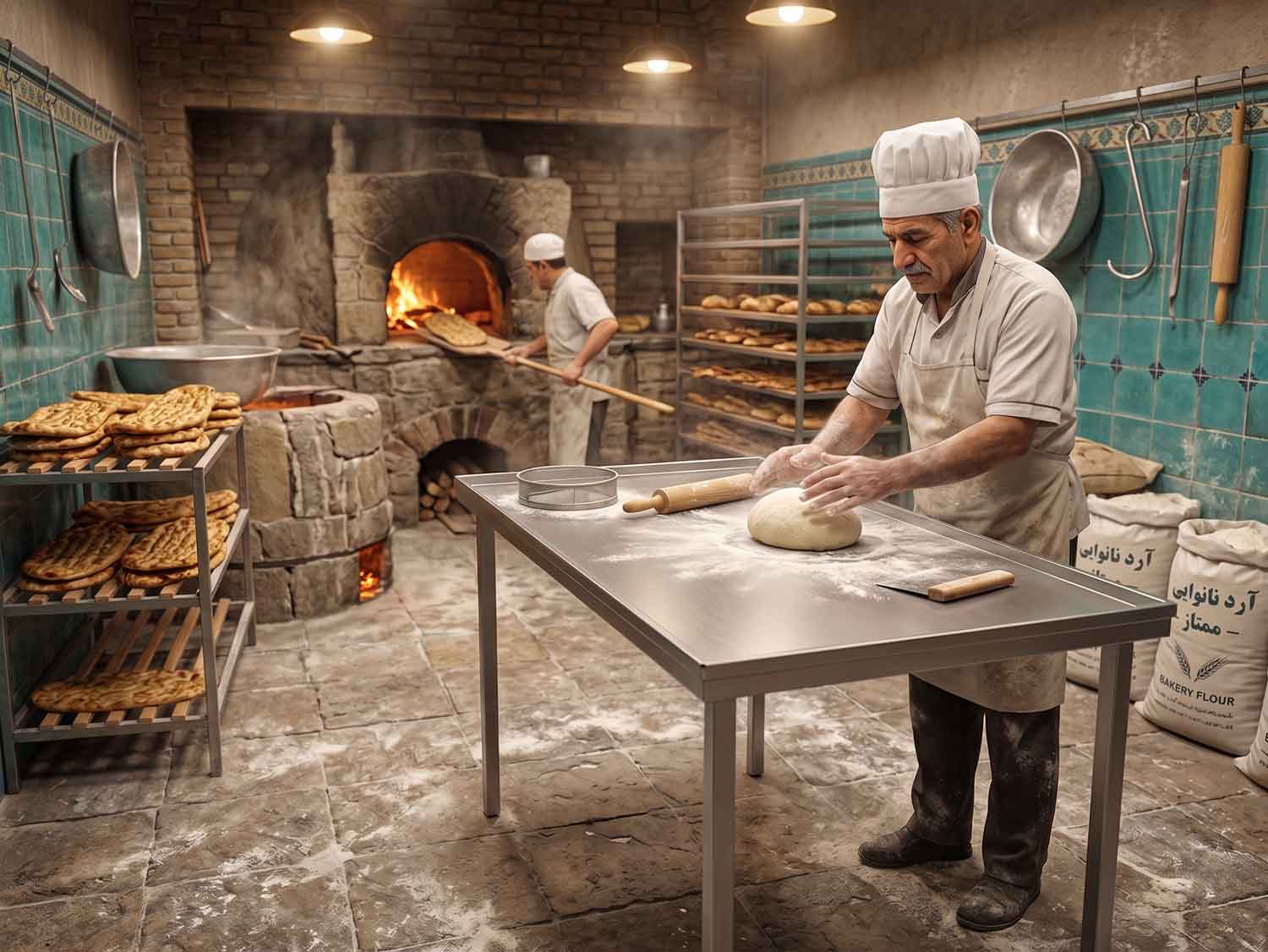
0122246

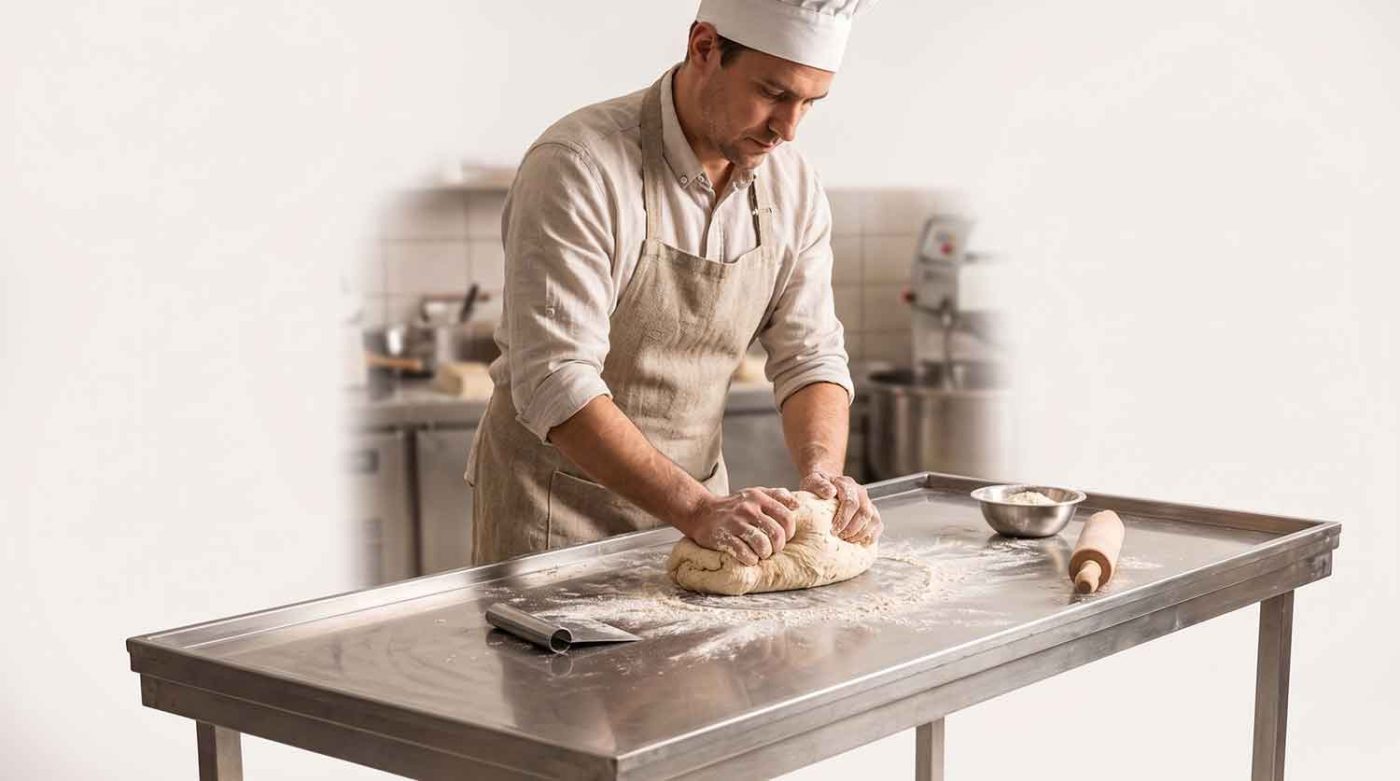
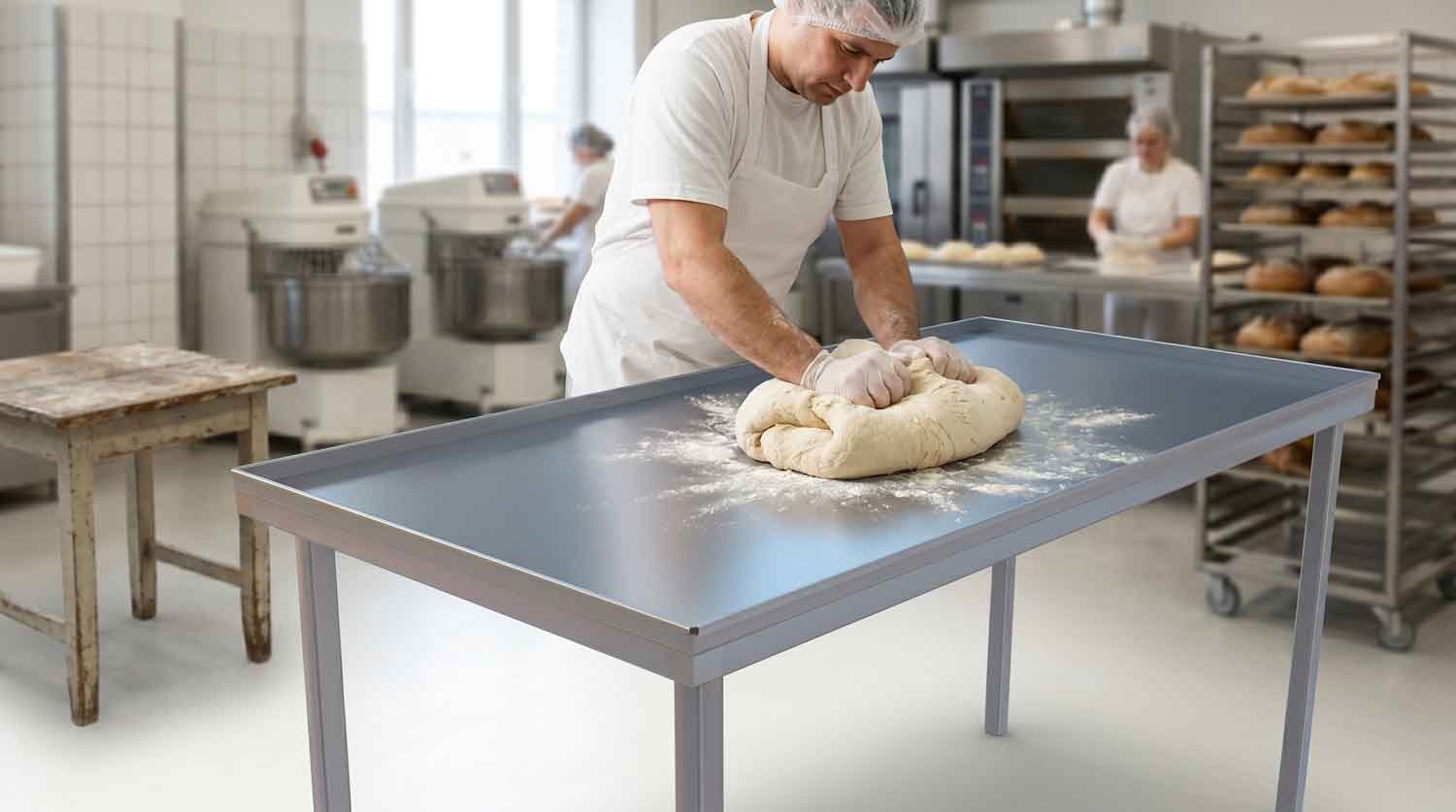
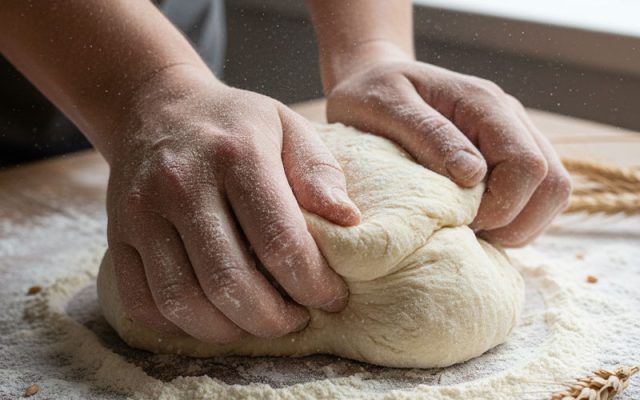
When designing or upgrading an industrial bakery, the spotlight almost always falls on the massive, high-ticket machinery. Bakeries spend weeks analyzing the heating profiles of rack ovens, calculating the precise shear forces of industrial spiral mixers, and mapping out the automated proofing chambers. Yet, in our decades of experience setting up large-scale commercial baking lines, we have witnessed entire production workflows grind to a frustrating halt due to a single, frequently overlooked piece of equipment: the industrial dough kneading and makeup table. It is the literal and metaphorical workspace where recipes turn into reality, where raw dough undergoes its final structural transformations, and where your bakers spend the majority of their physical working hours.

Imagine a bustling bakery floor in Mashhad during the pre-dawn rush. The automated mixers have perfectly hydrated hundreds of kilograms of high-quality flour, and the dough has undergone its initial bulk fermentation. But as the dividing and shaping team begins their shift, they find themselves working on a table that flexes under pressure, harbors microscopic dough residue in its unpolished seams, and stands at an uncomfortable height that causes lower-back strain within the first two hours. The result is a noticeable drop in shaping consistency, an increase in sanitation cycle times, and an exhausted, demotivated kitchen crew. This guide is built to ensure your bakery avoids these hidden bottlenecks by helping you choose a workspace engineered for ultimate durability, maximum hygiene, and peak ergonomic efficiency.

“A bakery’s throughput is only as fast as its slowest manual touchpoint. While a state-of-the-art mixer can prepare dough in minutes, it is the design, layout, and build quality of the kneading table that dictates how quickly and consistently that dough can be shaped, portioned, and moved to the proofing racks.” — MBICO Engineering Division

By the end of this guide, you will not only understand Choosing the Right Industrial Dough Kneading Table: A Buyer’s Guide, but also learn how to apply it effectively in your baking process.

The structural foundation of your bakery starts with the dough table

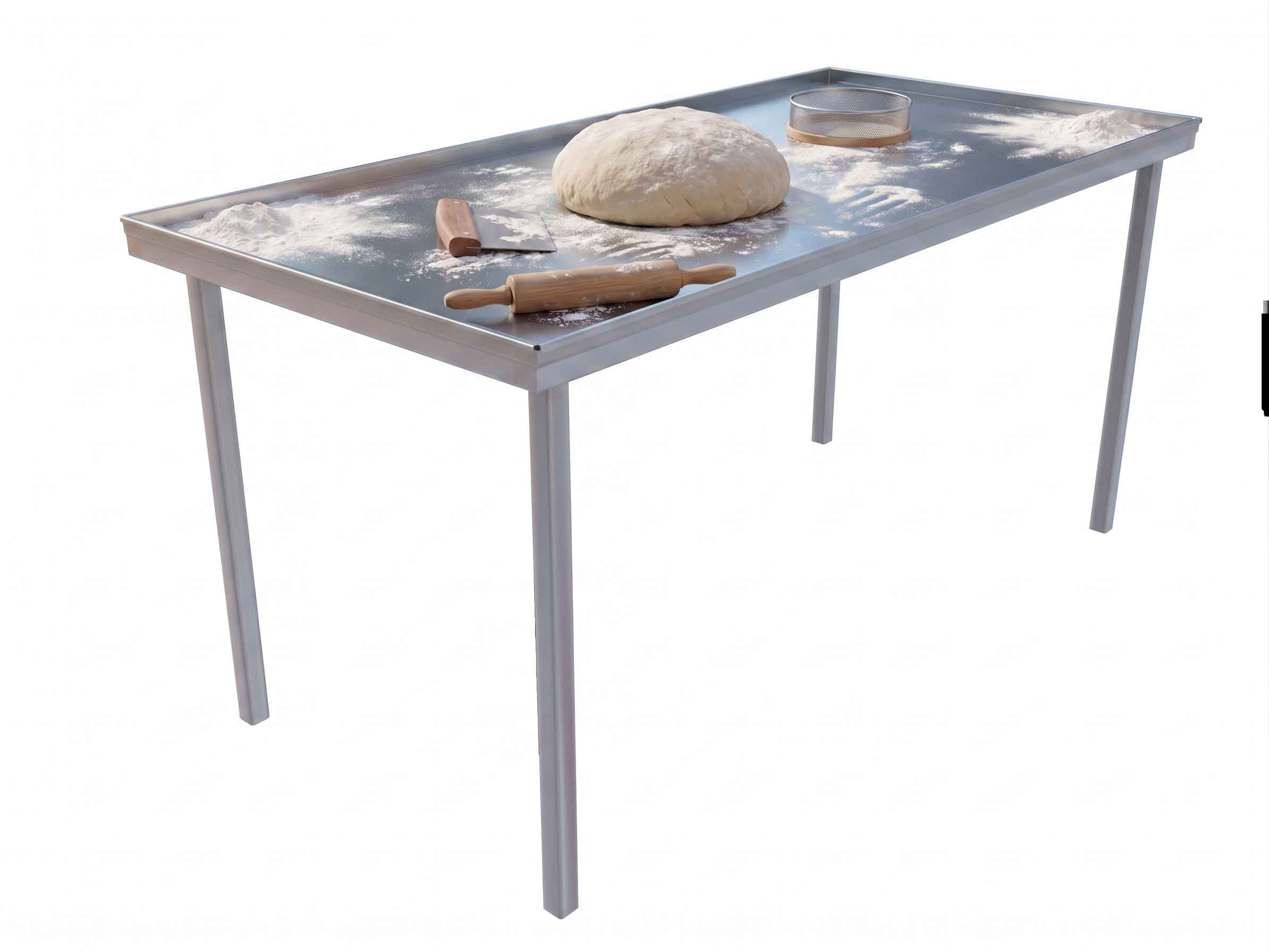
An industrial dough table is far more than a simple metal sheet resting on four legs. In a professional baking environment, this table functions as a heavy-duty mechanical interface. Every time a baker throws down a twenty-kilogram batch of sourdough, uses a metal scraper to clean the surface, or applies downward force to hand-knead and round dough portions, the table absorbs significant kinetic energy. If the table lacks structural rigidity, this energy dissipates through vibrations, wobbling, and structural flexing.

0124548254

According to MBICO’s internal baking chamber and production floor trials, structural vibration in prep tables does more than just annoy your staff. It actually contributes to rapid baker fatigue and can even subtly impact the dough itself. When a table wobbles or vibrates, the baker must subconsciously exert extra muscular force to stabilize their own body and control the dough. Over an eight-hour shift, this leads to micro-strain in the wrists, shoulders, and lower back, dramatically reducing manual shaping speed and precision. Furthermore, a vibrating surface makes it difficult to use precise tabletop portioning scales, leading to weight variations in your loaves and buns.

The science of kinetic force dissipation in dough handling

To understand why rigidity matters, we must look at the physics of manual dough manipulation. When a baker kneads, they apply both vertical and lateral forces. High-hydration doughs, such as those used for traditional rustic sourdoughs or local premium flatbreads like Barbari, require vigorous slapping and folding techniques to build gluten strength. This action puts a high-impact load on the table surface. A high-quality industrial table must be engineered to transfer these forces down through its legs directly to the floor, without any lateral sway. This is achieved through heavy-gauge stainless steel tops reinforced with internal structural channels, robust leg gussets, and solid, adjustable feet that can be bolted or leveled perfectly on uneven tiled bakery floors.

Selecting the right grade of stainless steel is critical for hygiene and longevity

Not all stainless steel is created equal, and choosing the wrong alloy for your dough table can lead to premature surface pitting, corrosion, and catastrophic health inspection failures. In the industrial food service sector, the two most common grades of stainless steel used for worktables are AISI 304 and AISI 430. Understanding the metallurgical differences between these two materials is the single most important step in protecting your long-term capital investment.

0124545458

Understanding the metallurgical differences between AISI 304 and AISI 430

The primary differentiator between these two steel grades lies in their chemical composition, specifically the presence of nickel. AISI 304 stainless steel is an austenitic alloy containing approximately 18% chromium and 8% nickel. The inclusion of nickel alters the crystalline structure of the steel, making it highly resistant to organic acids, moisture, and chlorine-based sanitizing agents. It is non-magnetic and highly ductile, allowing for seamless welds and polished finishes that prevent yeast, mold, and bacteria from finding micro-crevices to colonize.

In contrast, AISI 430 is a ferritic stainless steel that contains chromium but no nickel. While it is more affordable and magnetic, it has significantly lower resistance to corrosion. In a high-humidity bakery environment—where yeast is constantly active, water is frequently sprayed, and acidic sanitizers are used daily—an AISI 430 table will eventually develop micro-rust spots (pitting) along the seams, welds, and under-shelves. Once pitting begins, the table becomes impossible to truly sanitize, posing a severe risk of cross-contamination.

Analyzing the role of surface finish in dough release and sanitation

The roughness of the stainless steel surface, measured as Surface Roughness Average (Ra), directly influences how easily dough releases from the table and how quickly it can be cleaned. A standard brushed finish (often called a No. 4 finish) is the industry standard for food preparation. It provides a smooth surface that minimizes dough adhesion while allowing just enough texture for flour to hold when dusting is required. In our years of experience setting up industrial baking lines, we have found that cheaper, poorly polished steels possess microscopic ridges. These ridges act like tiny hooks, grabbing onto sticky doughs and requiring bakers to use excessive dusting flour, which can dry out the outer skin of the dough and alter the final bake quality.

Material / Alloy Grade Chemical Composition (Key Elements) Corrosion Resistance Level Best Suited For Relative Cost & Lifespan
AISI 304 Stainless Steel 18% Chromium, 8% Nickel Excellent (High resistance to organic acids & sanitizers) High-humidity zones, direct dough contact, heavy shaping, wash-down areas Higher initial cost / Exceptionally long lifespan (15+ years)
AISI 430 Stainless Steel 16-18% Chromium, 0% Nickel Moderate (Prone to pitting in highly humid or acidic environments) Dry ingredient storage tables, packaging zones, non-contact utility carts Lower cost / Moderate lifespan (requires dry environment)
Premium Maple / Beech Wood Natural Hardwood Fibers Low (Requires meticulous oiling and dry scraping) Traditional artisan bakery shops, manual rolling, pastry lamination Moderate to high cost / Medium lifespan (requires resurfacing)

Ergonomic table design prevents baker fatigue and increases daily output

One of the most common challenges our customers face is maintaining consistent worker productivity during long, demanding shifts. Baking is a physically intense profession. The repetitive motions of portioning, rolling, and shaping dough put immense strain on the musculoskeletal system. If your dough table is even a few centimeters too high or too low, your bakers will compensate by hunching their shoulders or bending their wrists at unnatural angles. This leads to Repetitive Strain Injuries (RSI), increased absenteeism, and a noticeable slowdown in production as the shift progresses.

Calculating the optimal working height for manual dough shaping

There is no single “perfect” height for an industrial dough table because different baking tasks require different physical leverage, and bakers vary in height. For light tasks like portioning with a bench scraper or decorating pastries, a table height close to elbow level (typically 95 to 105 centimeters from the floor) is ideal because it allows for high visual precision and keeps the neck upright. However, for heavy manual kneading and rolling of dense doughs, the baker needs to leverage their upper body weight to press downward. For these heavy-duty kneading tasks, the table should sit lower, around 85 to 90 centimeters, allowing the baker to keep their elbows slightly bent and use their core muscles rather than relying solely on arm strength.

At MBICO, we highly recommend integrating adjustable-height legs or utilizing custom-fabricated tables that match the average height of your primary shaping team. A simple investment in adjustable bullet feet can yield up to a 5-centimeter range of movement, which is often enough to transition a table from a generic, uncomfortable prep surface into a highly specialized ergonomic workspace.

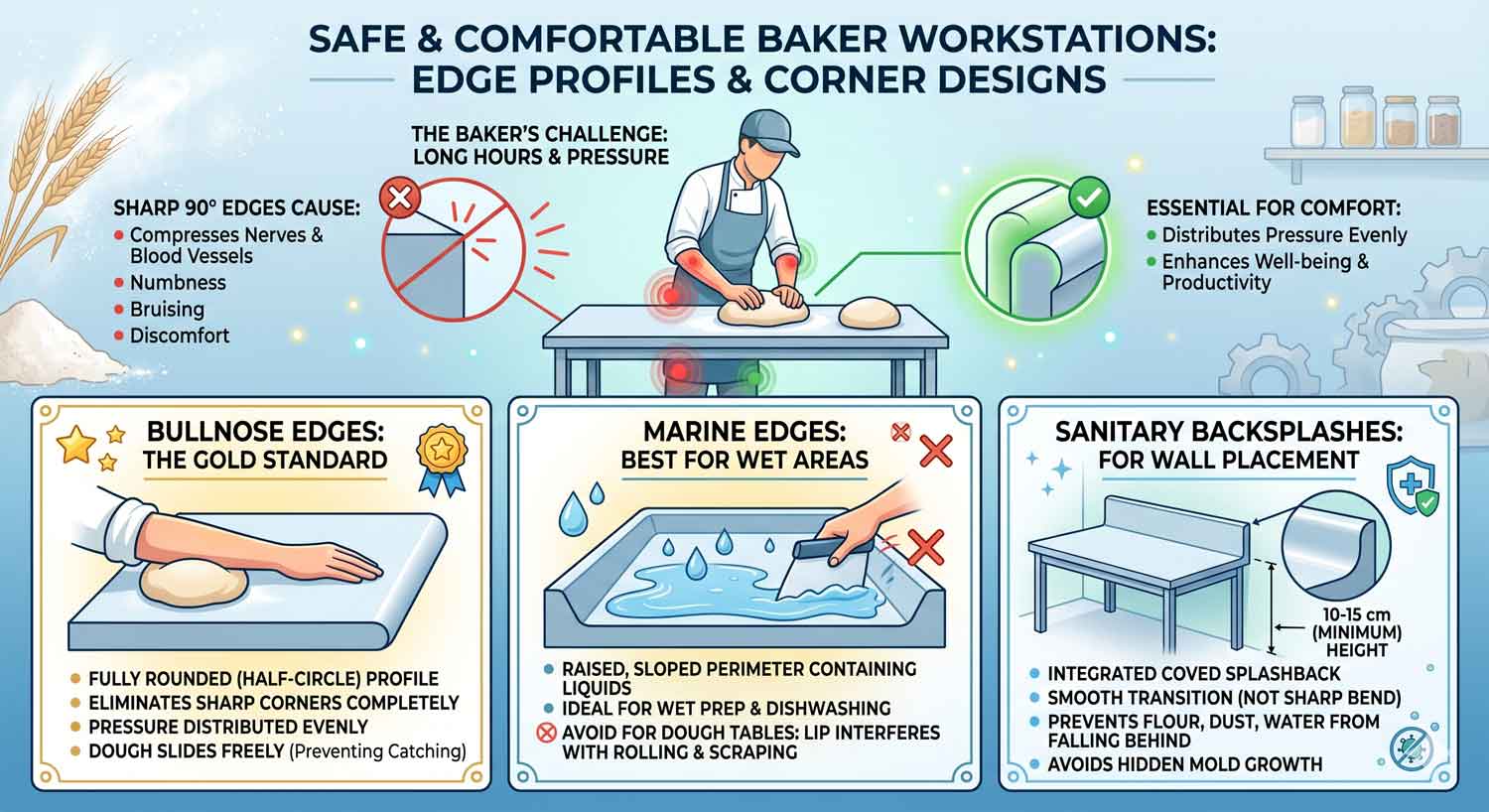
The importance of edge profiles and corner designs for safety and comfort

When bakers work at a dough table for hours, they constantly lean their hips, thighs, and forearms against the table’s edges. A sharp, 90-degree square edge will compress blood vessels and nerves, causing numbness, bruising, and discomfort. For this reason, professional dough kneading tables must feature rounded edge profiles.

  • Bullnose Edges: This fully rounded edge (resembling a half-circle) is the gold standard for dough prep tables. It eliminates sharp corners entirely, distributing pressure evenly across the baker’s forearms as they lean in to knead. It also prevents the dough from catching on a sharp metal edge during rapid sliding maneuvers.
  • Marine Edges: Featuring a raised, sloped perimeter, marine edges are designed to contain liquids. While highly useful for wet prep areas or dishwashing tables, they are generally avoided for dough tables because the raised lip interferes with flat dough rolling and makes thorough scraping of flour residue difficult.
  • Sanitary Backsplashes: If your dough table is positioned against a wall, a integrated, coved backsplash (at least 10 to 15 centimeters high) is non-negotiable. The transition between the table surface and the backsplash must be a smooth, coved curve rather than a sharp 90-degree bend. This prevents flour dust, water, and dough scrapings from falling behind the table where mold can grow undetected.

1012454563

High-load capacity tables endure the relentless force of automated dividers and manual kneading

In an industrial baking environment, a table must be rated for both static loads (such as storing heavy containers of flour or liquid ingredients) and dynamic loads (the forces exerted during kneading, pounding, or the operation of tabletop equipment like manual dough sheeters and heavy-duty scales). To guarantee the table will not bow, warp, or fail over time, you must pay close attention to the sheet metal gauge and the internal reinforcement systems.

Deciphering sheet metal gauges and under-table support structures

In the stainless steel fabrication industry, the thickness of the metal is measured in gauges. Crucially, a lower gauge number indicates a thicker, stronger sheet of steel. For light-duty commercial kitchens, 18-gauge steel (approx. 1.2 mm thick) is common, but it is completely inadequate for industrial dough handling. An 18-gauge table will loudly drum and flex the moment any real pressure is applied to it.

For professional industrial bakeries, we recommend a minimum of 14-gauge (approx. 1.9 mm) or heavy-duty 16-gauge (approx. 1.5 mm) stainless steel for the tabletop. A 14-gauge top provides a solid, rock-hard feel that mimics a heavy wooden butcher block but with all the sanitary advantages of premium stainless steel.

However, even the thickest steel plate requires structural reinforcement underneath to prevent bowing. Look for tables built with welded-in “hat channels.” These are U-shaped steel channels welded to the underside of the table surface running lengthwise. High-quality manufacturers like MBICO fill these channels with polyurethane foam or sound-deadening tape. This serves a dual purpose: it structurally reinforces the table against high weight loads and absorbs sound waves, preventing the annoying, metallic clanging noise that can make a busy bakery floor incredibly loud and stressful for your workforce.

Selecting the right base construction for stability and storage

The design of the table base directly impacts both its structural stability and its utility within your bakery’s daily workflow. You must choose between open-base frames, under-shelf designs, or fully enclosed cabinet systems.

  1. Open-Base Tables with H-Frames: These tables feature cross-braces running between the legs near the floor, forming an “H” or “U” shape. This design offers maximum legroom for seated bakers and allows you to roll mobile ingredient bins directly underneath the table, keeping flour and sugar within arm’s reach.
  2. Under-Shelf Tables: Featuring a solid stainless steel shelf positioned about 25 centimeters above the floor, this style provides immense storage space for proofing baskets, baking pans, and hand tools. However, you must ensure the under-shelf is also made of high-grade steel and is fully welded to prevent flour dust from accumulating in screw threads.
  3. Enclosed Cabinet Tables: For the ultimate in hygiene and organization, enclosed cabinets feature sliding or hinged doors that protect stored items from airborne flour dust. This is highly recommended for storing sensitive electronic scales, custom dough cutters, and clean linen liners.

02454787

Different dough types require specialized table surfaces and integrated accessories

One of the most exciting aspects of commercial baking is the sheer variety of baked goods produced, from highly hydrated, long-fermented artisanal sourdoughs to dense, laminated pastries and traditional regional flatbreads. Each of these dough types interacts differently with the workspace surface. Therefore, your choice of table must align with the specific physical properties of your product range.

Matching table surface materials to dough hydration and characteristics

If your bakery specializes in classic continental pastries, croissants, and puff pastry, temperature control is your primary concern. Butter-rich doughs must remain cold during rolling and lamination to prevent the fat from melting into the flour layers. For these applications, a traditional stainless steel table can sometimes transfer ambient room heat too quickly. Many premium pastry kitchens prefer tables fitted with thick, polished marble or granite slabs, which naturally retain a cool surface temperature and resist sticking.

On the other hand, traditional artisan bread bakers often prefer high-quality, oil-treated hardwood worktops (such as rock maple or beech). Wood is naturally porous; it absorbs a tiny amount of moisture from the outer layer of the dough, helping to create a delicate tension that is highly beneficial when hand-rounding boules and batards. However, wood requires intense maintenance, including daily scraping and food-grade oil treatments to prevent drying and cracking. For high-volume industrial operations, a finely polished AISI 304 stainless steel table remains the gold standard for its absolute hygiene, wash-down compatibility, and indestructible nature.

Customizing your table with integrated flour troughs and waste chutes

To maximize efficiency, a dough kneading table should function as a complete workstation. In our years of analyzing workflow optimization, we have seen bakeries save dozens of labor hours per week simply by choosing tables with integrated, smart accessories.

  • Integrated Flour Troughs: Rather than having bakers constantly reach for external flour bins, high-efficiency tables feature built-in, recessed flour wells or small, slidable troughs filled with dusting flour. This keeps the workspace clean and keeps the baker’s focus entirely on the dough.
  • Waste and Scraping Chutes: As bakers shape dough, they naturally generate small off-cuts, dried skin, and excess flour dust. A table designed with a flush-mounted waste chute allows the baker to quickly scrape debris directly into a trash bin positioned under the table, eliminating the need to stop and carry waste across the room.
  • Integrated Scale Platforms: A recessed platform that holds a digital portioning scale level with the tabletop surface allows bakers to slide dough pieces onto the scale rather than lifting them. This seemingly minor feature dramatically reduces wrist strain and accelerates the portioning process.

Seamless workflow integration connects your kneading table with mixers and ovens

When selecting your industrial dough table, you must look beyond the table itself and consider how it integrates into the physical flow of your bakery. A common mistake is treating the table as an isolated island. In reality, it is a vital bridge connecting your mixing zone, your proofing cabinets, and your baking ovens.

Optimizing floor space and layout patterns for peak efficiency

In a lean industrial bakery layout, the movement of ingredients and staff should follow a logical, non-overlapping path. The dough table should be positioned so that once dough is discharged from your commercial spiral mixer, it can be easily transferred to the table with minimal lifting or rolling distance.

If your bakery operates a linear production line, your tables should be arranged in a continuous row parallel to the flow of product. For artisan bakeries where multiple bakers work on a single batch, a large, central “island” table allows for collaborative working, where one team member portions, another shapes, and a third transfers the shaped loaves directly onto proofing trays. Always ensure there is a minimum clearance of 1.2 to 1.5 meters around the table to allow staff pushing heavy rack trolleys to pass safely without disrupting the shaping team.

Mobility vs. permanent stability in heavy-duty production lines

Should your dough table be permanently fixed to the floor, or should it roll on wheels? This is a crucial operational decision. Fixed tables with adjustable bullet feet offer the absolute highest levels of stability and load-bearing capacity. They are perfect for heavy manual kneading stations where lateral forces are extreme.

However, modern industrial bakeries prioritize flexibility. Choosing tables fitted with heavy-duty, locking polyurethane casters allows you to reconfigure your baking floor as your product mix changes. For example, you can roll the dough tables together to create a massive assembly line for holiday specials, and then separate them later for daily sanitation. If you choose mobile tables, ensure the casters are industrial grade, feature double-locking brakes (which lock both the wheel rotation and the swivel mechanism), and are rated to handle at least twice the expected weight of the table and ingredients combined.

Conclusion

Investing in the right industrial dough kneading table is not merely a purchase of steel and legs; it is a foundational decision that directly impacts your bakery’s daily hygiene, operational efficiency, product consistency, and workforce morale. By selecting high-grade, non-corrosive AISI 304 stainless steel, prioritizing ergonomic bullnose edges and proper working heights, and ensuring a robust 14-gauge structural build with sound-dampening reinforcements, you transform a simple prep surface into a high-performance culinary tool. At MBICO, we understand that every bakery has a unique story, a distinct product line, and specific layout requirements. Do not let a poorly designed workspace limit your growth. Contact MBICO’s industrial layout and equipment design team today to custom-tailor the perfect stainless steel workstations for your facility, and take the first step toward a more efficient, ergonomic, and profitable baking operation.

Frequently Asked Questions about Choosing the Right Industrial Dough Kneading Table: A Buyer’s Guide

Why should I choose AISI 304 stainless steel over AISI 430 for a dough table?

AISI 304 contains nickel, which makes it highly resistant to corrosion, rust, and the harsh chemical sanitizers used daily in commercial kitchens. AISI 430 does not contain nickel; while cheaper, it is highly prone to micro-rusting and pitting in humid bakery environments, which can harbor dangerous bacteria and lead to health inspection failures.

What is the ideal sheet metal gauge thickness for a heavy-duty kneading table?

For professional and industrial baking environments, a 14-gauge (approx. 1.9 mm) or at least a 16-gauge (approx. 1.5 mm) stainless steel top is highly recommended. Thicker steel prevents the table surface from flexing, bowing, or making loud metallic noises when bakers apply heavy force during kneading and portioning.

Can I use a wooden table for kneading and shaping dough in a commercial bakery?

Yes, premium hardwoods like maple or beech are excellent for artisan bakeries because they naturally absorb excess moisture, helping build tension in the dough skin. However, wood requires intensive maintenance, daily manual scraping, and periodic oiling. It is also not suitable for high-humidity wash-down zones where stainless steel remains the sanitary standard.

How does table height affect my bakery’s overall production output?

If a table is too high or too low, bakers must bend or strain their wrists, shoulders, and backs to work. This rapid physical fatigue slows down their shaping speed as the shift progresses. Choosing an ergonomic height (typically 85-90 cm for heavy kneading and 95-105 cm for light portioning or pastry work) keeps workers comfortable, consistent, and highly productive.

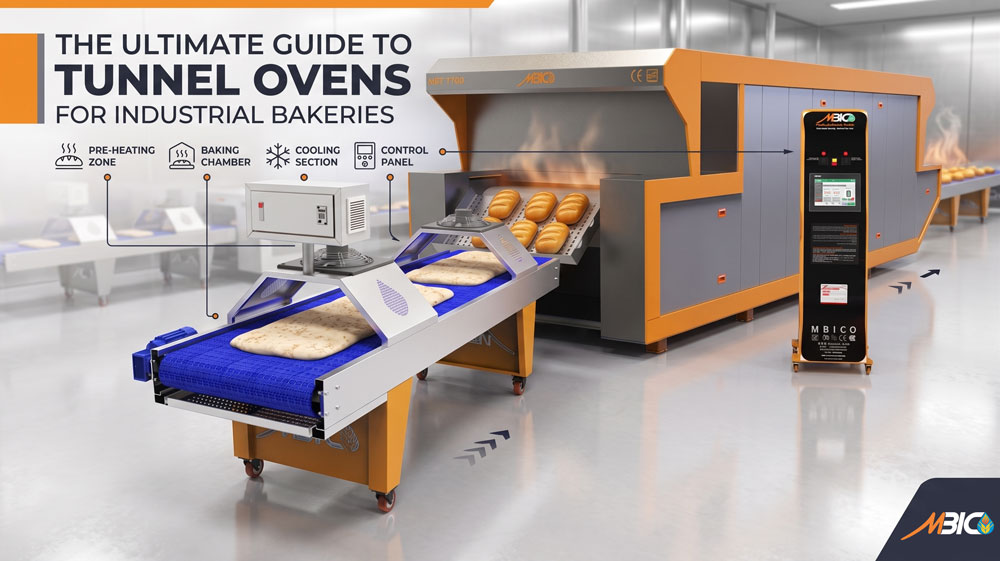
The Ultimate Guide to Tunnel Ovens for Industrial Bakeries

01215

To scale a commercial bakery successfully, you must eventually move past the limitations of batch baking. When production demands grow from a few hundred loaves a day to thousands of units per hour, the continuous tunnel oven becomes the indispensable heart of the production line. A tunnel oven is not merely a larger heating chamber; it is a highly engineered thermodynamic machine designed to apply precise heat profiles to a moving river of dough. By understanding the intricate mechanics of these systems, industrial bakers can achieve unmatched product consistency, reduce energy costs, and maximize their yield.

Imagine standing at the discharge end of a thirty-meter-long continuous baking system. Every single second, perfectly golden, uniformly risen loaves emerge, smelling of rich yeast and caramelized crust. There are no variations between the first loaf and the ten-thousandth loaf of the day. This absolute uniformity is the result of precise heat transfer, controlled moisture, and continuous movement. Achieving this level of baking perfection requires moving away from guesswork and adopting a deep, engineering-focused approach to thermal processing.

By the end of this guide from MBICO, you will not only understand The Ultimate Guide to Tunnel Ovens for Industrial Bakeries, but also learn how to apply it effectively in your baking process.

How heat transfer dynamics shape the crumb and crust in continuous baking

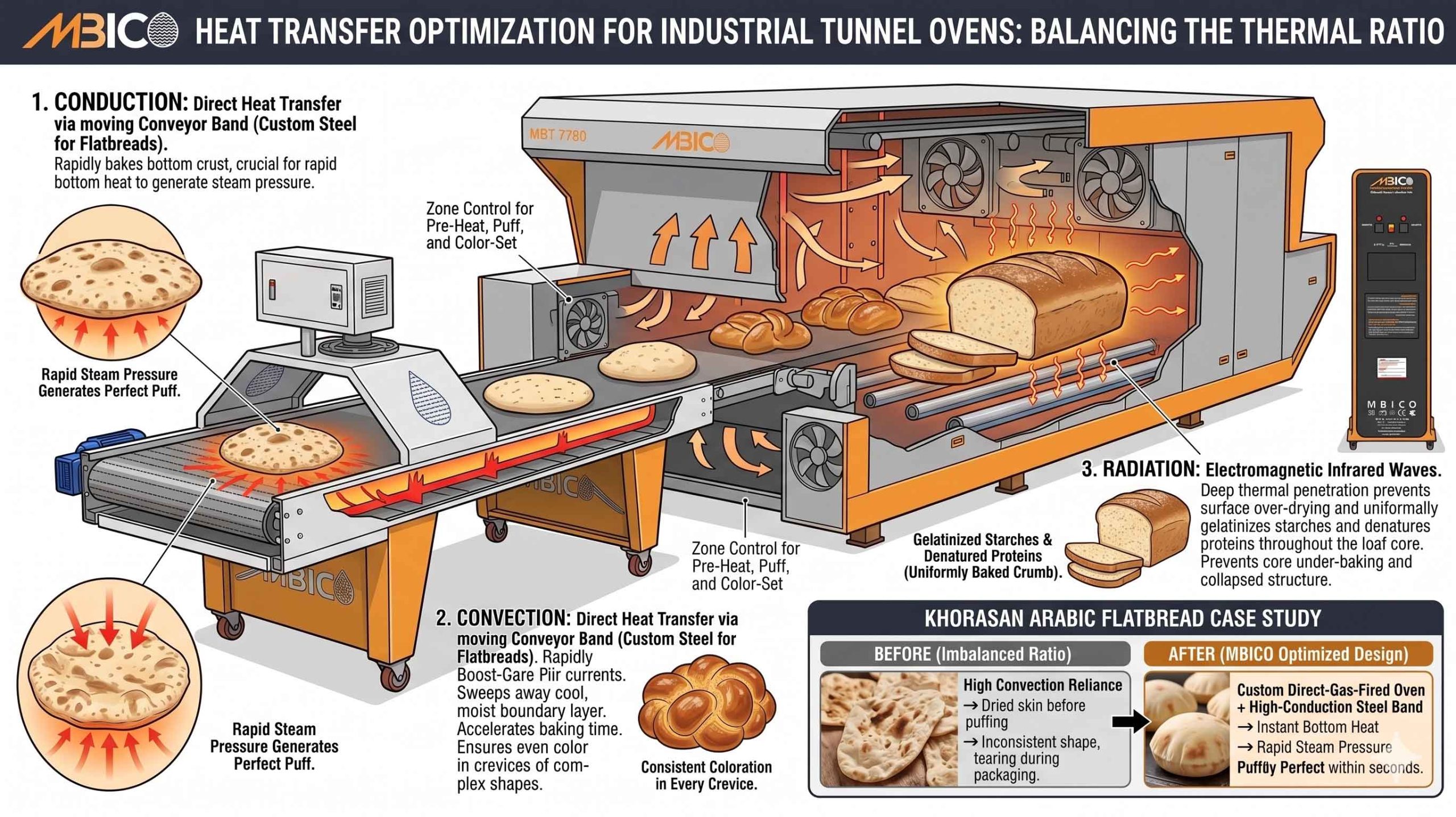
Every baking process relies on three primary modes of heat transfer: conduction, convection, and radiation. In a continuous tunnel oven, these three physical phenomena must be carefully balanced along the entire length of the baking chamber. If any of these modes is out of balance, the dough will either bake too quickly on the outside while remaining raw in the center, or it will dry out completely before achieving a proper oven spring.

Conduction occurs through direct contact between the dough and the moving conveyor belt. If you are using a heavy wire mesh or a solid steel band, thermal energy transfers directly into the bottom of the dough piece. This rapid transfer is vital for flatbreads, pizzas, and pan bread, where a strong bottom crust is required to support the rising structure of the crumb.

Convection involves the movement of hot air currents across the surface of the baking products. By utilizing forced-convection fans, industrial tunnel ovens sweep away the cool, moist boundary layer of air that naturally surrounds cold dough. This accelerated energy transfer speeds up baking times and ensures that complex shapes, such as braided brioche or rustic baguettes, receive even coloration in every crevice.

Radiation is the transfer of heat via electromagnetic infrared waves emitted by the hot interior walls of the oven chamber and burner tubes. Radiation penetrates deep into the dough matrix without drying out the surface prematurely. This deep thermal penetration is essential for gelatinizing starches and denaturing proteins uniformly throughout the loaf, preventing the collapsed structures often caused by under-baking the core.

“During our years of designing industrial baking lines at MBICO, we have learned that the perfect bake is not about maximizing raw heat. It is about balancing the thermal ratio between conduction, convection, and radiation to match the specific hydration level of your dough.”

To illustrate, a large Arabic flatbread bakery in Khorasan recently approached our engineering team. Their bread was puffing inconsistently, and the pockets were tearing during packaging. By analyzing their heat transfer profile, we discovered that their existing oven relied too heavily on convection, which dried out the top skin of the dough before it could puff. We redesigned their line with a custom direct-gas-fired tunnel oven featuring a high-conduction steel band. This modification allowed for instant bottom heat, generating the rapid steam pressure needed to puff the flatbread perfectly within seconds.

01545454 scaled

Choosing between direct and indirect heating methods determines your product versatility

When selecting a tunnel oven, one of the most fundamental design choices you will face is whether to use a direct-fired system or an indirect-fired system. This decision fundamentally dictates how heat is generated, how combustion gases interact with your products, and how much fuel your facility will consume on a daily basis.

In a direct-fired tunnel oven, burners are mounted directly inside the baking chamber, both above and below the conveyor belt. The combustion gases come into direct contact with the dough. This setup offers incredibly rapid temperature adjustments and high thermal efficiency, making it the preferred choice for products that require high temperatures and short bake times, such as crackers, pita, and various flatbreads.

Conversely, an indirect-fired tunnel oven isolates the combustion process entirely from the baking chamber. Burners fire into a highly durable heat exchanger system, and a system of recirculation tubes channels the clean, heated air through the baking zones. Because no combustion byproducts enter the baking chamber, this system is ideal for delicate pastries, sponge cakes, and gluten-free breads, where combustion chemistry could alter the flavor profiles or delicate structures.

Operational Feature Direct-Fired Tunnel Oven (DFO) Indirect-Fired Tunnel Oven (IFO)
Heat Source Interaction Burner flame and combustion gases contact the product directly. Heat is transferred via closed-circuit heat exchangers.
Temperature Response Time Extremely fast; changes are felt within seconds. Slower; requires heating up the mass of the heat exchanger.
Product Suitability Crackers, flatbreads, pizzas, and crispy cookies. Sponge cakes, pan bread, soft buns, and delicate pastries.
Fuel Efficiency Higher thermal efficiency due to zero exchange losses. Slightly lower efficiency; energy is lost through exhaust stacks.
Maintenance Complexity High; dozens of individual burner nozzles require cleaning. Low; single central burner with simple ductwork inspection.

One of the most common challenges our customers face is determining which system matches their expansion plans. A bakery producing only sandwich bread might be tempted by the high efficiency of direct-fired systems, but if they decide to expand into delicate butter croissants or sweet brioche in the future, the sulfur dioxide and moisture byproducts of direct combustion could negatively affect their glazes and crust lamination. Our role as copywriters and food engineers is to guide producers toward the technology that secures their future growth.

Selecting the right conveyor band is critical to heat distribution and product footprint

The conveyor band, or hearth, is the mechanical foundation of any continuous baking system. It is the surface that physically transports your product through the intense environment of the baking chamber. The thermal mass, conductivity, and physical texture of the band directly influence how the bottom of your bread bakes and releases from the conveyor.

There are four main types of conveyor bands utilized in industrial tunnel ovens today, each tailored to distinct baking applications:

  • Solid Carbon Steel Bands: These heavy steel belts provide exceptional conductive heat. They are perfectly flat, making them ideal for soft, liquid batters, cookies, and thin crackers. The solid surface prevents dough from dripping and creates a beautifully uniform, flat bottom crust.
  • Wire Mesh Bands: Constructed from woven steel wires, these bands are highly breathable. They allow hot air to circulate freely around the entire product, making them perfect for pan bread, buns, and high-volume rolls where uniform convective baking is preferred.
  • Stone or Ceramic Tile Hearth Bands: These bands are made of heavy ceramic or natural stone segments mounted on a heavy-duty chain drive. They mimic the thermal profile of a traditional brick deck oven, retaining a massive amount of heat to bake high-hydration rustic sourdoughs, artisanal baguettes, and authentic pizzas.
  • Link Grid Belting: A compromise between wire mesh and heavy plates, these grids offer high durability and excellent air circulation, frequently used in heavy tin bread lines where baking pans must travel smoothly without slipping.

In our years of experience setting up industrial baking lines, we have seen that choosing the incorrect band material is a primary cause of premature band fatigue and uneven baking. For instance, putting a high-water-content rye dough directly onto a cold solid steel band will cause the dough to stick, resulting in tearing at the discharge end. Conversely, placing small cookies on a wide-mesh wire band causes them to sag and lose their shape. Understanding these physical interactions is what separates a standard equipment supplier from a true baking partner.

Zoned temperature control and precise steam delivery create the perfect gelatinized crust

Baking is not a single thermal event; it is a sequence of precise physical and chemical changes that happen as the dough heats up. To manage these changes, a high-quality tunnel oven is split into multiple independent temperature zones, typically ranging from three to eight zones depending on the overall length of the oven.

In the first zone, often called the steaming or oven-spring zone, the dough enters a relatively cool environment (around 160°C to 180°C) saturated with low-pressure steam. This steam condensation is critical. When steam hits the cold dough, it condenses into water, releasing latent heat that quickly warms the dough surface without drying it out. This moisture keeps the dough outer skin elastic, allowing the gases inside to expand fully. Without this step, the crust would set too early, causing the loaf to tear open in random, unattractive ways.

In the middle zones, the temperature is increased to around 200°C to 220°C. Here, the yeast is inactivated (thermal death occurs at around 55°C), starches gelatinize, and proteins denature to form the stable crumb structure of the bread. This is where the structural integrity of your loaf is established.

In the final zone, the humidity is kept low, and the temperature is raised to its highest level (often up to 240°C) to promote the Maillard reaction and caramelization. The natural sugars in the dough react with amino acids to produce the deep golden color, rich aromas, and crispy texture that make baked goods irresistible.

Our R&D team at MBICO recently conducted a series of tests on steam distribution systems. We discovered that traditional static steam pipes often create cold spots inside the entry zone, leading to uneven crust shine. To resolve this, we engineered an active steam distribution manifold with adjustable nozzles that ensure every millimeter of the conveyor band receives a uniform blanket of steam. This advancement has allowed our clients to achieve a brilliant, glassy crust on their artisan baguettes without having to use expensive dough conditioners.

Comparing tunnel ovens with rotary and deck systems clarifies your operational scaling needs

Many bakeries reach a crossroads where they must decide whether to purchase multiple rotary ovens, invest in a larger multi-deck oven, or make the leap to a continuous tunnel oven. Making the right decision requires looking beyond the initial purchase price and evaluating long-term labor costs, energy consumption, and product consistency.

Rotary ovens are highly versatile and have a small footprint. They are excellent for bakeries that produce dozens of different product types in small batches throughout the day. However, they require significant manual labor to load and unload racks, and the constant opening of doors leads to substantial heat loss, which increases fuel bills.

Multi-deck ovens excel at baking heavy, artisanal crusty breads, offering exceptional bottom heat. But like rotary ovens, they are batch-based systems that require skilled operators to load and unload loaves using peel boards or manual setters. This limits your throughput and introduces human error into the baking profile.

Tunnel ovens remove the human element from the baking cycle. Once the dough is deposited onto the conveyor, it is baked automatically according to a highly precise, pre-programmed thermal curve. This continuous flow drastically reduces labor costs, saves floor space by removing the need for hundreds of baking racks, and ensures that every single product is baked under identical conditions.

Oven Category Throughput Level Labor Requirements Energy Efficiency per Kg Product Uniformity
Rotary Rack Oven Low to Medium (Batch) High (Manual rack loading) Moderate (Heat lost during door cycles) Good (Rotational compensation)
Multi-Deck Oven Medium (Batch) Very High (Manual peeling needed) High (Excellent thermal retention) Very High (Consistent deck contact)
Continuous Tunnel Oven High to Ultra-High Minimal (Fully automated lines) Exceptional (Continuous thermal equilibrium) Absolute (Every loaf follows the same path)

If your daily production exceeds 5,000 loaves of a single product type, continuing to use rack ovens is likely costing you thousands of dollars in wasted labor and excessive energy consumption. Transitioning to a continuous tunnel oven streamlines your workflow, allowing your baking team to focus on ingredient quality and product development rather than managing heavy racks and oven doors.

Diagnosing and resolving common thermal distribution and conveyor tracking errors

Operating an industrial tunnel oven requires proactive maintenance and a solid understanding of how to troubleshoot common issues. Because these machines run continuously, even a small technical problem can quickly ruin large quantities of dough if it is not resolved right away.

One of the most common issues operators face is uneven baking across the width of the conveyor belt. If the loaves on the left side of the belt emerge perfectly baked while those on the right side are pale and undercooked, you are dealing with a lateral heat imbalance. This is often caused by clogged burner nozzles, unbalanced extraction dampers, or air leaks around the oven inspection doors.

Another common mechanical issue is conveyor belt mistracking. Over time, the heavy steel or wire mesh band can drift to one side, causing it to rub against the internal structural frame of the oven. This can damage the edges of the belt and lead to costly production stops.

465465 scaled

To help your team quickly identify and resolve these issues, we have compiled a straightforward troubleshooting guide based on our field service experiences:

  1. Issue: Uneven lateral bake profile (left-to-right variation)Root Cause: Clogged burner gas ports or uneven damper extraction rates.

    Solution: Clean the gas burners with a fine wire brush, inspect the gas-to-air ratio valves, and adjust the sliding draft dampers until the exhaust suction is uniform across the entire width of the chamber.

  2. Issue: Conveyor belt drifting or tracking off-centerRoot Cause: Uneven tension on the drive rollers or a build-up of baked debris on the return drums.

    Solution: Thoroughly clean all return rollers, adjust the tensioning bolts on the non-drive side, and ensure the automatic pneumatic tracking guide system is working correctly.

  3. Issue: Excessively dry crumb or thick, leathery crustRoot Cause: Insufficient steam condensation in Zone 1 or excessive air circulation velocity in the middle zones.

    Solution: Increase the steam pressure at the inlet manifold, check the steam traps for water blockages, and reduce the speed of the convection fans to prevent moisture from stripping off the dough surface too early.

According to MBICO’s internal baking chamber trials, setting up a weekly maintenance routine that includes cleaning the burners and checking the belt alignment pneumatics can extend the lifespan of your conveyor band by up to 40%. Taking care of your equipment prevents unscheduled downtime and ensures your facility runs smoothly year after year.

Integrating waste heat recovery systems minimizes environmental impact and operating costs

In today’s competitive industrial baking market, managing energy consumption is essential for maintaining healthy profit margins. Tunnel ovens consume a significant amount of natural gas, LPG, or electricity. A substantial portion of this energy is lost through the exhaust stacks as hot air and steam are vented out of the building.

To address this waste, modern industrial tunnel ovens can be equipped with waste heat recovery systems (WHRS). These systems use high-efficiency heat exchangers installed directly inside the exhaust stacks. As hot exhaust gases (often exceeding 280°C) flow out of the oven, the heat exchanger captures this thermal energy and transfers it to a secondary fluid or air loop.

This recovered heat can be utilized in several highly beneficial ways within your bakery facility:

  • Preheating Combustion Air: Feeding hot air back into the burners reduces the fuel needed to reach your target baking temperature, saving up to 15% in gas consumption.
  • Generating Hot Water: The captured heat can warm the water used for mixing dough or sanitation cycles, reducing the load on your facility’s primary boilers.
  • Heating the Proofing Chamber: You can route the recovered thermal energy to the final proofer, eliminating the need for a separate heating system.

During a recent project for a large-scale baking facility in Mashhad, MBICO’s engineering team installed a customized heat recovery loop on a thirty-meter indirect-fired tunnel oven. This system successfully reduced the client’s overall monthly fuel consumption by 22%. By investing in smart, sustainable energy solutions, you protect both your bottom line and the environment, showing your customers that your brand values modern, responsible manufacturing practices.

Achieving industrial baking excellence requires a perfect balance of engineering and baking artistry

Investing in a continuous tunnel oven is a transformative step for any growing bakery. It is a decision that shifts your operation from labor-intensive manual processes to highly efficient, automated food engineering. By understanding the details of heat transfer, choosing the right burner configuration, selecting the ideal conveyor band, and utilizing multi-zone temperature and steam control, you can produce consistently high-quality baked goods on a massive scale. Managing these technical elements correctly ensures that every loaf of bread, pastry, or flatbread that leaves your facility is baked to perfection.

At MBICO, we believe that the best baking systems are built on collaboration, precise engineering, and a deep appreciation for the baker’s art. Our team of experienced food process engineers and technical designers is ready to help you analyze your current production lines, design custom tunnel ovens tailored to your exact recipes, and integrate advanced automation systems that simplify your daily operations. We invite you to contact the MBICO engineering department today to schedule a comprehensive technical consultation and take the first step toward optimizing your industrial bakery production.

The Ultimate Guide to Tunnel Ovens for Industrial Bakeriesا

Frequently Asked Questions about The Ultimate Guide to Tunnel Ovens for Industrial Bakeries

How long does an industrial tunnel oven typically last under continuous operation?

With a proper maintenance routine, a high-quality industrial tunnel oven has an operational lifespan of 20 to 30 years. The critical mechanical components, such as the conveyor band, burner assemblies, and drive chains, will need periodic servicing or replacement. However, the insulated main oven body and structural frame are designed to withstand decades of continuous thermal cycling without warping or degrading.

Can you bake multiple different products in a single tunnel oven line?

Yes, modern tunnel ovens are highly versatile thanks to advanced PLC control systems. These systems allow operators to save distinct recipes with unique temperature profiles, conveyor belt speeds, and steaming levels. While you cannot bake items with wildly different thermal requirements at the exact same moment, you can easily switch production from sandwich bread to soft buns by adjusting the oven parameters during a short changeover period.

What is the typical energy source used to power industrial tunnel ovens?

Most industrial tunnel ovens are powered by natural gas or liquefied petroleum gas (LPG) due to the high heating value and cost-effectiveness of these fuels. However, in regions where natural gas is less accessible or where electricity rates are favorable, fully electric tunnel ovens are an excellent alternative. Electric systems offer exceptionally clean operation, precise temperature control, and a smaller overall carbon footprint when connected to renewable energy sources.

How do you calculate the required length of a tunnel oven for a bakery?

The length of a tunnel oven is calculated based on your target hourly production output, the weight of each product unit, and the required baking time. The formula is: Oven Length = (Required Hourly Throughput / Product Width-wise Capacity) * (Baking Time in Minutes / 60) * Product Pitch. MBICO’s engineering team performs these calculations for each project to ensure your new oven matches your upstream make-up equipment and downstream cooling systems perfectly.


Sourdough or no-knead bread? Which is better?

Sourdough or no-knead bread? Which is better?

Sourdough vs. No-Knead: Which Artisan Bread Technique Delivers the Best Results?

For the dedicated home baker, the quest for truly artisan bread inevitably leads down two distinct, well-trodden paths: the deeply flavorful, biologically complex world of sourdough, and the miraculously simple, high-hydration universe of the no-knead loaf. This pivotal decision — which path offers the optimal balance of effort, exceptional flavor, and nutritional reward — is one of the most common dilemmas we encounter, whether we are consulting with hobbyists or guiding semi-industrial startups looking for efficient bread processes.

As manufacturers of professional bakery equipment, we understand that while commercial bakeries utilize high-tech mixers and precise temperature controls, the foundational elements of great bread — fermentation and technique — remain constant. You seek that perfect, crackling crust achieved by a controlled bake, whether it comes out of a commercial deck oven or your home baking oven.

It is easy to assume that because both sourdough and no-knead methods result in a beautiful crusty loaf, the differences are purely cosmetic. In reality, the choice dictates everything, from the structure of the gluten network to the final flavor profile and the ultimate digestibility of the bread you pull from the heat. We want to help you achieve bakery-quality results without the intensive time commitment often associated with professional baking.

This head-to-head analysis is designed to move beyond basic technique and peel back the curtain on the underlying chemistry, empowering you to select the process that truly aligns with your goals. Here is what this comparison will reveal:

  • Flavor Depth: Understanding how lactic acid and acetic acid development in sourdough compares to the simple, pure wheat flavor of a rapid no-knead fermentation.
  • Time Commitment: Balancing the intensive feeding, proofing, and scheduling required for sourdough versus the minimal hands-on time of the no-knead method.
  • Nutritional Value: Assessing the impact of long, slow fermentation on phytic acid reduction and nutrient bioavailability in both loaves.

We understand that juggling a busy life while striving for nutritional excellence and flavor depth is challenging. Read on to discover which method — sourdough or no-knead — provides you with the superior solution for your countertop baking ambitions.

By the end of this guide, you will not only understand Sourdough vs. No-Knead, but also learn how to apply it effectively in your baking process, transforming your approach to homemade bread.

The Core Philosophy of Sourdough and No-Knead Baking

Though both methods celebrate the marriage of flour, water, and salt, their approach to leavening and structuring the dough is fundamentally different. Understanding these core philosophies is the first step toward mastering either technique.

Sourdough or no-knead bread? Which is better?

Defining the essence of sourdough: Time and biology

Sourdough is defined by its use of a symbiotic culture of wild yeast and bacteria—specifically Lactobacilli—known as the sourdough starter maintenance. This microbial community is the engine of the loaf, responsible for both leavening (rising) and flavor development. The core philosophy of sourdough is patience and control. By utilizing a natural leavening agent instead of commercial baker’s yeast, the baker subjects the dough to a mandatory long fermentation period.

The crucial scientific insight here is the production of organic acids (lactic and acetic) during this slow fermentation. These acids do far more than just impart the characteristic tangy flavor; they interact with the flour proteins, fundamentally changing how the dough behaves. According to MBICO’s internal baking chamber trials, sourdough doughs exhibit greater stability in the oven due to this acid interaction, leading to better oven spring and a more open, yet sturdy, crumb structure compared to straight yeast breads.

“In our years of experience setting up industrial baking lines, the most demanding process is always sourdough. It requires not just temperature control, but an intimate relationship with the biological activity of the starter. This same dedication applies to the home baker seeking that complex, deep flavor.”

Defining the essence of no-knead: Minimal intervention, maximal hydration

The no-knead method, popularized by Jim Lahey, is the definition of efficiency. Its core philosophy is to substitute mechanical action (kneading) with chemical action (hydration and time). It relies heavily on high hydration levels—often 75% water or more relative to the flour—combined with a small amount of commercial yeast and an extremely long fermentation period, usually 12 to 18 hours at room temperature.

The science behind this is elegant: time allows the water to fully hydrate the flour proteins, and the high moisture content encourages the protein strands to move and align themselves naturally. This process is essentially a slow, gentle form of gluten development without physical manipulation. When the dough is highly hydrated and allowed to rest, enzymes break down starches into simpler sugars, which the yeast consumes, producing gas and creating a network of tiny bubbles. The resulting crumb structure tends to be exceptionally open and irregular, often softer than a traditional sourdough, but lacking the acidic complexity.

Process Analysis A Comparative Look at Technique and Time

While both methods rely on extended rest periods, the nature of the active work required at various stages differs dramatically, impacting the scheduling for the home baker.

The crucial role of starter maintenance in sourdough

The single greatest commitment in sourdough baking is the starter itself. This is a living organism that requires feeding (refreshing) and careful monitoring. Successful sourdough baking starts weeks before the first loaf is baked, requiring daily *starter maintenance*. This routine can be daunting for beginners.

The process of mixing the final dough also requires attention:

  1. Mixing and Autolyse (Optional but recommended): A brief period where flour and water mix before the starter is added, allowing initial hydration.
  2. Adding Starter and Salt: Incorporation and initial folding.
  3. Bulk Fermentation with Folding: Requires 3–5 sets of “stretch and folds” over 3–5 hours to manually build strength and initiate gluten development. This is the active management phase.
  4. Shaping and Cold Proofing: Typically 12–18 hours in the refrigerator for flavor development and structure setting.
  5. Baking: Often in a preheated bekery oven for maximum steam and crust development.

The sourdough process demands the baker be present and attentive during the bulk fermentation phase, though the total elapsed time is shorter than the no-knead method’s main rest period.

Why the autolyse technique is key to no-knead success

In contrast, the no-knead method minimizes active intervention, relying on the phenomenon of autolyse, though often the full process is done in a single mix.

The typical no-knead workflow is remarkably simple:

  1. Initial Mix: Flour, water, yeast, and salt are barely combined—just enough to ensure no dry streaks of flour remain.
  2. Ambient Fermentation: The dough is left untouched for 12–18 hours at room temperature (around 70°F/21°C). This is the passive development phase.
  3. Minimal Shaping: The highly sticky dough is lightly folded once or twice, then shaped and proofed briefly (1–2 hours).
  4. Baking: Always baked hot, usually in a oven to create the necessary steam required to set the high-hydration crust.

The key here is the initial high hydration and the minimal effort required. While the total time elapsed is long, the hands-on time might only be 15 minutes across the entire 18-hour process.

Analyzing bulk fermentation time in both methods

The time dedicated to long fermentation is the defining factor for both flavor and digestibility.

In sourdough, the bulk fermentation (the first rise) is generally shorter (3–6 hours), but the flavor development is deepened by the subsequent cold proofing (12+ hours). The microbial activity is slower and more complex throughout the cold proofing stage.

In the no-knead method, the bulk fermentation *is* the 12–18 hour room temperature rest. This rapid, uncontrolled fermentation leads to quick CO2 production (thanks to the commercial yeast) and a high level of gluten relaxation, resulting in the characteristic soft interior.

One of the most common challenges our customers face is learning to read their dough’s fermentation—especially how temperature affects the timeline. For no-knead, a cold day might require 24 hours, whereas a warm kitchen might be done in 10. Sourdough offers slightly more predictable results if the starter is consistently strong, but requires constant monitoring of the ambient temperature.

Understanding Gluten Development and Crumb Structure

The structural integrity of any great bread—the chew, the height, the gaping holes—comes down to how the gluten network is formed and strengthened.

How kneading differs from long fermentation

Gluten development is the creation of a mesh-like structure formed when the two main proteins in flour, gliadin and glutenin, combine in the presence of water and mechanical force.

In traditional baking (including sourdough’s active folding), this structure is built through physical manipulation—stretching, folding, or kneading. This tightens the network, allowing it to hold gases more efficiently.

In the no-knead method, the physical force is replaced by enzymatic action and time. The water allows the proteins to slowly align themselves without being forcibly tangled. While the resulting gluten structure is adequate for holding gas, it tends to be more extensible (stretchier) and less elastic (snappier) than a well-kneaded sourdough.

This difference explains the typical results: Sourdough often yields a loaf that is chewier and has a more defined structure due to the tension created by folding. No-knead yields a softer, more pillowy loaf with an often dramatic, but weaker, open cell structure.

The unique crumb structure achieved by natural leavening

The crumb structure of a sourdough loaf is significantly influenced by the acidic environment created by the wild culture. Lactic and acetic acids actually tighten and strengthen the gluten network, making it more resilient. This allows the dough to withstand the rigors of shaping and achieve maximum volume in the oven, leading to the sought-after “irregular open crumb.” The strong network can stretch thin without tearing, forming large, defined alveoli (holes).

Conversely, the no-knead loaf achieves an open crumb primarily through high hydration and extended enzymatic activity, rather than acidic strength. The crumb tends to be less uniform, often featuring very large, irregular voids separated by softer walls.

“According to MBICO’s internal baking chamber trials focusing on dough rheology, sourdough consistently shows a higher Resistance to Extension value than high-hydration no-knead doughs fermented with commercial yeast, confirming its greater structural integrity for complex shaping.”

To simplify: Sourdough builds a resilient steel structure; No-knead builds a sturdy concrete structure. Both stand tall, but they handle stress differently.

Health, Nutrition, and Digestibility

For many home bakers, the switch to artisan bread is driven by health consciousness. This is where the sourdough method truly gains a strategic advantage, largely due to the mandatory presence of natural leavening and long fermentation.

Phytic acid breakdown and enhanced digestibility

The superior digestibility of sourdough bread is not anecdotal; it is a proven function of the long, acidic fermentation. Grains, especially whole wheat, contain phytic acid (or phytate), which is an anti-nutrient that binds to minerals (iron, zinc, calcium) in the gut, making them unavailable for absorption.

The unique blend of bacteria and yeast in a sourdough starter produces phytase, an enzyme that effectively breaks down phytic acid during the long, slow, acidic fermentation period.

While the no-knead process also utilizes a long rest, the high proportion of commercial yeast and lack of Lactobacilli means that significantly less phytase is produced. Therefore, mineral bioavailability is generally higher in true sourdough bread. For those prone to gluten sensitivity (not celiac disease), the complex breakdown of gluten proteins during the long fermentation process also aids digestibility, reducing the burden on the digestive system.

Glycemic response differences

Studies indicate that sourdough bread tends to have a lower glycemic index (GI) compared to breads made quickly with commercial yeast. This is again attributed to the organic acids produced by the lactic acid bacteria. These acids, particularly acetic acid, appear to modify the way the body digests starch, leading to a slower release of glucose into the bloodstream.

While a long fermentation no-knead loaf is certainly better than a quick 2-hour yeast bread, the superior acidic environment of sourdough provides a clearer advantage for managing blood sugar response.

Head-to-Head Comparison Table: Sourdough vs. No-Knead

To summarize the operational differences and outcomes, here is a detailed breakdown for quick reference:

Feature Sourdough (Natural Leavening) No-Knead (Commercial Yeast)
Leavening Agent Wild Yeast & Lactic Acid Bacteria (Sourdough Starter) Commercial Baker’s Yeast (Instant or Active Dry)
Fermentation Time (Total) 18–30 hours (3–5 hr bulk + 12–24 hr cold proof) 14–24 hours (12–18 hr room temp rest + 1–2 hr final proof)
Hands-On Time Moderate (Requires folding, shaping, and starter maintenance) Minimal (5–15 minutes across the entire process)
Gluten Development Method Folding/Coiling combined with acidic strengthening Autolysis/Time (High hydration alignment)
Flavor Profile Complex, tangy, acidic, deeply nutty (Dependent on time/temperature) Mild, yeasty, slightly sweet, clean finish
Digestibility/Nutrition Excellent (Superior phytic acid breakdown, potentially lower GI) Good (Long fermentation aids starch digestion, but less phytase activity)
Crumb Structure Strong, chewy, defined, irregular open crumb Soft, pillowy, highly irregular and often cavernous
Required Skill Level Intermediate to Advanced (Need to “read” the starter and the dough) Beginner (Highly forgiving process)

MBICO’s Practical Verdict When to Choose Which Method

The ultimate decision rests on your personal baking goals: are you prioritizing efficiency and accessibility, or are you prioritizing flavor complexity and optimal health benefits?

Choosing Sourdough for Flavor Depth and Nutrition

If your primary goal is to maximize flavor complexity, achieve a distinct chewiness, and attain the highest nutritional benefit, sourdough is the undisputed choice. The extended microbial interactions are irreplaceable for producing those deep, sophisticated flavors.

We often advise professional bakers, even those using modern spiral mixers, to slow down their fermentation programs to mimic the effects of natural leavening. This principle holds true at home. Sourdough requires discipline and a commitment to starter maintenance, but the reward is a loaf that surpasses nearly all commercially produced breads.

Choosing No-Knead for Convenience and Consistency

If you are a beginner, have an unpredictable schedule, or simply want reliable, delicious crusty bread with minimal effort, the no-knead method is superior. It is the perfect gateway into high-hydration baking.

One of the greatest benefits of the no-knead approach is its resilience. Since it uses commercial yeast, it is far less sensitive to minor temperature fluctuations or missed feedings. It is the ultimate method for achieving that beautiful, rustic look using simple tools like a bowl and a good mini deck oven, while requiring almost no understanding of active gluten development techniques like folding or coiling.

“One of the most common challenges our customers face is scaling up quality production. At the home level, no-knead offers near-perfect consistency with minimal knowledge investment. It’s reliable, which is the most powerful tool for building confidence.”


Sourdough vs. No-Knead: A Head-to-Head Comparison for Home Bakersا

Conclusion

The journey into artisan bread baking is deeply rewarding, and both the sourdough and no-knead paths offer fantastic results when approached with respect for the process. Sourdough provides a truly complex, scientifically superior loaf that requires commitment to biological timing and technique, ensuring maximum digestibility and flavor depth through natural leavening and active gluten development. The no-knead method provides an accessible miracle: high-quality bread achieved through minimal effort and long, passive fermentation, making it the ideal choice for busy schedules. Neither method is objectively “better”—they simply serve different purposes. Your choice should reflect your time budget and your flavor ambition. Now that you understand the mechanics of long fermentation and crumb structure in both contexts, you are equipped to make an informed decision and master your kitchen.

If you are ready to apply these technical insights and perhaps upgrade your home baking setup, we encourage you to explore the science of controlled heat. Mastering the oven environment is crucial for both methods. Visit the MBICO Resource Center for deep dives into oven steaming techniques and heat retention principles that maximize your crust development, regardless of whether you choose a microbial or purely time-based approach. Take the next step: perfect your bake today.

Frequently Asked Questions about Sourdough vs. No-Knead: A Head-to-Head Comparison for Home Bakers

Is sourdough always healthier than no-knead bread?

Sourdough bread is generally considered nutritionally superior due to the presence of lactic acid bacteria, which actively break down phytic acid (improving mineral absorption) and partially hydrolyze gluten proteins, enhancing digestibility. While a long fermentation no-knead loaf is better than quickly baked bread, it lacks the necessary microbial profile for the comprehensive nutritional benefits provided by true natural leavening.

Can I make a no-knead bread using sourdough starter instead of commercial yeast?

Yes, this hybrid approach combines the minimal intervention of the no-knead process with the flavor benefits of a sourdough starter. You substitute the commercial yeast with an equal weight of active starter and proceed with a very long fermentation (usually 8–12 hours at room temperature, depending on temperature). This method still requires high hydration to achieve the necessary gluten development without kneading.

Do I need a Dutch oven for both sourdough and no-knead bread?

While you can technically bake either bread on a stone with added steam, using a Deck oven is highly recommended for both. The lidded pot traps the dough’s own moisture during the crucial first 20 minutes of baking. This trapped steam keeps the crust soft, allowing the loaf to expand fully (oven spring) before the crust sets, which is vital for achieving the desired crumb structure and a beautiful, golden crust.

Which method is better for using whole grain flours?

Sourdough is significantly better suited for baking with high percentages of whole grain flours. Whole grains contain more phytic acid and their denser structure benefits greatly from the acidic strength provided by the natural leavening culture. The extended, slow fermentation helps ensure maximum digestibility and better structural support in the final loaf, compensating for the shorter, weaker gluten strands found in whole grain flour.

How do I manage starter maintenance if I only bake occasionally?

For the home baker who bakes infrequently, the best strategy for starter maintenance is cold storage. Feed your starter, let it rest at room temperature for 1–2 hours, then place it in the refrigerator. It can usually last 1–2 weeks without feeding. To bake, take it out 12–24 hours beforehand and feed it 2–3 times to restore full activity before mixing the final dough.


What is the Best Bread Baking Method for Beginners?

Baking Method for Beginners

Are you staring at complex recipes for homemade bread, feeling completely overwhelmed by advanced kneading techniques, mysterious sourdough starters, and precise temperature controls? For anyone starting their journey into the world of baking, the sheer volume of information can feel crippling. The goal of baking a beautiful, crusty loaf of artisan bread often seems beyond a beginner’s reach.

At MBICO, Mashhad Baking Industries, we specialize in the science and machinery behind professional baking. Through years of running educational workshops, we recognize a common hurdle we call “baker’s paralysis”—the fear of doing something wrong. As one aspiring baker once confided, “I’m afraid to even mix the flour and water.”

The Definitive Solution for Beginner Bread Baking

The single best method for a complete beginner is one that strips away technical complexity, guarantees a high rate of success, and builds the confidence needed to explore further. This foundational technique relies on time and fundamental chemistry rather than difficult manual labor: the revolutionary no-knead method.

The no-knead approach is your secret weapon. It empowers you to create a loaf with a deep, complex flavor profile, a crackling crust, and an airy, open crumb structure—all using just four simple ingredients and almost no active work. This is pure baking science applied expertly for the home kitchen.

Why is the no-knead method the ideal starting point?

  • Focus on Flavor: Long, slow fermentation naturally develops the deepest flavor that kneading cannot achieve in a short time.
  • Guaranteed Gluten Structure: Hydration and time handle the heavy lifting of gluten development, removing the need for manual skill.
  • Confidence Builder: By minimizing active steps, this approach maximizes success, quickly transforming fear into enthusiasm for baking.

By the end of this guide, you will not only understand what is the best bread baking method for complete beginners, but also learn how to apply it effectively in your baking process to bake a stunning loaf this week.

Why a simple method is crucial for beginner success

The journey to becoming a competent baker is built on a series of small wins. When your first attempt produces a delicious, beautiful loaf, it provides the motivation to learn more. Conversely, early failures—a dough that doesn’t rise, a loaf as dense as a brick—can be so discouraging that the passion fizzles out before it truly ignites. This is why simplicity is the most important feature of a beginner’s baking method.

Traditional bread recipes often front-load the most technically demanding steps. They require you to learn how to knead properly—a physical skill that takes practice to master. You have to feel when the dough has developed enough gluten, a sensory judgment that is difficult for a novice to make. The no-knead method brilliantly sidesteps these challenges by replacing the physical work of kneading with the invisible work of time and fermentation.

In our years of experience setting up industrial baking lines, we’ve learned that the most reliable processes are often the simplest. Automation in our MBICO systems is designed to eliminate variables and guarantee consistency. The no-knead method does the same for the home baker; it removes the variable of inconsistent kneading technique.

For a beginner, the key is to focus on understanding the core relationship between flour, water, yeast, and time. By removing the physical barrier of kneading, you can observe the fermentation process directly, building an intuitive feel for how dough should look, smell, and feel as it develops. This foundational knowledge is far more valuable than memorizing a dozen complex shaping techniques on day one.

The no-knead method is the best starting point

First popularized by baker Jim Lahey in New York, the no-knead method is a high-hydration technique where a very wet, sticky dough is left to ferment for a long period—typically 12 to 18 hours. This extended time allows for full flavor development and, crucially, lets gluten form on its own without any kneading. The final step of baking in a preheated, covered pot like a Mini Deck Oven creates a steamy environment that mimics a professional deck oven, producing incredible oven spring and a bakery-quality crust.

This method is the perfect fit for a beginner for several key reasons:

  • It is incredibly forgiving. Is your fermentation time 14 hours instead of 12? It will likely be fine. Is your shaping a little clumsy? The rustic, artisan look is part of its charm.
  • It requires minimal hands-on time. The active work of mixing takes less than five minutes. The rest is simply waiting.
  • The results are consistently spectacular. It’s one of the easiest ways to achieve the coveted crackly crust and open, airy crumb that defines artisan bread.

Baking Method for Beginners

Discover how fermentation builds gluten without kneading

So, how can you develop a strong dough structure without the pushing, pulling, and folding of kneading? The answer lies in the science of flour and water. When flour is hydrated, two proteins within it—glutenin and gliadin—begin to link together to form the elastic network we know as gluten. Kneading is a mechanical process that speeds up this alignment, stretching and organizing the protein strands.

In the no-knead method, we use two natural processes to achieve the same result: autolysis and fermentation. Autolysis is the process that begins the moment you mix flour and water. Enzymes naturally present in the flour, primarily protease, start to break down the proteins, making them more pliable and ready to form gluten bonds. The high water content in a no-knead recipe (high hydration) creates a fluid environment where these proteins can move around and find each other more easily.

Next, the long, slow yeast fermentation process takes over. As the yeast consumes sugars and releases carbon dioxide gas, these gas bubbles move through the dough. This gentle, constant internal movement pushes and stretches the developing gluten strands over many hours, effectively organizing them into a strong and elastic web. It’s like a million tiny hands kneading the dough from the inside out. In our MBICO research and development labs, we use sophisticated rheometers to measure this dough development. But at home, you can see the proof in the pudding: a slack, sticky mixture transforms into a cohesive, web-like dough full of air bubbles, all while you were sleeping.

This method minimizes equipment and simplifies the process

Another significant barrier for many beginners is the perceived need for expensive and specialized baking equipment. You do not need a stand mixer, a banneton (proofing basket), or a baker’s lame (scoring blade) to get started with this method. The beauty of it lies in its simplicity.

Here is all the baking equipment for beginners that you truly need:

  • A large bowl: For mixing and the long first fermentation.
  • A spoon or spatula: To mix the ingredients.
  • Plastic wrap or a tea towel: To cover the bowl.
  • A mini oven or a heavy, oven-safe pot with a lid: This is the most crucial piece. It traps steam released from the dough, creating a humid environment essential for a crispy crust.
  • Parchment paper: Makes it easy and safe to lower the wet dough into the hot pot.

Baking Method for Beginners

This short list makes the process accessible to virtually anyone with a kitchen. The focus is on the technique and the ingredients, not on accumulating gear. This minimalist approach allows you to master the fundamentals of fermentation and baking before deciding to invest in more advanced tools.

Follow this step-by-step guide to your first artisan loaf

This is a foundational no-knead bread recipe for beginners. We’ll walk through each step, explaining the “why” behind the “how.” The goal is not just to follow instructions, but to understand the process. This four-ingredient bread is the cornerstone of your baking education.

Gather your four essential ingredients

Quality ingredients are the foundation of quality bread. For this simple bread baking recipe, you will need:

  • Bread Flour (500g): Bread flour has a higher protein content (typically 12-14%) than all-purpose flour, which helps form a stronger gluten network. This is ideal for the chewy, open crumb of artisan bread.
  • Water (375g – 400g): Use lukewarm water (around 32-35°C or 90-95°F). This temperature helps to wake up the yeast without being hot enough to harm it. This recipe has a hydration level of 75-80% (water weight divided by flour weight), which is key to the no-knead process.
  • Salt (10g): Salt is crucial for flavor, but it also plays a technical role in strengthening the gluten structure and controlling the rate of fermentation. Use fine sea salt or kosher salt.
  • Instant Dry Yeast (2g, or about 1/2 teaspoon): A tiny amount is needed because of the long fermentation time. Instant yeast can be mixed directly with the dry ingredients.

A note on measurements: Using a digital kitchen scale is highly recommended. Baking is a science, and volume measurements (cups) can be wildly inaccurate depending on how you scoop the flour. A scale ensures your dough hydration is precise every time, leading to consistent results.

Mix the dough in under five minutes

This is the only “active” work you will do for the next 12 hours. The process is incredibly simple.

  1. In your large bowl, whisk together the flour, salt, and instant yeast. This ensures the ingredients are evenly distributed.
  2. Pour in the lukewarm water.
  3. Using a spatula or wooden spoon, mix until just combined. The dough will look shaggy, sticky, and messy. Do not overmix. Your goal is simply to ensure there are no dry patches of flour left.
  4. Scrape down the sides of the bowl, cover it tightly with plastic wrap or a damp towel, and place it in a draft-free spot at room temperature (around 21-24°C or 70-75°F).

That’s it. You have now started the yeast fermentation process that will do all the hard work for you.

Let the long fermentation process work its magic

Now, you wait. For the next 12 to 18 hours, the dough will undergo its primary fermentation, also known as the bulk rise. During this time, you will see visible changes:

  • The dough will at least double, and possibly triple, in size.
  • The surface will be covered in bubbles of various sizes.
  • When you look closely, you will see web-like strands of gluten have formed throughout the dough.
  • It will smell slightly tangy and alcoholic, a pleasant byproduct of fermentation.

The exact time will depend on the temperature of your room. A warmer room will speed up fermentation, while a cooler room will slow it down. Don’t worry about hitting a precise time; look for the visual cues.

Shape the dough with gentle hands

After the long fermentation, the dough will be bubbly, sticky, and full of air. Our goal here is not to knead it, but to gently form it into a round shape (a boule) for its final proof.

  1. Generously flour a clean work surface. Also, flour your hands.
  2. Gently scrape the dough out of the bowl and onto the floured surface. It will be slack and want to spread out.
  3. Gently fold the dough over on itself a few times. Take one edge, stretch it slightly, and fold it toward the center. Rotate the dough and repeat this 3-4 times. This builds a little tension on the surface of the dough, which will help it hold its shape.
  4. Flip the dough over so the seams are on the bottom. Using your cupped hands, gently tuck the sides under to form a taught ball.
  5. Place the shaped dough on a piece of parchment paper. You can let it rest here for its final proof.

Prepare for the final proof and preheat your oven

The final proof is a shorter resting period (30-60 minutes) that allows the dough to relax and rise a little more before baking. Let the shaped dough rest on the parchment paper, covered lightly with plastic wrap or a tea towel.

About 30 minutes into this final proof, it’s time to preheat your baking oven. This is a critical step.

  1. Place your mini oven, with the lid on, into the cold oven.
  2. Set the oven temperature to 230°C (450°F).
  3. Let the oven and the pot preheat together for at least 30 minutes, and up to an hour. Getting the pot screaming hot is essential for the initial “oven spring” and a great crust.

Bake the bread to achieve a perfect crust and crumb

This is the final, exciting step. Be very careful, as the pot will be extremely hot.

  1. Once preheated, carefully remove the hot pot from the oven.
  2. Using the parchment paper as a sling, lift your proofed dough and carefully lower it into the hot pot.
  3. Place the lid back on the pot and return it to the oven.
  4. Bake for 30 minutes with the lid on. This traps the steam, keeping the crust soft and allowing the bread to expand to its maximum volume.
  5. After 30 minutes, remove the lid. The bread will be pale but fully risen.
  6. Continue to bake for another 15 to 25 minutes with the lid off. This allows the crust to dry out and develop a deep, golden-brown color.
  7. Carefully remove the bread from the pot and place it on a wire rack to cool completely. Do not cut into it while it’s hot! The bread is still cooking internally, and slicing it too early can result in a gummy texture.

The sound of the crackling crust as it cools is one of the most satisfying rewards in all of baking. You have just made a phenomenal crusty bread recipe with minimal effort.

Avoid these common mistakes beginners often make

While the no-knead method is forgiving, a few common issues can trip up new bakers. Understanding them will help you troubleshoot and perfect your technique.

Understand why your dough feels too sticky

A common concern is that the dough is “too wet” or “impossible to handle.” Remember, this is a high-hydration dough by design. That’s what creates the open, airy crumb. The key is not to add a lot more flour, which will make your bread dense. Instead, use flour strategically on your work surface and hands during the brief shaping stage. A bench scraper can also be a beginner’s best friend for handling and folding wet dough. The stickiness is a feature, not a bug!

Learn what to do if your dough does not rise

The most common cause for a dough that doesn’t rise is inactive yeast. Yeast is a living organism and can die if it’s old or stored improperly. Always check the expiration date. Another culprit is water temperature—water that is too hot (above 50°C or 120°F) can kill the yeast instantly. Finally, a very cold room can significantly slow down fermentation. If your house is chilly, find a warmer spot, like inside an oven with just the light on.

See why a mini oven is your secret weapon

One of the most frequent questions our customers ask is if they can bake this bread on a simple baking sheet. While you can, the results will not be the same. The magic of the mini oven is its ability to trap steam.

In our MBICO industrial tunnel and deck ovens, we have sophisticated steam injection systems. These systems release a precise amount of steam into the baking chamber during the first few minutes of baking. This moisture keeps the outer crust of the dough soft and pliable, allowing it to expand fully—a phenomenon called “oven spring.” The Convection Oven creates a personal steam chamber for your loaf, perfectly replicating this professional environment on a small scale. It is the single most important tool for achieving a bakery-quality crust at home.

Compare the no-knead method to other baking techniques

To fully appreciate why the no-knead method is the best starting point, it’s helpful to see how it stacks up against other common methods. This comparison highlights the trade-offs between time, skill, and results.

Technique Time Commitment Skill Level Equipment Flavor Profile
No-Knead Method Low Active Time (10 mins)
High Passive Time (12-20 hours)
Beginner Minimal (Bowl, Convection Oven) Complex, slightly tangy due to long fermentation
Traditional Kneading (Direct Method) Medium Active Time (20-30 mins)
Low Passive Time (2-3 hours)
Intermediate Standard (Bowl, Baking Sheet/Stone) Simple, clean flavor of the grain
Sourdough Baking High Active Time (multiple folds)
Very High Passive Time (Days/Weeks for starter)
Advanced Specialized (Banneton, Lame, Scale) Deeply complex, tangy, and sour

The direct method requires active dough development

The traditional method, often called the “direct method,” uses more yeast and relies on 10-15 minutes of vigorous kneading to develop gluten. The fermentation time is much shorter, typically 1-2 hours. While it’s faster from start to finish, it requires the baker to learn the feel of a properly developed dough, which is a significant hurdle for beginners. The flavor is also simpler, as it lacks the complexity developed during a long, slow fermentation.

Sourdough baking introduces the challenge of starter management

Sourdough is the pinnacle for many bakers, but it is not a starting point. It uses a wild yeast culture (a “starter”) that you must feed and care for daily. This adds a significant layer of complexity and responsibility. The fermentation is less predictable, and the techniques for handling sourdough are more advanced. It’s a wonderful goal to aspire to, but we advise our clients to first master the fundamentals of fermentation with commercial yeast via the no-knead method.

Your baking journey has only just begun

Mastering the basic no-knead recipe is a monumental first step. It proves to you that you *can* bake incredible bread at home. From this solid foundation, a whole world of possibilities opens up. You can begin to experiment with small, simple changes that have a big impact.

Try swapping 25% of the bread flour for whole wheat or rye flour to add new flavors and textures. Fold in a handful of olives, herbs, or cheese during the shaping stage. Once you are comfortable with the feel of the dough, you can start exploring slightly lower hydration recipes and practice more advanced shaping techniques. Each loaf is a new experiment and a new lesson. The confidence you build with this simple, foolproof method is the most important ingredient you will carry forward in your baking journey.

Remember that every master baker, every artisan who shapes loaves with effortless grace, started with the same basic elements: flour, water, salt, and yeast. They started with a first loaf. This method ensures that your first loaf is a resounding success.

What is the Best Bread Baking Method for Complete Beginners?ا

Frequently Asked Questions about What is the Best Bread Baking Method for Complete Beginners?

Can I use whole wheat flour for this no-knead recipe?

Yes, you can, but it’s best to start gradually. Whole wheat flour absorbs more water and has a different gluten structure. We recommend starting by replacing 25% of the bread flour with whole wheat flour (e.g., 375g bread flour and 125g whole wheat). You may need to add a little extra water (10-15g) to get the right consistency. A 100% whole wheat no-knead loaf is possible, but it will be denser and is a more advanced variation to try later.

What if I do not have a Mini Deck Oven?

A Mini Deck Oven is ideal, but you can simulate the effect. The goal is to trap steam. One alternative is to use a heavy pizza stone or a steel baking sheet on a lower rack and place a metal pan (like a broiler pan) on the rack below it. Preheat everything together. When you load the bread onto the hot stone/sheet, carefully pour a cup of hot water into the pan below and quickly close the oven door to trap the steam. Be very careful of the burst of steam. The crust may not be quite as robust, but it’s the next best thing.

How do I know when my dough has fermented long enough?

While the 12-18 hour window is a great guideline, the best way is to use visual cues. The dough should have more than doubled in volume, the surface should be covered in bubbles, and it should jiggle like gelatin when you gently shake the bowl. If you poke a floured finger into the dough, the indentation should spring back very slowly. If it springs back immediately, it needs more time. If it collapses, it may be slightly over-proofed, but it will still make a tasty (though perhaps flatter) loaf.

Can I let the dough ferment in the refrigerator?

Absolutely. This is called “cold fermentation” or “retarding” and it’s a great technique for developing even more complex flavor and managing your schedule. After the initial 12-hour rise at room temperature, you can place the covered bowl in the refrigerator for 1 to 3 days. The cold temperature slows the yeast activity way down, but flavor-producing bacteria continue to work. When you’re ready to bake, take the dough out, shape it, and let it have its final proof at room temperature for about 1-2 hours before baking as usual.


5 Common Baking Mistakes to Avoid

145451

How to Fix Dense Homemade Bread:

You dedicated hours to perfecting your loaf—carefully measuring ingredients, kneading with dedication, and waiting patiently for your dough to rise. If the result is a loaf that is more like a brick than the light, airy bread you envisioned, you are encountering one of the most common and frustrating hurdles in home baking.

Baking dense homemade bread is not a reflection of your lack of skill; it is simply an indicator that a few crucial elements in the bread-making process need adjustment. Transforming heavy, compact bread into a perfectly light, fluffy crumb requires specific knowledge rooted in the science of gluten, yeast, and hydration.

Our Authority: Understanding the Science Behind Light Bread

Here at MBICO (Mashhad Baking Industries), we leverage decades of expertise gained from engineering large-scale industrial bakery systems. While our day-to-day work involves maximizing efficiency in massive operations, the underlying principles of chemistry and technique remain the same.

We know firsthand how technical precision dictates the final product. From our testing kitchens in Mashhad, we understand precisely how a small adjustment can completely change your loaf. That dense piece of bread is not a failure—it’s valuable data telling a story about fermentation, water, or gluten development.

The solution is rooted in mastering the fundamentals. To help you diagnose and prevent heavy, gummy bread, we will focus on the most common, correctable baking mistakes that lead to a lack of rise. These typically include:

  • Improper measurements or inaccurate hydration levels.
  • Insufficient gluten development (under-kneading).
  • Over-proofing or under-proofing the dough.
  • Temperature issues affecting yeast activity.

Let’s dive into the expert techniques used by commercial bakers to ensure your next loaf is perfectly voluminous and airy.

By the end of this guide, you will not only understand How to Fix Dense Homemade Bread: 5 Common Baking Mistakes to Avoid, but also learn how to apply it effectively in your baking process.

You are not developing enough gluten in your dough

The foundation of any great bread is its structure. Think of it like the steel frame of a building. Without a strong, flexible frame, the entire structure will be weak and squat. In bread, that frame is the gluten network, and if it’s underdeveloped, your loaf is destined for density.

Breads on table

The Scientific Cause of Poor Structure

Flour contains two key proteins: glutenin and gliadin. When you add water and begin mixing or kneading, these proteins link together to form a complex, elastic web called gluten. Glutenin provides the strength and elasticity (the ability to bounce back), while gliadin provides the extensibility (the ability to stretch without breaking). A well-developed gluten network is strong enough to trap the carbon dioxide gas produced by the yeast during fermentation. This trapped gas is what makes the dough rise and creates the light, airy crumb structure we cherish in good bread. If you don’t knead enough, this network remains a weak, disorganized mess, unable to hold onto the gas. The gas simply escapes, and the dough fails to rise properly, resulting in dense bread.

The Telltale Symptom of Underdeveloped Gluten

The primary symptom presents itself long before you bake. During kneading, an underdeveloped dough will feel slack and sticky, and it will tear easily when you try to stretch it. It won’t have that smooth, elastic, and slightly tacky feel of a properly worked dough. The definitive diagnostic tool is the “windowpane test.”

  1. Take a small piece of dough, about the size of a golf ball.
  2. Gently stretch it between your fingers.
  3. If the gluten is well-developed, you should be able to stretch it thin enough to see light pass through it without the dough tearing, like a small windowpane.
  4. If it tears before you can get it thin, it needs more kneading.

A loaf baked with underdeveloped gluten will have poor oven spring, a tight and crumbly texture, and will often feel heavy for its size.

The MBICO Solution for Perfect Gluten Development

In our commercial bakery consulting, we often find that operators either under-mix or over-mix their dough. For the home baker, under-mixing is the far more common issue. The solution is a combination of technique and patience.

  • Proper Kneading Technique: Don’t just push the dough around. Use the heel of your hand to press the dough down and away from you. Then, fold it over, give it a quarter turn, and repeat. This folding and stretching action is what aligns the gluten proteins. Knead for a consistent 10-15 minutes by hand or 8-10 minutes on a low-to-medium speed in a stand mixer.
  • Incorporate Rest Periods (Autolyse): One technique we use in both artisanal and industrial baking is the autolyse. Before you add salt or yeast, simply mix your flour type and water until just combined and let it rest for 20-30 minutes. This gives the flour time to fully hydrate, kicking off gluten development without any kneading. You’ll find the dough is much smoother and easier to work with afterward.
  • Trust the Windowpane Test: Don’t rely solely on time. Different flours, hydration levels, and ambient temperatures affect kneading time. The windowpane test is your most reliable indicator of sufficient gluten development.

One of our clients, a small artisan bakery in Isfahan, was struggling with inconsistent sandwich loaves. Some days they were perfect, other days they were dense. We discovered their bakers were kneading by time, not by feel. By implementing the windowpane test as their non-negotiable final check, their consistency improved by over 90% within a week. The dough, not the clock, tells you when it’s ready.

close-up image of dough being kneaded with flour and wheat

Your yeast is not working effectively for you

If gluten is the frame of your bread, yeast is the engine that lifts it. Yeast is a living, single-celled organism, and like any living thing, it needs the right conditions to thrive. Many bakers treat yeast like any other dry ingredient, but this misunderstanding is a primary cause of dense, lifeless bread.

The Scientific Cause of Inactive Yeast

The species Saccharomyces cerevisiae, or baker’s yeast, performs one critical job: fermentation. It consumes the simple sugars present in the flour and converts them into carbon dioxide (CO2) gas and alcohol. The CO2 gas gets trapped by the gluten network, inflating the dough like millions of tiny balloons. However, yeast activity is highly sensitive to its environment.

  • Temperature: Yeast is dormant at cold temperatures (below 4°C), becomes sluggish in cool water, is most active in a warm range (24°C to 35°C), and dies rapidly at high temperatures (above 50°C). Using water that is too hot is one of the most common ways home bakers accidentally kill their yeast before it even has a chance to work.
  • Salt: Salt is crucial for flavor and for strengthening gluten, but it is also hygroscopic, meaning it draws water out of cells. If undissolved salt comes into direct contact with the yeast, it can dehydrate and kill it.
  • Age: Yeast has a shelf life. Expired yeast will have significantly reduced potency, leading to poor leavening.

The Telltale Symptom of Poor Yeast Activity

The most obvious symptom is a dough that doesn’t rise, or rises very slowly and minimally. After the first proofing time suggested in your recipe, the dough will have barely increased in volume. It will feel heavy and dense, not light and airy. When baked, the resulting bread will have a very tight crumb, a pale crust (due to lack of sugars for browning), and can sometimes have a “yeasty” or off-flavor. This is a classic sign of one of the most significant bread baking mistakes.

The MBICO Solution for Vibrant Yeast Activity

Treating yeast with respect is paramount. In our MBICO R&D labs, we control water temperature to a tenth of a degree because we know that consistency starts here. You can apply the same precision at home.

  1. Proof Your Yeast: If you’re using active dry yeast, always “proof” it first. This is your insurance policy. Dissolve the yeast and a pinch of sugar in a portion of the recipe’s water, warmed to about 38°C–43°C (lukewarm to the touch, not hot). Let it sit for 5-10 minutes. If it becomes foamy and bubbly, your yeast is alive and ready to work. If not, discard it and start over with fresh yeast.
  2. Control Your Water Temperature: Invest in an inexpensive digital thermometer. For mixing your dough, aim for a water temperature that results in a “Desired Dough Temperature” (DDT) of around 24°C–26°C. This is the sweet spot for fermentation.
  3. Keep Salt and Yeast Separate: When adding your ingredients to the bowl, add the salt on one side and the yeast on the other. Mix them in with the flour before adding your liquid. This prevents the salt from directly killing the yeast.

Here is a quick comparison of common yeast types:

Yeast Type Characteristics Best Practice
Active Dry Yeast Granules that need to be rehydrated. Must be proofed in warm water before use.
Instant Yeast Finer granules, more potent. Can be mixed directly with dry ingredients. No proofing required, but it confirms viability. Shortens rising times.
Fresh Yeast (Cake) A moist block of live yeast cells. Highly perishable. Crumble into warm water to dissolve before adding to flour. Store in the refrigerator.

You are struggling with dough proofing and fermentation

You’ve developed your gluten and your yeast is active. Now comes the stage that requires the most intuition and observation: proofing. Proofing (or proving) is the fermentation period where the yeast does its work, filling the dough with gas. Both under-proofing and over-proofing are common culprits behind a dense loaf, and they produce very different types of density.

The Scientific Cause of Improper Fermentation

During fermentation, two processes are happening simultaneously. The yeast is producing CO2, which leavens the dough, and enzymes are breaking down proteins and starches, which develops the flavor and matures the gluten network. The goal is to find the perfect balance.

  • Under-proofed dough: The yeast hasn’t had enough time to produce sufficient CO2. The gluten network is still very tight and strong. When this dense, powerful dough hits the high heat of the oven, the trapped gasses expand violently, causing an explosive, uncontrolled oven spring that often rips the side or top of the loaf. The interior crumb doesn’t have a chance to set in an open structure, resulting in a dense bottom and a tight texture.
  • Over-proofed dough: The yeast has consumed too much of the available sugar and has produced so much CO2 that the gluten network has been stretched to its breaking point. The structure becomes weak and full of large, irregular gas bubbles. When you try to score or move this delicate dough, or when it hits the oven’s heat, the fragile structure collapses, releasing the trapped gas. The result is a flat, dense loaf with a potentially sour flavor.

The Telltale Symptom of a Proofing Problem

Visual cues can be misleading, as dough volume can be affected by temperature and hydration. The most reliable method is the “poke test.”

Gently press your fingertip into the side of the dough, about half an inch deep. Observe how the dough springs back. This is the single most important skill for judging proofing dough.

  • Under-proofed: The indentation springs back immediately and completely disappears. The dough is still “young” and has a lot of fight left in it. It needs more time.
  • Perfectly proofed: The indentation springs back slowly and only partially, leaving a small divot. The dough is at the perfect intersection of strength and gas production. It’s ready to bake.
  • Over-proofed: The indentation remains completely, and the area around it may even deflate slightly. The dough has lost its structural integrity.

The MBICO Solution for Mastering the Proof

In our commercial proofing chambers, we control temperature and humidity to ensure every single loaf proofs identically. While you can’t replicate that at home, you can use the principles of controlled environments to your advantage.

    1. Find a Warm, Draft-Free Spot: Your ideal proofing temperature is between 24°C and 27°C. An bakery oven that is turned off with only the light on can often create this perfect environment. Cover your bowl with plastic wrap or a damp towel to prevent a dry “skin” from forming, which can restrict its rise.
    2. The Poke Test is King: Do not blindly follow recipe times. A recipe might say “let rise for 1 hour,” but in a warm kitchen, it might be ready in 40 minutes, while in a cold one, it could take 90 minutes. Start checking your dough with the poke test about 20 minutes before the recipe time suggests it will be ready.
    3. Understand Bulk vs. Final Proof: Most recipes have two proofs. The first (bulk fermentation) is typically when the dough doubles in size and develops most of its flavor. The second (final proof) happens after the dough is shaped. The poke test is critical for both, but especially for the final proof, as there is no recovering from an over-proofed shaped loaf.

A common challenge our customers face is adapting recipes to different climates. A baker in humid Bandar Abbas will have a much faster proofing time than one in dry, high-altitude Tabriz. The poke test is the universal language of dough that works everywhere.

Your dough hydration level is not properly balanced

The ratio of water to flour in your recipe, known as the hydration level, is one of the most powerful variables you can control. It dictates the dough’s consistency, the speed of fermentation, and the final crumb structure. Getting it wrong can lead to a dough that’s impossible to work with and a loaf that’s disappointingly dense.

The Scientific Cause of Hydration Imbalance

Hydration is expressed as a percentage of the flour’s weight. For example, if you use 1000g of flour and 700g of water, you have a 70% hydration dough. Water’s role is multifaceted:

      • Activates Gluten and Yeast: As we’ve discussed, water is necessary to begin both gluten development and yeast activity.
      • Affects Dough Consistency: Lower hydration doughs (55-65%) are stiffer, easier to handle, and naturally produce a tighter, denser crumb, typical of sandwich breads or bagels. Higher hydration doughs (70-85%+) are stickier, more challenging to work with, but produce a more open, airy crumb with larger holes, like ciabatta or artisan-style boules.
      • Impacts Fermentation: Water acts as a conduit for yeast and enzymes to move around and find food. A wetter dough will generally ferment faster than a drier dough, all else being equal.

A common mistake is following a recipe verbatim without considering your specific flour. Different types of flour absorb water differently. Whole wheat flour, with its high bran content, absorbs much more water than white bread flour. If you use a recipe designed for white flour but substitute whole wheat without adjusting the water, your dough will be far too stiff, resulting in a very dense loaf.

The Telltale Symptom of Improper Hydration

You can diagnose this problem by the feel of the dough consistency.

      • Too Low Hydration: The dough feels stiff and dry. It’s difficult to knead and doesn’t come together into a cohesive ball easily. It might look “shaggy” and refuse to become smooth. The final bread will be dry, dense, and may even be hard.
      • Too High Hydration: The dough is excessively sticky and slack, sticking to your hands, the counter, and everything it touches. It has no structure and spreads out like a pancake. While experienced bakers can handle high-hydration doughs, for a beginner, it often leads to a flat, gummy, and dense loaf because they can’t shape it to create tension.

The MBICO Solution for Nailing Hydration

Think of hydration as a target range, not a fixed number. Our philosophy is to teach bakers to respond to what the dough is telling them.

      1. Hold Back Some Water: When trying a new recipe, always hold back about 10% of the water. Add it in gradually only if the dough feels too dry. It’s always easier to add more water than it is to add more flour, which would throw off your entire recipe’s balance of salt and yeast.
      2. Learn to “Read” Your Flour: Understand that different flours have different thirsts. Bread flour is higher in protein and can absorb more water than all-purpose flour. Whole wheat flour is the thirstiest of all.
      3. Adjust for Your Environment: On a humid day, your flour may have already absorbed moisture from the air, and you’ll need slightly less water. On a dry day, you may need a little more.

Here is a general guide to hydration levels for different bread styles:

Bread Style Typical Hydration Range Resulting Crumb Structure
Bagels, Pretzels 50-57% Very dense and chewy
Sandwich Loaf, Enriched Breads 60-65% Soft, tight, and uniform crumb
Artisan Boules, Baguettes 65-75% Moderately open crumb, slightly chewy
Ciabatta, Focaccia 75-85%+ Very open, large, irregular holes

Your oven environment is hindering your bread’s potential

The final, and perhaps most dramatic, stage of baking is the bake itself. You can do everything perfectly—develop gluten, manage yeast, nail the proof—but if your oven environment is wrong, you can lose all that potential in 20 minutes. A lackluster oven setup is a primary reason for a dense crumb and a pale, thick crust.

The Scientific Cause of Poor Baking Conditions

Two critical factors are at play in the first 10 minutes of baking: high initial heat and steam.

      • Oven Spring: When you place your cool, proofed dough into a hot oven, a flurry of activity occurs. The yeast has a final burst of activity, producing a last gasp of CO2 before it dies. Simultaneously, the water in the dough turns to steam and expands, and the existing CO2 bubbles also expand due to the heat. This rapid expansion is called “oven spring,” and it’s responsible for up to a third of the loaf’s final volume. For maximum oven spring, the heat transfer to the dough needs to be fast and intense.
      • The Role of Steam: Steam is the secret to a great crust and maximum volume. In a steamy oven, moisture condenses on the surface of the dough, keeping the crust soft and pliable for the first few minutes of baking. This allows the loaf to expand to its fullest potential during oven spring. Without steam, the crust forms and hardens too quickly, creating a restrictive shell that physically prevents the bread from rising further, leading to a denser loaf.

The Telltale Symptom of a Bad Baking Environment

The evidence is written all over the finished loaf. You’ll see minimal oven spring; the baked loaf isn’t much bigger than the proofed dough you put in the oven. The crust will be thick, tough, and often pale in color. If you made a score (a cut across the top), it may not have opened up much, or the loaf may have cracked or burst in a different, undesirable location as the trapped steam tried to escape. The interior will be dense and can even be slightly gummy, as it wasn’t heated quickly enough to set the structure properly.

The MBICO Solution for Creating a Professional Oven at Home

Our industrial deck ovens are engineered with massive thermal mass and precision steam injection systems to optimize this process. But you can replicate these principles in your home oven with a few key techniques.

      • Preheat Thoroughly: Your oven needs to be fully saturated with heat. Preheat your oven for at least 45 minutes to an hour at a high temperature (around 230°C–250°C), and make sure you preheat your baking surface inside it.
      • Use a Baking Surface with Thermal Mass: A baking stone, steel, or a heavy cast-iron Dutch oven stores a tremendous amount of heat. Placing your dough directly on this intensely hot surface gives it that initial blast of energy needed for a powerful oven spring. A Dutch oven is especially effective because it also traps the steam released by the dough itself, creating a perfect steamy environment.
      • Create Steam: If not using a Dutch oven, you must introduce steam. The safest home method is to place a sturdy metal pan (not glass!) on the bottom rack while the oven preheats. Immediately after you load your bread onto the middle rack, carefully pour a cup of boiling water into the hot pan and quickly shut the oven door. Be very careful of the burst of steam. This will fill the oven with steam for those crucial first 10-15 minutes.

How to Fix Dense Homemade Bread: 5 Common Baking Mistakes to Avoidا

In our years of experience setting up industrial baking lines, we’ve seen that the single biggest leap in quality comes from mastering the baking chamber’s atmosphere. A loaf baked with steam can be 20-30% larger in volume than the exact same loaf baked without it. That difference is almost entirely in the airy, open crumb structure—the direct opposite of dense bread.

Conclusion: From Frustration to Mastery

The journey from a dense, disappointing loaf to a light, flavorful masterpiece is not about finding a “magic” recipe. It is about understanding the five fundamental pillars of baking: gluten development provides the structure, yeast activity provides the lift, proper proofing provides the timing, balanced hydration levels provide the texture, and a hot, steamy baking temperature provides the magnificent final rise. Each dense loaf you’ve baked has been a lesson. By learning to identify the symptoms of under-kneaded dough, inactive yeast, an imbalanced proof, incorrect hydration, or a poor oven environment, you are no longer just following instructions—you are truly baking.

Embrace the process, trust your senses, and use tools like the windowpane and poke tests to have a conversation with your dough. With this knowledge, you are now equipped to diagnose your baking mistakes and, more importantly, to know exactly how to fix them. Your next great loaf is waiting.

To take your baking to the next level, start by mastering consistency. Download our free MBICO Baker’s Percentage & Hydration Chart to begin building your recipes with precision and confidence.

Frequently Asked Questions about How to Fix Dense Homemade Bread: 5 Common Baking Mistakes to Avoid

Why is my whole wheat bread always so dense?

Whole wheat flour contains the bran and germ of the wheat kernel. The sharp edges of the bran can cut through the delicate gluten strands, weakening the structure and leading to a denser loaf. To combat this, whole wheat doughs often require a higher hydration level, as the bran absorbs a lot of water. Additionally, including an “autolyse” step (soaking the flour and water before kneading) can help soften the bran and improve the dough’s final texture.

Can I save a dough that has been over-proofed?

It is difficult, but not always impossible. If you catch an over-proofed dough before it has completely collapsed, you can try to gently “punch down” or degas the dough, reshape it very gently, and let it go through a much shorter second proof (perhaps only 15-20 minutes). However, you must manage your expectations. The yeast has consumed much of the available sugar, so the final loaf may have less flavor, a paler crust, and a less-than-ideal texture. Often, a better use for over-proofed dough is to turn it into focaccia or flatbreads.

How important is the type of water I use for my bread?

The water’s mineral content can have a subtle effect. Very soft water can lead to a slack, sticky dough, while very hard water can tighten the gluten and slow fermentation. For most home bakers, tap water is perfectly fine. However, if your tap water is heavily chlorinated, the chlorine can impede yeast activity. An easy solution is to let the water sit out on the counter for a few hours to allow the chlorine to dissipate before you use it.

My recipe calls for bread flour. Can I use all-purpose flour instead?

You can, but it will change the result. Bread flour has a higher protein content (typically 12-14%) than all-purpose flour (10-12%). This higher protein content allows for stronger gluten development, which is ideal for chewy, structured breads. If you substitute all-purpose flour, you may get a slightly softer, less chewy loaf with a tighter crumb. You may also find you need to use slightly less water, as all-purpose flour absorbs less than bread flour.

Does the kneading technique really matter if I’m using a stand mixer?

Absolutely. While a stand mixer does the physical work, the baker’s technique is still crucial. Using the wrong speed can be detrimental. Starting on a low speed allows the flour to hydrate and the dough to come together. Mixing on too high a speed for too long can over-oxidize the dough, damage the gluten network, and generate too much heat from friction, which can negatively affect fermentation. Always finish by checking the dough’s temperature and performing the windowpane test, regardless of whether you kneaded by hand or machine.


Dutch Oven vs. Bread Machine: Which Baking Method is Better?

Dutch Oven vs Bread Machine

The Ultimate Baking Showdown: Dutch Oven vs. Bread Machine Efficiency

Every dedicated home baker faces a critical decision that dictates not only the texture and flavor of the final loaf but the entire baking journey: manual craft versus streamlined automation. Do you choose the rustic, artisan appeal of the heavy-duty Dutch oven, promising that perfect, crackling crust and airy crumb? Or do you opt for the convenience and hands-off perfection offered by a modern, automated bread machine? This is more than just selecting two pieces of baking equipment; it’s choosing your philosophy in the kitchen.

Here at MBICO, we spend our days designing and optimizing industrial baking lines that produce thousands of flawless loaves every hour. Through this extensive experience, we’ve learned a fundamental truth: the core principles of great bread are universal. The science—the critical physics of heat transfer, the magic of steam management, and the precise science of gluten development—applies equally, whether you are utilizing our multi-deck tunnel ovens or a simple cast-iron pot on your home counter.

We often see bakers, both amateur and professional, struggling with common issues like dense loaves, pale crusts, or inconsistent results. The solution almost always lies in understanding the foundational science behind your chosen method. This head-to-head comparison between the Dutch oven and the bread machine allows us to break down that science, helping you achieve professional-level results at home.

What Determines the Best Choice for Your Kitchen?

In this comprehensive guide, drawing upon decades of industrial expertise, we will analyze the key factors essential for achieving ideal baking results:

  • Control vs. Convenience: Evaluating how much influence each method gives you over environmental factors like humidity and temperature.
  • Crust and Crumb Development: A deep dive into the science of steam and consistent heat, and how each tool impacts the final texture.
  • Cost and Space: A practical comparison of initial investment and kitchen footprint.
  • The Final Verdict: Determining which option aligns best with your time commitment, desired loaf quality, and personal baking goals.

By the end of this guide, you will not only understand Dutch Oven vs. Bread Machine: Which Baking Method is Better?, but you will also have a clear framework for choosing the right method for your lifestyle, your goals, and the type of bread you dream of creating.

What is a Dutch Oven and How Does it Bake Bread

A Dutch oven is, at its heart, a simple yet powerful piece of technology. It’s a heavy, thick-walled cooking pot, typically made of seasoned cast iron, with a tight-fitting lid. Its genius lies not in complexity but in its fundamental mastery of heat and moisture. When you bake bread in a preheated Dutch oven, you are essentially creating a miniature, professional-grade oven inside your conventional home oven. This “oven-within-an-oven” effect is the secret to achieving bakery-quality, artisan bread baking results at home.

The process hinges on two key scientific principles: thermal mass and steam retention.

First, let’s talk about thermal mass. Cast iron is dense and absorbs a massive amount of heat energy. When you preheat your Dutch oven for 45-60 minutes, it becomes a vessel of intense, stored heat. Placing your cool dough inside this scorching environment delivers a powerful thermal shock. This immediate and sustained burst of radiant heat from all directions is what drives a phenomenal oven spring—the rapid expansion of the dough during the initial minutes of baking. It’s the same principle we engineer into the hearths of our MBICO deck ovens, where a solid, hot surface ensures the loaf expands upwards dramatically.

Second, and perhaps more critically, is steam. As the dough heats up, the water within it turns to steam. The Dutch oven’s heavy, tight lid traps this steam, creating a super-humid baking chamber. This is incredibly important for the crust.

In our MBICO test bakery, we’ve demonstrated countless times that a steam-filled environment during the first 15-20 minutes of baking is non-negotiable for a superior crust. The moisture keeps the outer surface of the dough pliable and elastic, allowing the loaf to expand fully without the crust setting prematurely and cracking.

This trapped steam also gelatinizes the starches on the dough’s surface. When you finally remove the lid for the last part of the bake, this gelatinized layer bakes into a stunningly crisp, shiny, and deeply caramelized crust, a result of the Maillard reaction. This is precisely why many no-knead bread Dutch oven recipes produce such professional results with minimal effort; the pot does the work of a professional steam injection system.

A Real-World Example from Our Workshop

I remember a passionate home baker named Sarah who attended one of our workshops. She was frustrated because her free-form loaves baked on a pizza stone were always dense with a dull, thick crust. She had a good recipe and followed the steps for proofing perfectly, but the result was disappointing. We asked her to bring her dough to the next session and simply bake it in one of our preheated Dutch ovens. The difference was night and day. Her loaf exploded with oven spring, the crust was thin and shattered when she cut into it, and the crumb structure was open and light. It wasn’t her recipe or her skill that was lacking; it was her baking environment. The Dutch oven provided the intense, steamy chamber her dough was crying out for.

What is a Bread Machine and How Does it Work

The bread machine, or Automatic Bread Maker, is an entirely different philosophy. It’s an all-in-one appliance designed for maximum convenience. It combines a small, non-stick baking pan with a built-in mixing paddle, a heating element, and a microprocessor. The user simply adds the ingredients in the specified order, selects a program, and presses “start.” The machine then automates the entire process: mixing, kneading, proofing, and baking, all within its self-contained unit.

The science behind a bread machine is one of controlled, sequential automation. The process typically unfolds like this:

  1. Mixing and Kneading: A small paddle at the bottom of the pan rotates to combine the ingredients and develop the gluten network. The machine often includes rest periods to allow the flour to fully absorb the water, which is crucial for proper dough hydration. The kneading, however, is less vigorous and comprehensive than manual kneading or a stand mixer.
  2. Rising (Proofing): The internal heating element gently warms the baking chamber to an optimal temperature for yeast activity, ensuring a consistent first and sometimes second rise. This removes the environmental variables that can challenge beginners, like a cold kitchen.
  3. Baking: The heating element then ramps up to baking temperature. The heat is primarily convective and conductive, radiating from the sides and bottom of the pan. This direct contact is why bread machine loaves often have a very dark, thick bottom and side crust, with a paler, softer top crust.

The primary appeal of this method is its reliability and ease of use, making it a fantastic entry point for bread making for beginners. You can have fresh bread with less than ten minutes of active work. Many machines also come with advanced features like delayed start timers, so you can wake up to the smell of freshly baked bread. Popular bread machine recipes often include whole wheat, gluten-free, and even quick breads or jams.

The Trade-Off for Convenience

One of the most common challenges our customers transitioning from bread machines to more traditional methods face is a desire for a better crust and a more irregular, open crumb. A client, a busy father of three named Ali, loved the convenience of his bread machine for daily sandwich bread. But for weekend dinners, he wanted something more special. He told us, “The machine gives me bread, but the Dutch oven gives me an experience and a result that feels like an achievement.”

His experience highlights the inherent limitations of the bread machine’s design. The vertical, deep pan restricts the loaf’s shape and oven spring. The lack of a humid baking environment means the crust sets faster and never achieves that thin, crackly quality. The single-paddle kneading is efficient but often results in a tighter, more uniform crumb structure compared to the irregular, airy crumb of an artisan loaf.

The Head-to-Head Comparison: Dutch Oven vs. Bread Machine

Choosing between these two methods depends entirely on your priorities. Are you optimizing for quality and craft, or for convenience and consistency? Let’s break down the key differences in a detailed comparison.

Feature Dutch Oven Method Bread Machine Method
Crust Quality Superior. Thin, crispy, crackly, and deeply caramelized due to trapped steam and high thermal mass. Professional-level results are achievable. Variable. Typically softer, paler on top, with thicker, darker sides and bottom. Lacks the signature “crackle” of an artisan loaf.
Crumb Structure Potentially more open, airy, and irregular (artisan-style), especially with higher hydration doughs. Allows for greater control over fermentation. Typically more uniform, tighter, and denser. Excellent for sandwich bread but less “artisanal.” The paddle can leave an indentation at the bottom.
Convenience & Effort Low. Requires manual mixing, kneading (unless no-knead), shaping, and monitoring. Multiple steps and significant hands-on time. High. “Set-it-and-forget-it” process. Add ingredients, press a button. Minimal active time and cleanup.
Versatility High. The pot itself can be used for soups, stews, and roasts. For bread, it allows for various shapes (boule, batard if using an oval baker) and recipes. Moderate. Limited to the shape of its pan. However, many models have settings for different types of bread, cakes, jams, and dough-only cycles.
Skill Level Required Beginner to Advanced. While a no-knead recipe is simple, mastering shaping, scoring, and proofing takes practice and understanding. Beginner. Designed to be foolproof. The machine controls all critical variables, making it ideal for those new to baking.
Cost Moderate. A quality enameled cast iron Dutch oven can be a significant investment ($50 – $400), but it lasts a lifetime. Moderate. A good bread machine typically costs between $70 and $300. Electronics can fail over time.
Consistency & Reliability Dependent on user skill. Variables like room temperature, proofing time, and shaping technique can lead to inconsistent results initially. Extremely high. The controlled environment produces a very consistent loaf every single time, provided the recipe is followed precisely.
Cleaning & Maintenance Relatively easy. Can be hand-washed. Enameled versions are simpler to clean than raw cast iron, which requires seasoning. Very easy. The non-stick pan and paddle are usually easy to clean. Some are dishwasher-safe.

The Science Behind the Perfect Crust and Crumb

To truly understand why these two methods produce such different results, we need to look at the underlying food science. At MBICO, we obsess over these details because they are the difference between a good product and a great one.

Why Steam is Crucial for an Artisanal Crust

As mentioned, steam is the Dutch oven’s superpower. When hot, humid air surrounds the dough, it accomplishes two things. First, it delays crust formation. This allows the yeast to work for longer in the hot oven, creating that last burst of leavening known as oven spring, leading to a lighter, more voluminous loaf. Second, the moisture on the surface interacts with the flour’s starches.

Think of it like cooking rice. The steam gelatinizes the starches, creating a thin, flexible, and slightly glossy layer. When the steam is removed (by taking off the lid), this layer is exposed to dry, high heat, which then crisps and browns it beautifully through the Maillard reaction. A bread machine, lacking this initial steam bath, moves directly to the dry-baking phase, setting the crust early and preventing this magical transformation.

How Kneading Affects Gluten Development and Crumb

Gluten development is the process of hydrating and agitating flour proteins (glutenin and gliadin) to form a strong, elastic network. This network traps the CO2 produced by the yeast, creating the pockets that form the bread’s crumb. A Dutch oven loaf is typically made with dough that is kneaded by hand, in a stand mixer, or through a long, slow fermentation (like a no-knead recipe). These methods allow for superior gluten development, creating a web that can stretch thin to support large, irregular air pockets—the hallmark of an open crumb structure.

A bread machine’s single paddle is effective, but it works the dough in a more uniform, less comprehensive way. This tends to create a more homogenous gluten network with smaller, tighter, and more regular air pockets. This is perfect for a sturdy sandwich slice that holds fillings well, but less desirable for a rustic loaf you want to tear apart and dip in olive oil.

The Impact of Heat Distribution on Oven Spring

Heat transfer is the final piece of the puzzle. A Dutch oven, preheated to a high temperature, bombards the dough with intense, even, radiant heat from its thick walls. This immediate energy transfer supercharges the yeast’s activity and rapidly turns water in the dough into expanding gas, resulting in a powerful and vertical oven spring.

A bread machine uses a combination of conduction (from the pan) and convection (from the circulating air). The heat source is at the bottom, so the baking is less even. The top of the loaf is farthest from the primary heat source and receives less direct energy, which is why it’s often paler and softer. The overall temperature is also generally lower and more controlled than what you can achieve in a home oven with a preheated Dutch oven, limiting the potential for a dramatic oven spring.

Dutch Oven vs. Bread Machine: Which Baking Method is Better?ا

Who Should Choose a Dutch Oven

The Dutch oven is for the baker who sees bread making as a craft and a sensory experience. If you love the feeling of dough in your hands, the satisfaction of perfectly shaping a loaf, and the thrill of seeing your creation rise in the oven, this is the tool for you.

You should choose a Dutch oven if:

  • Quality is your top priority. You are chasing the perfect crust, a beautiful open crumb, and the deep flavor that comes from controlled fermentation.
  • You enjoy the process. For you, the journey of baking—the mixing, kneading, and shaping—is as rewarding as the final product.
  • You want versatility. You want to bake round boules, oval batards, and use your pot for a wide range of other cooking applications.
  • You want to control every variable. You want to experiment with dough hydration levels, proofing times, and scoring patterns to create your signature loaf.

Who Should Choose a Bread Machine

The bread machine is for the pragmatist, the time-crunched parent, the novice baker, or anyone who wants the reward of fresh, homemade bread without the time commitment and learning curve of traditional methods.

You should choose a bread machine if:

  • Convenience is your top priority. You have a busy lifestyle and need a “set-it-and-forget-it” solution for fresh bread.
  • You value consistency. You want a reliable, predictable loaf every single time without worrying about external factors like kitchen temperature.
  • You are a beginner. You want a gentle introduction to bread making for beginners, building confidence before tackling more complex techniques.
  • You primarily want sandwich bread. The uniform shape and tighter crumb of a bread machine loaf are perfectly suited for slicing and sandwiches.

Can You Use Both Methods Together

Absolutely. This “hybrid” approach offers the best of both worlds and is a fantastic way to upgrade your bread quality without a huge time investment. You can use the bread machine’s “Dough” cycle to handle the laborious mixing and kneading, as well as the first rise in a perfectly controlled environment.

Once the cycle is complete, you simply remove the perfectly developed dough, gently shape it by hand, let it go through a final proof, and then bake it in a preheated Dutch oven. This method leverages the machine’s convenience for the heavy lifting while harnessing the Dutch oven’s superior baking environment to achieve an incredible crust and oven spring. For many bakers, this is the ultimate compromise, delivering artisan-quality results with machine-level ease.

In conclusion, the question is not which method is inherently “better,” but which is better *for you*. The Dutch oven is an instrument of craft, offering unparalleled quality at the cost of time and effort. The bread machine is a tool of convenience, delivering consistent, good-quality bread with almost no hands-on work. By understanding the science behind how each method works, you can make an informed choice that aligns with your baking aspirations and lifestyle. Whether you choose the path of the artisan or the path of the automaton, the ultimate reward is the same: the simple, profound joy of a warm, fresh loaf of bread made in your own home.

Our advice at MBICO is always to start with your goal. If your goal is to replicate the bread from your favorite artisan bakery, the Dutch oven is your clear choice. If your goal is to replace store-bought sandwich bread with a healthier, homemade alternative without adding stress to your week, the bread machine will be your most trusted kitchen ally.

Ready to take your understanding of baking science to the next level? Explore MBICO’s definitive guide on Industrial Deck Ovens to see how the principles of thermal mass and steam injection are applied on a massive scale to produce the world’s finest baked goods.

Frequently Asked Questions about Dutch Oven vs. Bread Machine: Which Baking Method is Better?

Can I get a crispy crust from a bread machine?

It is difficult to achieve a truly crispy, artisan-style crust in a bread machine due to the lack of a steamy environment and intense radiant heat. However, you can improve it slightly. Some tips include removing the loaf from the machine as soon as it’s done to prevent it from steaming in the pan and becoming soft, or even placing the finished loaf in a conventional oven at 200°C (400°F) for 5-10 minutes to help crisp up the exterior.

What size Dutch oven is best for bread?

For most home bakers, a 5 to 7-quart (approximately 4.7 to 6.6 liters) round Dutch oven is ideal. This size is large enough to allow for good oven spring for a standard-sized loaf (made with about 3-4 cups of flour) without being so large that the steam dissipates too quickly. A round shape helps the dough hold its structure as it bakes upwards.

Do I need to preheat my Dutch oven?

Yes, preheating is absolutely critical. Placing cold dough into a fully preheated Dutch oven (usually for at least 45 minutes at a high temperature) creates the thermal shock necessary for maximum oven spring. Baking in a cold or partially heated Dutch oven will result in a denser, less impressive loaf. Always handle the hot Dutch oven with extreme care.

Is a bread machine more energy-efficient?

Generally, yes. A bread machine is a small, insulated appliance that uses significantly less energy than heating a full-sized conventional oven for over an hour (including preheating time). If you bake bread frequently, using a bread machine can lead to noticeable energy savings over time.

Choosing the Right Location for Oven in bakery

bakery

Mastering Commercial Kitchen Layout: The Ultimate Guide to Bakery Oven Placement

Investing in a professional-grade bakery oven—whether a powerful deck oven or a high-capacity convection unit—is one of the most significant decisions for any serious baker or commercial enterprise. At mbico (Mashhad Baking Industries), we understand that this isn’t just about selecting equipment; it’s about optimizing your entire production environment.

The strategic placement of this central appliance dictates efficiency, safety, and profitability for years to come. Installing a large, high-heat appliance requires careful planning, transforming what seems like a simple choice into a high-stakes, permanent design decision.

Deciding the optimal location is a complex challenge that requires balancing competing priorities. Ignoring even one can lead to costly operational bottlenecks or compliance failure. This decision sits squarely at the intersection of four critical pillars:

  • Workflow & Efficiency: How does the bakery oven fit into your production line? Placement must minimize steps between preparation, proofing, baking, and cooling.
  • Ergonomics & Safety: Ensuring comfortable, safe access for loading and unloading is crucial for minimizing operator fatigue and preventing accidents.
  • Codes & Compliance: Meeting non-negotiable local health, fire, and ventilation codes for professional commercial equipment.
  • Aesthetics & Future Growth: Creating a functional space that reflects the final look and feel of your dream kitchen while allowing room for potential expansion.

This guide will serve as your trusted companion through this process. Together, we’ll demystify the technical jargon, share wisdom from seasoned designers and professional bakers, and empower you to make an informed choice. The goal is to create a kitchen that is not just compliant and beautiful, but a highly efficient engine for baking success.


Mastering Your Workflow in bakery

Placing your bakery oven is not an isolated decision. It’s a key step in choreographing the dance of the kitchen—a system of movement and efficiency that, when done right, feels effortless.


The Classic Kitchen Triangle

For decades, the undisputed king of kitchen layout has been the “work triangle.” This universally recognized principle connects the three primary work areas: the sink, the refrigerator, and the oven. Its purpose is simple but profound: to minimize the number of steps a cook takes, creating an efficient path for everyday tasks.

The classic guidelines suggest that each leg of the triangle should measure between 4 and 9 feet, with the total perimeter of all three sides falling between 13 and 26 feet. This provides a tangible sense of scale, preventing the key work areas from being too cramped or too spread out. The oven forms one of the critical points of this triangle. Its relationship to the sink (for draining hot pasta pots) and the refrigerator (for grabbing ingredients) is paramount for a smooth cooking experience.

The Art and Science of Kitchen Ergonomics

The Rise of Kitchen “Work Zones”

The traditional work triangle was conceived in an era of closed-off kitchens and a single primary cook. Today’s reality is often quite different. Modern kitchens are frequently open-plan social hubs where multiple people cook, prep, or simply gather at the same time. This evolution in how we live has given rise to a more flexible and realistic design philosophy: the “work zone.”

Instead of a single path, this concept creates distinct areas for specific tasks like prepping, cooking, baking, and cleaning. A dedicated baking zone, for instance, might group a wall oven, a stand mixer on the counter, and deep drawers for baking sheets and pans. Planning your kitchen around zones that reflect your personal habits—whether you’re an avid baker, a frequent entertainer, or have kids who help with dinner—makes the space intuitive and highly efficient for everyone.


Mapping Your Movement in Different Kitchen Layouts

The fundamental shape of your kitchen heavily influences where your oven can and should go to optimize workflow.

  • U-Shaped Kitchens: This layout is ideal for creating a perfect work triangle. The range is often placed on the central wall, serving as a natural focal point, with the refrigerator and sink on the opposing legs of the “U”.
  • L-Shaped Kitchens: A highly adaptable layout, the L-shape often features the range and refrigerator at opposite ends of the “L,” with the sink positioned in the middle to maintain efficiency. In larger spaces, adding an island can create a new, central home for a cooktop and wall oven.
  • Galley Kitchens: In this efficient, two-walled layout, the work triangle is flattened. A common and effective strategy is to place the range and refrigerator on one wall, with the sink directly opposite. This arrangement prevents the primary cook from being blocked by someone else accessing another appliance.
  • Island Kitchens: The island has become a prime location for a range or cooktop. This placement allows the cook to face outwards, transforming cooking from a solitary task into a social activity where they can interact with family and guests. However, this popular choice requires careful planning for ventilation and safety, especially with seating nearby.

Ultimately, the flow of your kitchen is not just about convenience; it’s a critical safety issue. Placing an oven in a “low-traffic area” is a common piece of advice, but its importance cannot be overstated. An oven door that opens into a major walkway becomes a serious burn and trip hazard, especially for children and pets. Before finalizing your oven’s location, map the primary traffic patterns of your home—from the garage to the living room, for example. An oven placed in what is effectively a hallway is a design failure, no matter how perfectly it fits into a work triangle.

MBICO bakery ovens

The Art and Science of Kitchen Ergonomics

Beyond the kitchen’s overall flow, the best oven placement is one that works in harmony with your body. Ergonomics is the science of designing for human comfort and efficiency, and in the kitchen, it can mean the difference between a joyful cooking experience and a daily source of strain.


Why Oven Height Matters

For generations, the standard oven placement has been under the counter, either as part of a range or as a built-in unit. This design forces you into a deep bend or stoop every time you use it—a major ergonomic flaw, especially when lifting a heavy, hot dish like a Thanksgiving turkey.

The ergonomic ideal is the wall oven, installed at a comfortable height. Placing an oven so that the middle rack is at waist or chest level is optimal, reducing back strain and making it significantly easier and safer to move dishes in and out.

To find your perfect height, stand with your forearm bent at a 90-degree angle, as if you were stirring a pot. The ideal height for the bottom of the oven cavity is slightly below your standing elbow height. For double ovens, this often means the lower oven is in a more ergonomic position than the upper one, a trade-off to consider based on which oven you anticipate using most frequently. This focus on long-term usability is about more than just comfort; it’s about “future-proofing” your kitchen. A design that feels comfortable today will continue to be safe and accessible for years to come, allowing you to age in place gracefully.


Your Kitchen’s Most Important Safety Feature

A “landing zone” is a dedicated, heat-resistant countertop space located immediately adjacent to or directly across from your oven. This is not a luxury; it is a non-negotiable safety feature. It provides a safe place to immediately set down a scalding hot dish, preventing a dangerous walk across the kitchen and minimizing the risk of spills, drops, and severe burns. A minimum of 15 to 18 inches of clear counter space is recommended for this purpose.


Giving Yourself Room to Maneuver

A common and deeply frustrating design mistake is failing to account for the oven door’s full swing. Before finalizing placement, ensure the open door will not collide with an island, an adjacent refrigerator door, or block a primary walkway. You also need clearance for yourself. Plan for at least 40 to 42 inches of clear floor space in front of the oven to allow you to stand, bend, and access the cavity comfortably while the door is open. As one ergonomic study noted, a traditional pull-down oven door creates a “two-foot barricade” between you and the hot interior, forcing improper leaning and reaching. Providing ample clearance is the key to overcoming this built-in obstacle.


The Rules of the Room: Safety, Codes, and Clearances Made Simple

Behind every great kitchen design is a set of rules that ensure it’s not just beautiful, but safe. Understanding building codes and technical requirements doesn’t have to be intimidating. These rules are designed to protect you and your home.


Giving Your Oven Room to Breathe: Understanding Clearances

Clearances are the minimum safe distances required between your cooking appliance and surrounding surfaces, especially combustible ones like wood cabinets.

  • The 30-Inch Rule: The International Residential Code (IRC) mandates a minimum vertical clearance of 30 inches between a cooktop and any unprotected combustible materials above it.
  • Common Exceptions: This clearance can often be reduced to 24 inches if a protective layer (like insulating millboard covered with sheet metal) is installed, or, more commonly, if a listed over-the-range microwave or ventilation hood is installed according to its own specifications.
  • Side Clearances: Horizontal clearances are also critical. Gas ranges typically require more space from side walls (often 6 inches) to prevent heat damage, while electric ranges may have less stringent requirements.
  • The Golden Rule: While codes provide a baseline, the single most important rule is this: the manufacturer’s installation instructions for your specific appliance always take precedence. The manufacturer has tested and certified that appliance as safe under specific conditions, making their manual the ultimate authority.

a bakery

The Unseen Protectors: Anti-Tip Brackets and Anchoring

One of the most serious and overlooked dangers in the kitchen is range tip-over. This can happen if a heavy weight is placed on an open oven door, a scenario made terrifyingly possible by a small child attempting to climb on it. To prevent this, manufacturers provide a simple but vital device called an anti-tip bracket, which anchors the range to the wall or floor.

Disturbingly, while these brackets have been required since 1991, they are frequently neglected during installation by both homeowners and professionals. This creates a dangerous “safety responsibility gap.” The manufacturer provides the part, but it’s up to you to ensure it’s installed. Be proactive: ask your installer to confirm the bracket is in place, and check it yourself.


Let’s Clear the Air: Ventilation Essentials

Proper ventilation, usually in the form of a range hood, is crucial for maintaining a healthy and comfortable kitchen environment. It’s designed to remove not just cooking odors, but also heat, steam, airborne grease, and, in the case of gas appliances, potentially harmful combustion byproducts. All direct gas-fired ovens are automatically rated as “Class A” appliances and require a powered exhaust system. For maximum effectiveness, a hood should be ducted to vent outside, not simply recirculate air. This requires planning for ductwork, which can influence where you place your oven, as it’s often easier to vent through an exterior wall.


Planning Your Gas and Electrical Hookups

The location of your gas line and the correct type of electrical outlet (for example, a dedicated 240-volt circuit is required for most electric ranges) must be planned before your cabinets are installed. Relocating these utilities can be a significant expense and may influence your final placement decision; keeping appliances in their original spots is often a major cost-saving strategy in a remodel. Always use licensed professionals for these connections to ensure safety and code compliance.

MBICO Products

Finding Your Perfect Match: Which Oven Type Fits Your Space?

With the foundational principles of workflow and safety in mind, the next step is to choose the type of oven that best fits your kitchen, your cooking style, and your budget.


The Pros and Cons of a Range Oven

This is the classic combination of a cooktop and oven in a single unit. Ranges come in two main styles: freestanding, which have finished sides and a backguard with controls, and slide-in, which have front controls and sit flush with countertops for a more integrated look. They are space-efficient, generally more affordable, and offer a simpler installation process, making them an excellent choice for smaller kitchens or tighter budgets. The primary trade-off is poor ergonomics, as they require bending and stooping for oven access.


Is a Wall Oven Right for You?

A wall oven is built directly into a tall cabinet stack and is separate from the cooktop. They are available as single, double, or combination (microwave/oven) units. When placed at waist height, they offer superior ergonomics and create a sleek, high-end built-in look. This separation also allows for more flexible work zones. The downside is that they require significant dedicated cabinet space and are a more expensive option, as you must purchase the oven, a separate cooktop, and the custom cabinetry to house them.


The Surprising Versatility of Under-Counter Ovens

This hybrid solution involves installing a wall oven in a base cabinet rather than a tall one. The primary benefit is that it frees up wall space, allowing for a long, uninterrupted countertop run—a huge advantage in smaller kitchens that still want the aesthetic of a separate cooktop. However, it shares the same poor ergonomics as a range oven. It’s also crucial to check manufacturer specifications carefully, as not all cooktops are designed to be installed safely above all under-counter ovens.


Double Duty: When to Consider a Double Oven

Available as either a stacked wall unit or a single range with two compartments, a double oven is a game-changer for serious home cooks. It offers massive cooking flexibility, allowing you to roast a chicken at a high temperature in one oven while baking a delicate cake at a lower temperature in the other. They are ideal for entertainers and large families, but they require significant space and come at a higher cost.

Feature Range Oven (Freestanding/Slide-in) Wall-Mounted Oven (Waist-Height) Under-Counter Oven
Ergonomics Poor (Requires significant bending/stooping) Excellent (Minimal bending, easy access) Poor (Same bending as a range)
Space Efficiency Excellent (Cooktop & oven in one footprint) Poor (Requires a full tall cabinet) Good (Preserves continuous countertop)
Cost Low-Medium (Single appliance purchase) High (Oven + Cooktop + Custom Cabinetry) Medium-High (Oven + Cooktop + Cabinetry)
Workflow Good (Cooking functions are consolidated) Excellent (Allows for separate cooking/baking zones) Excellent (Separates cooking/baking zones)
Aesthetics Can be a focal point; slide-ins offer a more built-in look. Sleek, integrated, high-end look. Minimalist, clean lines, less visually dominant.


The Look of the Kitchen: Making Your Oven a Design Statement

With the practicalities handled, it’s time to consider how your oven will contribute to the overall look and feel of your kitchen. Do you want it to be the star of the show or a quiet, integrated team player?


The Star of the Show: Creating a Focal Point

As the heart of the cooking process, the oven is a natural candidate for a design focal point. Making your range a statement piece can anchor the entire room’s design. This choice often reflects a philosophy where cooking is seen as a passionate, celebrated performance.

  • Dramatic Range Hood: A custom hood crafted from materials like copper or brass, or designed in a unique shape, instantly draws the eye upward and establishes the cooking area as the kitchen’s centerpiece.
  • Feature Backsplash: Frame your range with a bold, patterned tile, a solid slab of marble, or an intricate mosaic mural. This not only protects your wall but also acts as a piece of art that highlights the stove.
  • The Stove Alcove: For a touch of old-world charm, consider creating a recessed nook for your range. Often lined with brick or tile, this architectural feature provides character and creates functional shelves for spices and oils.
  • Colorful Appliances: Break away from stainless steel with a range in a vibrant hue. A pop of color from a red, blue, or green oven can become a stunning centerpiece in an otherwise neutral kitchen.


The Quiet Achiever: Seamless Integration

For a more minimalist, modern, or transitional aesthetic, the goal is often to have the oven blend in, creating a calm, uncluttered, and multi-functional living space. This approach suggests the kitchen is a serene and orderly part of the home, not just a workshop.

  • Wall Ovens in Cabinetry: The most effective method for integration is to install wall ovens so they sit perfectly flush with the surrounding cabinetry. This creates a clean, uninterrupted vertical plane that is both sophisticated and understated.
  • Under-Counter Placement: Placing an oven under the counter inherently makes it less of a focal point, allowing the clean, horizontal line of the countertop to dominate the visual landscape.


Harmony with Other Appliances

The placement of large appliances is a masterclass in managing a room’s “visual weight.” A common and highly effective design strategy is to group tall elements—the wall oven stack, the refrigerator, and tall pantry cabinets—together on one wall. This consolidates the bulky items, preventing them from making the room feel chaotic and unbalanced. This “tall zone” allows the rest of the kitchen to feel more open and airy.

This often leads to the question: can you put an oven next to a refrigerator? While traditionally this was a design sin, modern appliances have far superior insulation, making it a perfectly viable option today. The key is to check the manufacturer’s specifications for both appliances and ensure there is enough clearance for both doors to open fully without their handles colliding.


Conclusion: Avoiding Remodel Regret – Lessons from the Kitchen Trenches

Choosing your oven’s location is a journey of balancing priorities. To make a decision you’ll be happy with for years, it helps to learn from the experiences—and regrets—of those who have gone before.

  • “I wish I hadn’t put it in the main walkway.” Homeowners frequently regret placing ovens in high-traffic areas, which leads to constant congestion and a heightened risk of accidents.
  • “I wish I had a place to put down the hot pan.” The lack of an adjacent landing zone is a top complaint, forcing people into a dangerous pivot-and-walk with scalding dishes.
  • “I wish I had thought about the door swing.” The daily frustration of an oven door that bangs into the refrigerator or blocks access to a crucial cabinet is a common and entirely preventable mistake.
  • “I wish it wasn’t so low to the ground.” While many appreciate the space-saving nature of a range, the regret over the constant bending is a recurring theme, especially as homeowners get older.

The perfect oven location isn’t about following a single rigid rule. It’s about a thoughtful process of understanding your workflow, designing for your body, respecting the rules of safety, and choosing a style that brings you joy. By balancing these four pillars, you can create a kitchen that is uniquely yours—a space that not only looks beautiful but feels right, works effortlessly, and will truly be the heart of your home for many years to come.

The Definitive Guide to Quality Standards in Commercial Baking Oven Manufacturing: A Strategic Framework for European Bakeries

0245

Choosing a Commercial Baking Oven: Your Guide to High-Stakes Capital Investment

For any operation—from a thriving local artisan shop to a sprawling industrial facility—the purchase of a new commercial baking oven is not just an expense; it is perhaps the single most significant capital investment you will make. This equipment is the cornerstone of your production line, directly dictating product quality, operational scale, and ultimately, profitability.

Bakery owners, production managers, and procurement specialists are routinely faced with an overwhelming landscape of dense technical specifications, conflicting marketing claims, and opaque industry standards. Navigating this complexity to find the optimal solution requires more than just browsing catalogs; it demands an evidence-based framework for evaluation.

Why This Investment Demands Rigorous Evaluation

The high stakes of acquiring professional bakery equipment necessitate a clear, comprehensive approach. Making the right choice is critical because it directly influences several core operational pillars:

  • Product Consistency: Ensuring every product, regardless of volume, is baked perfectly, maintaining brand quality and reputation.
  • Operational Efficiency: Minimizing energy usage, reducing necessary maintenance costs, and maximizing throughput per shift.
  • Regulatory Compliance: Guaranteeing the equipment meets all current food safety, sanitation, and environmental standards.
  • Long-Term Profitability: Accurately calculating the Total Cost of Ownership (TCO) over the lifespan of the equipment, not just the initial sticker price.

This comprehensive guide, developed by the experts at Mashhad Baking Industries (mbico), provides the clear, evidence-based methodology you need to cut through the noise and ensure your critical investment delivers decades of reliable performance and maximized profitability.

This report provides that framework. It is designed to be the single, most comprehensive resource for demystifying the quality standards that define a superior commercial baking oven. It moves beyond superficial features and branding to focus on the verifiable, internationally recognized benchmarks that ensure safety, reliability, and a tangible return on investment. The core principle is that a truly high-quality commercial oven is not defined by a single attribute but by the demonstrable integration of four foundational pillars. First is Regulatory and Safety Compliance, the non-negotiable “license to operate” within the European market, proven by correct CE marking and adherence to EU Directives. Second is

Hygienic Design and Food Safety, the engineering discipline that protects product integrity and brand reputation through cleanability and certified food-safe materials. Third is

Manufacturing and Process Consistency, the guarantee of reliability that comes from an oven built within a certified Quality Management System like ISO 9001. Fourth, and most critical to the bottom line, is

Engineered Performance and Efficiency, the engine of profitability proven through objective metrics like thermal uniformity, temperature accuracy, and energy efficiency.

This guide will systematically explore each of these four pillars. It will provide the technical knowledge and strategic perspective necessary to evaluate potential suppliers, ask the right questions, and make an informed decision. The following sections will delve into the mandatory European regulations, the principles of hygienic engineering, the importance of a manufacturer’s quality systems, and the specific performance metrics that translate into a perfect bake and a healthier balance sheet, culminating in a financial analysis to justify the investment in quality.

Section 1: The Foundation of Market Access: Decoding European Regulatory Compliance

Before any discussion of performance or features, a commercial baking oven must meet the fundamental legal requirements to be sold and operated in the European Union. This regulatory framework, centered around the CE mark, is not a mere bureaucratic hurdle; it is the bedrock of operator safety and a key indicator of a manufacturer’s engineering discipline. Understanding these regulations allows a buyer to move past the logo and assess the depth of a supplier’s commitment to safety.

1.1 Beyond the Badge: What the CE Mark Truly Signifies for a Commercial Oven

The CE mark is a mandatory conformity marking for a wide range of products sold within the European Economic Area (EEA). It is crucial to understand that it is not a mark of quality or origin, but rather the manufacturer’s declaration that the product meets the essential health, safety, and environmental protection requirements of all applicable EU directives. By affixing the CE mark, the manufacturer or their authorized representative assumes sole responsibility for the product’s compliance, making it a legally binding assertion of safety and fitness for the European market.

For a commercial baking oven, this mark indicates compliance with several key directives, most notably the Machinery Directive, the Low Voltage Directive, and the Electromagnetic Compatibility Directive. If the oven is manufactured outside the EEA, the importer is legally obligated to verify that the product meets all requirements and, if marketing it under their own name, assumes the full responsibilities of the manufacturer. This chain of responsibility places the burden of proof squarely on the vendor, who must be able to substantiate their compliance claims.

The process of achieving CE conformity is far more than applying a sticker. It is the culmination of a rigorous engineering and documentation process. A manufacturer must conduct a thorough risk assessment, apply relevant technical standards, compile a comprehensive Technical File to prove compliance, and finally, issue a formal Declaration of Conformity. A buyer’s ability to probe a manufacturer on these underlying processes serves as a powerful tool for vetting their expertise. A confident, detailed response regarding the specific directives and standards applied indicates a mature and disciplined engineering culture, whereas a vague or evasive answer should be considered a significant red flag. The CE mark is merely the visible tip of a deep and complex iceberg of safety engineering.

1.2 The Machinery Directive 2006/42/EC: Key Safety Principles for Your Operation

For nearly all commercial baking ovens, the Machinery Directive 2006/42/EC is the central piece of safety legislation. Its scope applies to any equipment with powered moving parts and/or electrical systems, which includes the fans, conveyors, and control systems integral to modern ovens. The directive’s primary goal is to ensure a high level of protection for operators and other exposed persons. Compliance is demonstrated through the implementation of specific safety features, which serve as tangible evidence of a manufacturer’s commitment to operator well-being.

Key safety features mandated by or derived from the principles of the Machinery Directive include:

  • Guard Monitoring and Interlocks: Ovens must be equipped with systems that protect operators from mechanical and thermal hazards. A prime example is the use of proximity sensors on oven doors. These sensors are interlocked with the control system to immediately stop the high-velocity convection fans when a door is opened, preventing the operator from being struck by a blast of high-temperature air.
  • Anti-Entrapment Systems: For larger walk-in or roll-in ovens where an operator could potentially become trapped inside, the directive’s principles require that doors can be opened from the inside, even if locked from the outside. This is a critical life-safety feature.
  • Emergency Stops: All control panels must feature a clearly identifiable, red “mushroom” shaped emergency stop button. This device must be connected directly to a dedicated safety relay, and when activated, it must halt all machine functions to mitigate any immediate danger.
  • Hazardous Temperature Mitigation: Beyond the primary temperature controller, ovens must incorporate redundant safety circuits to prevent dangerous over-temperature conditions. These systems often feature two distinct thresholds: a “High Temperature” setpoint that automatically shuts down the heating elements, and an “Extremely High Temperature” alarm that can trigger external alerts or even fire suppression systems.

1.3 Essential Harmonized Standards: The Technical “How-To” of Safety

While EU directives lay out the essential safety requirements in broad terms, “harmonized standards” provide the detailed technical specifications for how to meet them. These standards are developed by European standards organizations (like CEN and CENELEC) and, when a manufacturer complies with them, their product is granted a “presumption of conformity” with the corresponding directive. For a buyer, a manufacturer’s adherence to these standards is a strong indicator of technical competence.

For a commercial baking oven, the most critical harmonized standards include:

  • EN 60204-1 (Safety of Machinery – Electrical Equipment of Machines): This is the foundational standard for the entire electrical system of the oven. It governs everything from wiring practices and component selection to the control panel layout, ensuring the electrical system is safe, reliable, and provides consistent control responses.
  • EN ISO 13849-1 / EN 62061 (Safety of Machinery – Safety-related parts of control systems): These advanced standards are used to design and validate the reliability of safety functions like emergency stops and door interlocks. They establish Performance Levels (PL) or Safety Integrity Levels (SIL) that quantify the ability of a safety system to perform its function without failure. A manufacturer designing to these standards demonstrates a sophisticated approach to safety engineering.
  • EN 746-1 & EN 746-2 (Industrial thermoprocessing equipment): This series of standards deals specifically with the safety of industrial ovens. Part 1 covers general safety requirements, while Part 2 is critical for gas-fired ovens, covering all aspects of the combustion and fuel handling systems. These standards are frequently cited as a source of compliance challenges, so a manufacturer’s fluency with them is essential.
  • EN 1672-2 (Food processing machinery — Basic concepts — Part 2: Hygiene requirements): Often applied in conjunction with the Machinery Directive, this standard provides the specific rules for hygienic design necessary to prevent food contamination, infection, or sickness. It bridges the gap between mechanical safety and food safety.

1.4 The Manufacturer’s Pledge: Understanding the Declaration of Conformity (DoC) and the Technical File

The culmination of the CE marking process results in two critical documents: the Declaration of Conformity (DoC) and the Technical File.

  • The EC Declaration of Conformity (EC-DoC) is the formal, legally binding document signed by the manufacturer that declares the oven’s compliance. It must explicitly list all the EU directives the product conforms to and, ideally, the key harmonized standards that were used to demonstrate that conformity. A copy of this document must be supplied with every oven sold.
  • The Technical File is the comprehensive body of evidence that the manufacturer must compile and maintain to support their DoC. This is the “proof” behind the pledge. It contains all the necessary documentation to demonstrate compliance, including design and manufacturing drawings, material specifications, a formal risk assessment (typically performed according to EN ISO 12100), test reports from internal or third-party labs, and user manuals. While a buyer will not typically see the entire Technical File, its existence is mandatory. A manufacturer’s willingness to discuss its contents and the risk assessments performed is a powerful indicator of transparency and trustworthiness.
Standard/Regulation Title/Purpose Why It Matters to Your Bakery
Machinery Directive 2006/42/EC Sets essential health and safety requirements for machinery. This is the core safety law for your oven. It ensures the equipment has fundamental safety features like emergency stops, guard interlocks, and anti-entrapment systems to protect your staff from physical harm.
Low Voltage Directive 2014/35/EU Ensures that electrical equipment within certain voltage limits provides a high level of protection. Guarantees that the oven’s electrical components are designed and tested to prevent electrical shock and fire hazards, a critical safety aspect in any kitchen environment.
Regulation (EC) 1935/2004 Framework regulation for all Food Contact Materials (FCMs). This is the foundational rule for food safety. It ensures that no part of the oven that touches your dough or product will leach harmful substances or alter the food’s taste or smell, protecting both your customers and your brand’s reputation.
EN 60204-1 Safety of Machinery – Electrical Equipment of Machines Provides the technical “rulebook” for the oven’s entire electrical system. Compliance ensures the wiring is safe, the controls are reliable, and the machine responds consistently, reducing the risk of electrical faults and operational errors.
EN 746-2 Industrial Thermoprocessing Equipment – Safety requirements for combustion and fuel handling systems For gas ovens, this standard is paramount. It governs the safe design of burners and fuel lines, minimizing the risk of gas leaks, fires, or explosions. It is a critical standard for ensuring the safe operation of the heating system.
EN 1672-2 Food Processing Machinery – Hygiene requirements This standard mandates that the oven is designed to be cleanable and to prevent contamination. It ensures the equipment is constructed in a way that avoids the risk of infection, sickness, or contamination of your baked goods.

Section 2: The Non-Negotiable Core: Hygienic Design and Food Contact Materials

Moving beyond general machine safety, the next pillar of quality focuses on the integrity of the food product itself. For a bakery, where reputation is built on taste, quality, and safety, the hygienic design of an oven is not a luxury but a fundamental requirement. This section explores the regulations and design principles that ensure an oven is not only safe to operate but also safe for the food it bakes, directly impacting cleanliness, labor efficiency, and brand trust.

2.1 Regulation (EC) No 1935/2004: The Golden Rule for Food Contact Materials (FCM)

The cornerstone of food safety legislation in the EU is Regulation (EC) No 1935/2004, which applies to all materials and articles intended to come into contact with food, known as Food Contact Materials (FCMs). This regulation governs every surface within an oven that your product might touch, from the baking deck and interior walls to conveyor belts and racks oven.

The regulation is built on a powerful and straightforward principle: FCMs must be manufactured according to Good Manufacturing Practices (GMP) so that they do not transfer their constituents to food in quantities that could endanger human health, bring about an unacceptable change in the composition of the food, or deteriorate its organoleptic characteristics (taste and odor).

For specific materials, the framework is further detailed:

  • Plastics: The use of plastics in FCMs is strictly controlled by Regulation (EU) No. 10/2011. This regulation contains a “Union list” of substances (monomers, additives, etc.) that are authorized for use in manufacturing plastic components that will contact food. Any plastic component must be made from these approved materials.
  • Coatings and Other Materials: For materials like non-stick coatings, for which a harmonized EU-wide regulation does not yet exist, reputable manufacturers often demonstrate due diligence by adhering to stringent national recommendations. The German Federal Institute for Risk Assessment (BfR) Recommendation LI for frying, cooking, and baking equipment is a widely recognized benchmark in this area.
  • Declaration of Compliance (DoC): A manufacturer must be able to provide a written Declaration of Compliance for the food contact materials used in their oven. This document confirms that the materials meet the legal requirements of Regulation (EC) 1935/2004 and any other specific measures, providing auditable proof of food safety.

2.2 Principles of Hygienic Engineering (EHEDG): Designing for Cleanability

While regulations set the rules for materials, the principles of hygienic engineering dictate how those materials should be shaped and assembled to create a cleanable piece of equipment. The European Hygienic Engineering & Design Group (EHEDG) is the foremost authority in this field, providing guidelines that represent the industry’s best practices. Adherence to EHEDG principles is a hallmark of a high-quality oven, as it demonstrates a manufacturer’s commitment to preventing food contamination at the design stage.

The fundamental goal of hygienic design is to eliminate features that can harbor food residue and microorganisms. An inadequately designed oven with cracks, crevices, or dead spaces will be difficult, if not impossible, to clean effectively, creating a breeding ground for bacteria and a constant risk of cross-contamination. Key design principles include:

  • Surface Finish: All food contact surfaces must be smooth, non-porous, and non-toxic. A rough surface provides microscopic peaks and valleys where bacteria can attach and form biofilms, making them resistant to cleaning. A surface roughness (Ra) of less than or equal to 0.8 micrometers is a common industry benchmark for food contact zones.
  • Geometry and Construction: Sharp internal corners are eliminated in favor of generous radii that are easy to clean. Dead ends in pipework or unsealed pockets in the structure are forbidden. Permanent joints in food contact areas should be made with continuous, smooth welds rather than mechanical fasteners like bolts or rivets, which create crevices where food can become trapped.
  • Accessibility and Disassembly: All parts of the equipment must be readily accessible for inspection, maintenance, and cleaning. Components that require removal for cleaning should be designed for simple disassembly and reassembly, ideally without the need for tools.
  • Drainability: Equipment should be designed to be fully self-draining. Any horizontal surfaces are sloped (a minimum of 3 degrees is recommended) to prevent water or cleaning solutions from pooling, as standing liquid encourages microbial growth.

The application of these principles has a direct and significant impact on a bakery’s bottom line. An oven designed for cleanability inherently reduces the time, labor, and resources (water, chemicals) required for sanitation. This translates directly into lower operational expenditures (OPEX). Furthermore, by minimizing the risk of contamination events and associated product recalls or downtime, hygienic design protects revenue and brand reputation. Therefore, an investment in an oven with superior hygienic design is not merely a compliance cost but a strategic investment in operational efficiency and risk management.

0121

2.3 Material Science in the Bakery: A Practical Comparison of Stainless Steel Grades

Stainless steel is the material of choice for bakery oven construction due to its durability and hygienic properties. However, the term “stainless steel” covers a family of alloys, and the specific grade used in food contact zones has major implications for performance and longevity. The two most common food-grade stainless steels are Type 304 and Type 316.

  • Grade 304 Stainless Steel (18/8 or 18/10): This is the workhorse of the food industry and the most common grade found in kitchen appliances, worktables, and many oven interiors. Its composition (typically 18% chromium, 8% nickel) provides excellent resistance to corrosion from most oxidizing acids and food products. For general-purpose baking of bread, pastries, and cakes, Grade 304 is a reliable and cost-effective choice.
  • Grade 316 Stainless Steel: This is a premium-grade alloy that includes molybdenum (typically 2-3%) in its composition. This addition gives it significantly enhanced resistance to corrosion from chlorides (found in salt and some cleaning agents) and other aggressive chemicals. While more expensive upfront, Grade 316 is the superior choice for applications involving highly salted products (e.g., pretzels, certain savory goods), acidic foods, or facilities that use aggressive, chloride-based sanitation protocols. In these harsh environments, Grade 316 will resist pitting corrosion and have a much longer service life than Grade 304.

The decision between these grades is a classic example of evaluating Total Cost of Ownership (TCO) over initial price. For a bakery producing standard goods with mild cleaning routines, Grade 304 is perfectly adequate. However, for an operation with more corrosive products or cleaning needs, the higher initial investment in Grade 316 can prevent costly premature equipment failure and replacement, resulting in a lower TCO over the oven’s lifespan.

Property Grade 304 SS Grade 316 SS Recommendation for Your Bakery
Key Composition 18% Chromium, 8% Nickel 16% Chromium, 10% Nickel, 2% Molybdenum The addition of molybdenum in Grade 316 is the key differentiator for corrosion resistance.
Corrosion Resistance Excellent resistance to most oxidizing acids and general food products. Susceptible to pitting from chlorides (salt). Superior resistance to chlorides, acids, and alkalis. The preferred choice for salty or highly acidic environments. Evaluate your product mix and cleaning chemicals. If salt or chlorides are prevalent, 316 is a safer long-term investment.
Typical Applications General kitchen appliances, prep tables, cookware, most oven interiors, dairy and brewery equipment. Equipment for processing seafood, pickles, and other salty foods; high-end cookware; marine applications; environments with harsh chemical cleaners. Use 304 for general bread and pastry baking. Specify 316 for oven components in direct contact with salted products or if using aggressive sanitizers.
Relative Cost Lower initial cost. The standard for most food-grade applications. Higher initial cost due to nickel and molybdenum content. A premium material for demanding applications. The higher cost of 316 should be weighed against the potential cost of premature failure and replacement if used in an unsuitable application.
Best For… Bakeries producing standard breads, cakes, and pastries with standard cleaning protocols. Bakeries producing highly salted products (e.g., pretzels), dealing with acidic ingredients, or using aggressive sanitation procedures. An informed choice based on your specific operational reality will optimize both performance and cost over the oven’s life.

Section 3: The Blueprint for Consistency: Why a Manufacturer’s Quality Management System Matters

The physical attributes of an oven—its safety features, materials, and design—are critically important. However, the true measure of a manufacturer’s commitment to quality lies not just in the final product, but in the systems and processes used to create it. A quality oven is the predictable output of a quality system. This section explains why a manufacturer’s certification to an internationally recognized standard like ISO 9001 is a powerful guarantee of consistency, reliability, and a lower total cost of ownership for the buyer.

3.1 The Value of ISO 9001 Certification: What It Guarantees About Your Oven Supplier

ISO 9001 is the global benchmark for a Quality Management System (QMS). It is essential to understand that ISO 9001 is not a product standard; it does not certify the oven itself. Instead, it certifies the manufacturer’s processes. An ISO 9001 certification signifies that an accredited, independent body has audited the manufacturer and verified that they have a robust, documented system in place to consistently produce products that meet customer expectations and applicable regulatory requirements.

For a bakery purchasing an oven, this certification provides assurance on several key principles that are foundational to the standard :

  • Customer Focus: The manufacturer’s entire operation, from design to support, is oriented around understanding and fulfilling the customer’s needs and expectations.
  • Process Approach: The manufacturer manages all its activities—from sourcing raw materials and component fabrication to final assembly and delivery—as an interconnected system, not as a series of isolated departments. This ensures smooth workflow and consistent outcomes.
  • Evidence-Based Decision Making: Decisions within the company are made based on the analysis of data, not on intuition or guesswork. This leads to more effective problem-solving and process improvements.
  • Continuous Improvement: ISO 9001 requires the manufacturer to be perpetually engaged in seeking out and implementing ways to improve their processes, products, and services.

Choosing a manufacturer with ISO 9001 certification is a strategic move. It signals a commitment to quality that permeates the entire organization, from leadership to the factory floor, and provides a strong indication that the equipment purchased will be reliable and perform as specified.

3.2 The Process Approach: Ensuring Quality from Raw Steel to Final Assembly

The “process approach” at the heart of ISO 9001 provides tangible, real-world benefits that are built into the final oven. A certified QMS is what transforms the promise of quality into a repeatable reality.

First, a QMS mandates comprehensive control and traceability at every stage of production. This means that every component in the oven, from a sheet of stainless steel to a motor or a sensor, can be traced back to its original supplier and material batch. This level of documentation is invaluable for quality control and for quickly addressing any issues that may arise during the oven’s service life.

Second, the system enforces the use of standardized procedures for all critical activities. For example, a documented purchasing procedure ensures that raw materials are only bought from vetted, approved suppliers who meet specific quality criteria. A documented training procedure ensures that welders, electricians, and assemblers are all properly qualified and perform their work to a consistent standard. This systematic approach minimizes the variability and human error that can lead to quality defects, ensuring that the 100th oven built is identical in quality to the first.

The ultimate benefit of this process-driven methodology is consistency. For the bakery owner, this translates directly into reliability. An oven built under an ISO 9001 certified QMS is far less likely to suffer from the manufacturing defects or inconsistencies that lead to premature failures, excessive maintenance, and costly downtime. The discipline imposed by the QMS directly combats the primary drivers of a high Total Cost of Ownership. Therefore, the selection of an ISO 9001 certified manufacturer is an investment in a more reliable asset with a more predictable and lower lifetime operational cost.

3.3 Integrating HACCP Principles into Oven Design for Inherent Food Safety

Hazard Analysis and Critical Control Points (HACCP) is the globally recognized systematic approach to identifying, evaluating, and controlling food safety hazards. While a bakery implements its own HACCP plan for its production process, a forward-thinking equipment manufacturer integrates HACCP principles into the design of the oven itself.

The structured framework of an ISO 9001 QMS makes it significantly easier for a manufacturer to seamlessly integrate food safety management systems like HACCP into their design and production processes. This means the manufacturer is proactively thinking like a baker. They analyze the oven design to identify potential hazards—such as areas that could trap food particles, surfaces that are difficult to clean, or components that could fail and contaminate the product—and then engineer those risks out of the equipment. This results in an oven that is inherently safer and makes it easier for the bakery to implement and maintain its own HACCP plan. It is a prime example of how a manufacturer’s internal processes can deliver direct value and risk reduction to the end-user.

021245

Section 4: Demonstrating Experience: A Case Study in Global Quality Manufacturing

Theory and standards are essential, but the ultimate test of a manufacturer’s quality is its application in the real world. A proven track record, backed by experience in diverse and demanding markets, separates established experts from mere assemblers. Based on direct experience at MBICO, exporting to 47 countries has provided a clear lesson: navigating global standards is not merely about collecting certificates; it is about embedding a philosophy of integrated quality into every facet of the operation. Achieving a portfolio of demanding certifications—including

CE Europe, ISO 9001, UL Canada, CSA, and GOST Russia—is not possible through a simple checklist approach. It is the natural outcome of a holistic system where regulatory compliance, hygienic design, and a robust Quality Management System are fused into a single, unified process.

4.1 From Theory to Practice: Our Philosophy of Integrated Quality

The journey to becoming a globally trusted manufacturer requires a shift in perspective. The goal is not simply to “pass the test” for a given standard, but to build processes so robust that compliance becomes an inherent characteristic of the product. For instance, the CE mark is not the objective; the objective is to engineer a fundamentally safe machine through rigorous risk assessment and adherence to harmonized standards like EN 60204-1 and EN 746. The CE mark is the resulting symbol of that deep-seated engineering work. Similarly, an ISO 9001 certificate is not the end goal; the goal is to create a culture of consistency and continuous improvement, of which the certificate is the external validation. This philosophy ensures that quality is not an afterthought, but the guiding principle from the initial design concept to after-sales support.

4.2 Case Study: Overcoming Production Bottlenecks with Certified Technology

To illustrate the tangible impact of this integrated approach, consider a realistic business profile based on common industry challenges, “Artisan Wholesale Bakers”.

The Challenge: Artisan Wholesale Bakers built a strong local reputation on the quality of their traditional breads. As demand grew, they attempted to scale up production but quickly hit a “consistency ceiling”. Their older, non-certified deck ovens became a major bottleneck. The ovens suffered from significant temperature variations, leading to inconsistent bakes and high levels of wasted product. Frequent equipment reliability issues caused unplanned downtime, resulting in thousands of dollars in lost production and forcing them to turn down lucrative contracts with larger retailers. Furthermore, the ovens’ outdated design made them difficult and time-consuming to clean, driving up labor costs and posing a constant food safety concern.

The Solution and Analysis: The bakery made a strategic decision to invest in a new, modern baking line from a manufacturer with verifiable certifications. The impact was transformative, directly addressing their core problems through the pillars of quality:

  1. Safety and Compliance: The new ovens, being fully CE-marked, incorporated modern safety features like door interlocks and emergency stops as per the Machinery Directive. This immediately improved operator safety and ensured full compliance with local health and safety regulations, eliminating a significant business risk.
  2. Hygienic Design: The new equipment was engineered with hygienic principles in mind, featuring smooth, radiused stainless steel surfaces, no crevices, and easily removable parts for cleaning. This design overhaul dramatically reduced sanitation time, leading to direct labor cost savings and making it far easier to maintain a high standard of food safety.
  3. Reliability and Consistency: Because the new ovens were built by an ISO 9001 certified manufacturer, they were reliable from the first day of operation. The documented processes and quality control inherent in the QMS eliminated the random “equipment reliability issues” that had plagued their old line. This newfound reliability erased the cost of unplanned downtime and gave them the confidence to accept larger orders.
  4. Engineered Performance: The new ovens delivered superior thermal uniformity and precise temperature control. This resulted in a perfectly consistent product, batch after batch. Waste from under- or over-baked goods was nearly eliminated, saving on ingredient and energy costs. The consistent, high-quality output allowed Artisan Wholesale Bakers to not only fulfill their existing orders more efficiently but also to successfully secure the large retail contracts they previously had to refuse, opening up a major new revenue stream.

4.3 The MBICO Commitment: Verifiable Proof of Expertise

This case study is not a hypothetical exercise; it is a reflection of the results that an integrated quality approach delivers. The standards discussed throughout this report are the very principles embedded in the manufacturing processes at MBICO. The certifications held are not just badges, but a transparent promise to the customer.

  • The CE mark on MBICO equipment is an assurance that it is backed by a comprehensive Technical File and a rigorous safety engineering process.
  • The ISO 9001 certification is a guarantee that the manufacturing processes are meticulously controlled for consistency and reliability.
  • The attainment of further international standards like UL Canada, CSA, and GOST Russia demonstrates the capacity to meet the stringent and diverse requirements of global markets, underscoring a deep and flexible engineering expertise.

Furthermore, being recognized as the “first knowledge-based company” in this field is a testament to a foundational commitment to research, development, and innovation. This commitment ensures that the equipment is not only compliant with today’s standards but is also designed with the future of baking in mind.

Section 5: The Physics of a Perfect Bake: Verifiable Engineering & Performance Metrics

A truly superior oven is defined by its ability to execute the baking process with scientific precision. This requires moving beyond subjective assessments and focusing on objective, measurable engineering principles that directly govern the final product’s quality. This section delves into the technical heart of the oven, explaining the core performance metrics—thermal uniformity, temperature precision, and energy efficiency—that separate a world-class machine from a standard heating box.

5.1 Thermal Uniformity: The Science of Even Heat

Thermal Uniformity is arguably the single most critical performance metric of a baking oven. It refers to the temperature consistency throughout the entire usable volume of the baking chamber. An oven with poor uniformity will have hot and cold spots, resulting in products on the same rack baking at different rates—some burning while others remain undercooked. This leads to inconsistent quality, increased waste, and the need for constant, labor-intensive tray rotation.

Achieving exceptional thermal uniformity is a matter of sophisticated airflow engineering, not simply adding more heating elements. The key principles are:

  • Airflow Design and Volume: The sheer volume of air recirculated within the oven, often measured in “air changes per minute,” is paramount. A high rate of air changes, propelled by powerful fans, ensures that heat is distributed actively and evenly. This is complemented by meticulously designed ductwork, plenums, and nozzles that direct the airflow in a specific pattern (e.g., horizontal cross-flow) to eliminate temperature stratification and ensure heated air reaches every corner of the product load.
  • Forced Convection: In a convection oven, the fan acts as the “lungs,” creating forced convection. This moving air breaks up the static, insulating boundary layer of cooler air that naturally forms around the surface of the dough. By actively forcing hot air into contact with the product, heat transfer is dramatically accelerated and made more uniform across all surfaces, leading to a faster, more even bake and superior crust development.

The definitive method for validating this performance is a Temperature Uniformity Survey (TUS). This is a formal, data-driven test where multiple calibrated thermocouples are placed at various points within the oven’s “qualified working zone”. The oven is brought to a stable temperature, and the readings from all thermocouples are recorded over time. The maximum temperature variation across all points determines the oven’s classification (e.g., a Class 3 oven maintains uniformity within ±13°C). A manufacturer committed to quality should be able to provide TUS data as objective proof of their oven’s performance.

5.2 Precision and Repeatability: The Role of Advanced PID Controllers

If thermal uniformity ensures evenness in space, temperature precision ensures consistency over time. The “brain” behind this precision is the PID (Proportional-Integral-Derivative) temperature controller. This technology represents a quantum leap over the simple on/off thermostats found in older or lower-quality ovens.

A basic thermostat operates with a wide temperature swing, turning on at full power when the temperature drops too low and shutting off completely when it gets too high. This creates a volatile baking environment. A PID controller, in contrast, functions with surgical precision:

  • It constantly measures the current temperature (often multiple times per second) and compares it to the desired setpoint (Proportional).
  • It calculates the accumulated error over time, correcting for any persistent temperature drift (Integral).
  • It anticipates future temperature changes based on the current rate of heating or cooling, preventing overshoot and undershoot (Derivative).

By combining these three actions, the PID controller intelligently pulses the heating elements, delivering the exact amount of energy needed to hold the setpoint with extreme accuracy, often within ±1°C to ±2°C. This level of precision is fundamental to achieving repeatable results.

This precision is further enhanced by Cycle Traceability. Modern digital controllers have integrated data logging capabilities, allowing every parameter of a bake cycle—temperatures, times, fan speeds, steam injections—to be recorded with timestamps and archived. This creates a verifiable digital record for each batch, which is invaluable for quality assurance, troubleshooting, and proving to customers that products were baked to exact specifications.

Together, these technologies transform baking from a subjective art into a data-driven science. A TUS provides a validated “map” of the oven’s heating profile, allowing for the development of an optimal loading strategy. The PID controller executes the desired temperature profile with precision, and cycle traceability provides the auditable proof. This system institutionalizes quality, making it less dependent on the variable skill of individual operators and enabling a level of consistency that builds brand reputation and reduces waste.

5.3 Energy Efficiency by Design: Understanding EU Ecodesign and Its Impact

Energy consumption is one of the largest operational costs in a commercial bakery. The EU’s Ecodesign Directive (2009/125/EC) aims to drive improvements in the energy efficiency of products placed on the market, including industrial ovens. While specific harmonized standards for professional baking ovens are still evolving, the principles of energy-efficient design are well-established and are a key differentiator for high-quality equipment.

Manufacturers achieve superior energy efficiency through intelligent engineering, not by compromising on performance:

  • Superior Insulation and Sealing: A significant portion of an oven’s energy is lost directly through its walls and door seals. High-quality ovens use thicker, more effective insulation materials and robust, well-designed door gaskets to minimize this thermal leakage, keeping heat inside the chamber where it belongs.
  • Optimized Heat Transfer: The efficiency of the heating system itself is critical. This involves advanced burner designs (for gas ovens) or low-watt-density heating elements (for electric) that maximize the transfer of energy into the recirculating air, as well as highly efficient heat exchanger designs that extract the maximum amount of heat from combustion gases before they are exhausted.
  • Smart Control Systems: Modern controls play a vital role in efficiency. A key innovation is the use of variable speed drives (VSDs) on exhaust and recirculation fans. Instead of running at a fixed, high speed all the time, a VSD allows the control system to dynamically adjust the fan speed to match the precise requirements of the baking process. For example, the exhaust fan can be modulated to match the actual volume of steam and gases being released from the product, a technique that has been shown to reduce gas usage by a measurable 4.7% or more compared to fixed-speed systems.

Section 6: The Strategic Investment: Analyzing Total Cost of Ownership (TCO) and ROI

The decision to purchase a new commercial oven is, at its core, a financial one. While the upfront price is a significant factor, a truly strategic evaluation looks beyond the initial capital expenditure to consider the full financial impact of the equipment over its entire service life. This section translates the technical and quality features discussed previously into the language of business, providing a clear framework for calculating the Total Cost of Ownership (TCO) and Return on Investment (ROI), demonstrating why a higher initial investment in a quality oven is often the most profitable decision in the long run.

6.1 Moving Beyond the Price Tag: A Framework for Calculating True TCO

Total Cost of Ownership (TCO) is a financial estimate designed to uncover all the direct and indirect costs associated with purchasing, operating, and owning an asset throughout its lifecycle. Focusing solely on the initial purchase price can be misleading, as it often represents less than 10% of the true TCO for industrial equipment. A comprehensive TCO analysis provides a far more accurate basis for comparing different oven models.

The TCO for a commercial oven can be broken down using a simple but powerful formula: TCO = I + O + M + D – R.

  • I (Initial Cost): This is the most visible cost, including the purchase price of the oven, plus all associated costs for shipping, installation, and initial employee training.
  • O (Operational Costs): These are the recurring costs of running the oven. The largest component is energy consumption (gas or electricity). This is where an oven with documented energy efficiency provides direct, measurable savings on every utility bill.
  • M (Maintenance Costs): This includes the cost of scheduled preventive maintenance programs, spare parts, and the labor required for both planned and unplanned repairs. An oven built with higher quality components and under a rigorous QMS (as discussed in Section 3) will have greater reliability, leading to significantly lower maintenance costs over its life.
  • D (Downtime Costs): This is often the largest and most underestimated component of TCO. Downtime represents the cost of lost production and revenue when the oven is inoperable due to an unexpected failure. A single major breakdown can easily cost a bakery thousands of euros in lost sales, wasted ingredients, and idle labor, often dwarfing the annual maintenance budget.
  • R (Remaining Value): This is the residual or resale value of the oven at the end of its useful life. A well-built, durable oven from a reputable manufacturer will retain more value than a lower-quality alternative.

The decision to invest in a high-quality, certified oven is fundamentally a risk management strategy. The higher initial price acts as an insurance premium against the unpredictable and potentially catastrophic costs of downtime. The reliability engineered into a superior oven through adherence to standards (CE, ISO 9001), use of quality materials, and robust design directly mitigates the single largest financial risk in the TCO equation. A procurement decision based on the lowest initial price saves on the capital budget but exposes the operation to massive and unbudgeted operational risk.

6.2 Quantifying the ROI of Quality: How Reliability and Efficiency Drive Profitability

Return on Investment (ROI) measures the financial gain from an investment relative to its cost. The formula is: ROI = (Net Profit / Cost of Investment) × 100. When evaluating an oven, “Net Profit” can be calculated from new revenue generated or, more commonly, from the cost savings the new equipment delivers. Each quality feature discussed in this report contributes directly to this calculation.

  • Energy Efficiency Savings: This is one of the most direct returns. As case studies show, implementing energy-saving modifications like variable speed drives can reduce gas usage by 4.7%, potentially saving up to £14,000 per oven annually. Broader energy management strategies and equipment upgrades can reduce a bakery’s total energy costs by as much as 30%. These savings contribute directly to the “Net Profit” side of the ROI equation.
  • Reduced Product Waste: Superior thermal uniformity and precise temperature control lead to a highly consistent bake. This drastically reduces the volume of products that must be discarded due to being burnt, undercooked, or inconsistent, saving money on wasted ingredients, energy, and labor.
  • Lower Labor Costs: Hygienic design that simplifies and speeds up the cleaning process provides a direct reduction in sanitation labor hours, a significant operational expense. Automation features, such as robotic loaders, can further optimize labor efficiency.
  • Increased Throughput and Revenue: A reliable oven with minimal downtime is a more productive asset. It can produce more sellable goods per shift, enabling the bakery to fulfill more orders and generate more revenue. This increased capacity can be the key to unlocking growth and securing larger contracts.

6.3 Practical Application: A TCO Comparison

To illustrate the financial impact, the following table provides a simplified 10-year TCO comparison between a hypothetical “Standard Oven” with a low initial price and a “High-Performance Certified Oven” with a higher upfront cost.

Cost Factor Oven A (Standard) Oven B (High-Performance Certified) Notes
Initial Cost (I) €40,000 €60,000 Oven B has a 50% higher upfront investment.
Annual Energy Cost €15,000 €12,000 Oven B’s efficiency saves €3,000 per year.
Annual Maintenance Cost (M) €2,500 €1,000 Oven B’s higher reliability reduces repair needs.
Downtime Cost (D) over 10 Yrs €50,000 €5,000 Assumes Oven A has two major failures (€25k each) vs. one minor incident for Oven B over the decade. This is a conservative estimate.
Remaining Value (R) after 10 Yrs €2,000 €8,000 Oven B’s quality construction and brand reputation lead to higher resale value.
Total Operational & Maint. Cost (10 Yrs) (€15,000 + €2,500) x 10 = €175,000 (€12,000 + €1,000) x 10 = €130,000
TOTAL COST OF OWNERSHIP (TCO) €40k + €175k + €50k – €2k = €263,000 €60k + €130k + €5k – €8k = €187,000
10-Year TCO Savings with Oven B €76,000

This analysis makes the financial argument clear. Despite costing €20,000 more upfront, the High-Performance Certified Oven delivers a €76,000 lower Total Cost of Ownership over a decade. This provides a powerful, data-driven justification for investing in quality, empowering a bakery manager to make a compelling case to financial stakeholders.

Section 7: The Future of Baking Quality: Data, Automation, and Sustainability

Choosing an oven today is not just about meeting current production needs; it is about investing in a platform that is ready for the future of the baking industry. The next generation of quality is being defined by the integration of digital technologies and a growing commitment to sustainability. A modern, high-quality oven is no longer a simple heating apparatus but an intelligent, connected asset that serves as the central hub for a data-driven, efficient, and environmentally responsible bakery operation.

7.1 The Rise of the “Smart Oven”: Leveraging IoT for Predictive Maintenance

The Internet of Things (IoT) is revolutionizing industrial maintenance by embedding sensors into equipment to monitor its health and performance in real-time. In a commercial oven, this means placing sensors to track vibration on fan motors, pressure differentials across filters, current draw on heating elements, and temperature fluctuations in critical zones.

This capability enables a fundamental shift from traditional maintenance strategies to a far more intelligent approach:

  • From Preventive to Predictive Maintenance: Traditional preventive maintenance involves servicing components on a fixed schedule, regardless of their actual condition, which can lead to unnecessary work or missed failures. An IoT-enabled system facilitates

predictive maintenance. By continuously collecting data and transmitting it to a cloud platform, the system can analyze trends, learn the normal operating signature of each component, and detect subtle deviations that signal an impending failure. It can predict the remaining useful life of a filter or bearing days or even weeks in advance, allowing maintenance to be scheduled during planned downtime, thus preventing costly, unexpected breakdowns. Some bakeries using these systems report a reduction in maintenance downtime by up to 50%.

7.2 From Data to Dough: How AI and Analytics are Optimizing the Baking Process

Artificial Intelligence (AI) and machine learning take the data generated by IoT sensors and elevate it into actionable intelligence that can optimize the entire baking operation.

  • Real-Time Process Optimization: AI systems can synthesize data from a multitude of sources simultaneously. They can correlate temperature and humidity data from inside the oven with inputs from vision systems that monitor product color, size, and shape on the conveyor. If the AI detects that products are becoming slightly too dark, it can automatically make micro-adjustments to the oven’s temperature or belt speed to bring the product back into perfect specification without human intervention. This creates a self-correcting loop that ensures unprecedented product consistency and minimizes waste.
  • Intelligent Business Operations: The application of AI extends beyond the oven itself. By analyzing historical sales data, seasonal trends, and even external factors like weather, AI algorithms can create highly accurate demand forecasts. This allows the bakery to optimize production schedules and inventory management, ensuring the right amount of product is baked at the right time. AI can also assist in recipe development by analyzing ingredient costs and flavor profiles to suggest new, profitable products that are likely to appeal to customers.

The adoption of these technologies fundamentally transforms the commercial oven from a passive tool into an active participant in the management of the bakery. This has profound implications, requiring an upskilling of the workforce to interpret data and manage these advanced systems. A bakery’s competitive advantage will increasingly depend not just on artisanal skill, but on its ability to leverage technology to achieve consistency, efficiency, and quality at scale.

7.3 Designing for Tomorrow: Sustainability, the Circular Economy, and the Next Generation of Ovens

The principles of quality and efficiency are intrinsically linked to sustainability. An energy-efficient oven that consumes less gas or electricity directly reduces a bakery’s operational costs and its carbon footprint, enhancing both profitability and brand reputation among environmentally conscious consumers.

Looking further, leading manufacturers are beginning to incorporate principles of the Circular Economy into their equipment design. This approach seeks to move away from the traditional linear model of “take-make-dispose” and towards a system that emphasizes durability, repairability, modularity, and the use of sustainable materials.

Practical applications of circular principles in oven design include:

  • Designing for Longevity and Modularity: Building ovens with a robust chassis designed to last for decades, while allowing for key components like burners, control systems, or insulation to be upgraded as technology improves. This modular approach avoids the need for complete equipment replacement.
  • Sustainable Materials: Prioritizing the use of materials with a lower environmental impact, such as recycled stainless steel, and avoiding harmful substances in construction.
  • Alternative Fuel Sources: The most forward-thinking innovation is the development of ovens that can operate on cleaner energy sources. The engineering of the first industrial tunnel ovens capable of running on green hydrogen, which reduces CO2 emissions from the baking process by 99.9%, represents a major step towards a decarbonized baking industry.

Investing in an oven designed with these future-forward principles is a strategic decision to future-proof the bakery. It ensures the operation is not only efficient and profitable today but also resilient, compliant, and aligned with the environmental and technological expectations of tomorrow.

Conclusion

The selection of a commercial baking oven is a decision of profound consequence, shaping a bakery’s operational capacity, product quality, and financial health for years to come. This guide has demonstrated that a truly superior oven is defined not by a single feature, but by a holistic and verifiable commitment to quality across four essential pillars: regulatory compliance, hygienic design, manufacturing consistency, and engineered performance.

A review of the key takeaways reinforces this integrated view:

  • Regulatory & Safety Compliance, signified by the CE mark, is the absolute foundation. It is a manufacturer’s legal pledge of safety, backed by a deep process of risk assessment and adherence to harmonized standards like the Machinery Directive.
  • Hygienic Design & Food Safety, guided by principles from EHEDG and regulations for Food Contact Materials, is non-negotiable. It protects product integrity and brand reputation while simultaneously driving down operational costs by reducing cleaning labor and contamination risks.
  • Manufacturing & Process Consistency, validated by certifications like ISO 9001, guarantees reliability. It provides assurance that the oven is the product of a controlled, repeatable, and continuously improving system, which is the best defense against the high cost of equipment failure.
  • Engineered Performance & Efficiency, proven through objective metrics like Temperature Uniformity Surveys (TUS), precise PID control, and energy-efficient design, is the engine of profitability. It ensures a consistent, high-quality product with minimal waste and lower utility costs.

Ultimately, this analysis reveals that an oven should not be viewed as a commodity purchase. It is a long-term strategic investment in a bakery’s safety, efficiency, brand equity, and future readiness. The initial price tag is but one component in a much larger financial equation, where the costs of unreliability, downtime, and energy waste often prove to be far greater over the equipment’s lifespan. Therefore, the most critical decision a bakery owner or manager can make is to choose a manufacturing partner who can demonstrate deep, verifiable expertise across all four of these quality pillars.

The standards we’ve discussed are not just theoretical benchmarks; they are the principles we build into every machine at MBICO. Contact our engineering team to discuss how our portfolio of certified, high-performance, and future-ready oven solutions can align with your specific quality standards and production goals, and to receive a personalized TCO analysis for your operation.