



Articles
Choosing the Right Industrial Dough Kneading Table
13
Jun
Jun
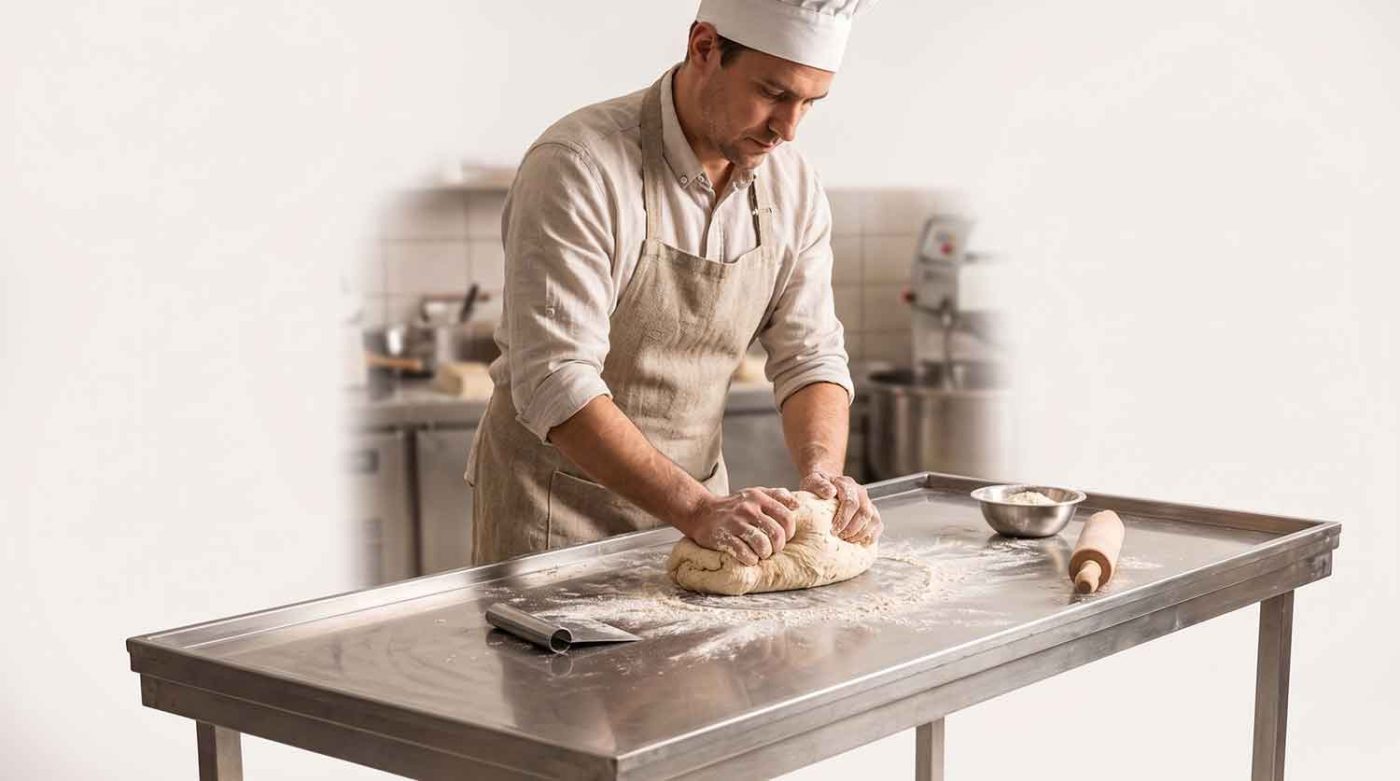
When designing or upgrading an industrial bakery, the spotlight almost always falls on the massive, high-ticket machinery. Bakeries spend weeks analyzing the heating profiles of rack ovens, calculating the precise shear forces of industrial spiral mixers, and mapping out the automated proofing chambers. Yet, in our decades of experience setting up large-scale commercial baking lines, we have witnessed entire production workflows grind to a frustrating halt due to a single, frequently overlooked piece of equipment: the industrial dough kneading and makeup table. It is the literal and metaphorical workspace where recipes turn into reality, where raw dough undergoes its final structural transformations, and where your bakers spend the majority of their physical working hours.
Imagine a bustling bakery floor in Mashhad during the pre-dawn rush. The automated mixers have perfectly hydrated hundreds of kilograms of high-quality flour, and the dough has undergone its initial bulk fermentation. But as the dividing and shaping team begins their shift, they find themselves working on a table that flexes under pressure, harbors microscopic dough residue in its unpolished seams, and stands at an uncomfortable height that causes lower-back strain within the first two hours. The result is a noticeable drop in shaping consistency, an increase in sanitation cycle times, and an exhausted, demotivated kitchen crew. This guide is built to ensure your bakery avoids these hidden bottlenecks by helping you choose a workspace engineered for ultimate durability, maximum hygiene, and peak ergonomic efficiency.
“A bakery’s throughput is only as fast as its slowest manual touchpoint. While a state-of-the-art mixer can prepare dough in minutes, it is the design, layout, and build quality of the kneading table that dictates how quickly and consistently that dough can be shaped, portioned, and moved to the proofing racks.” — MBICO Engineering Division
By the end of this guide, you will not only understand Choosing the Right Industrial Dough Kneading Table: A Buyer’s Guide, but also learn how to apply it effectively in your baking process.
The structural foundation of your bakery starts with the dough table
An industrial dough table is far more than a simple metal sheet resting on four legs. In a professional baking environment, this table functions as a heavy-duty mechanical interface. Every time a baker throws down a twenty-kilogram batch of sourdough, uses a metal scraper to clean the surface, or applies downward force to hand-knead and round dough portions, the table absorbs significant kinetic energy. If the table lacks structural rigidity, this energy dissipates through vibrations, wobbling, and structural flexing.
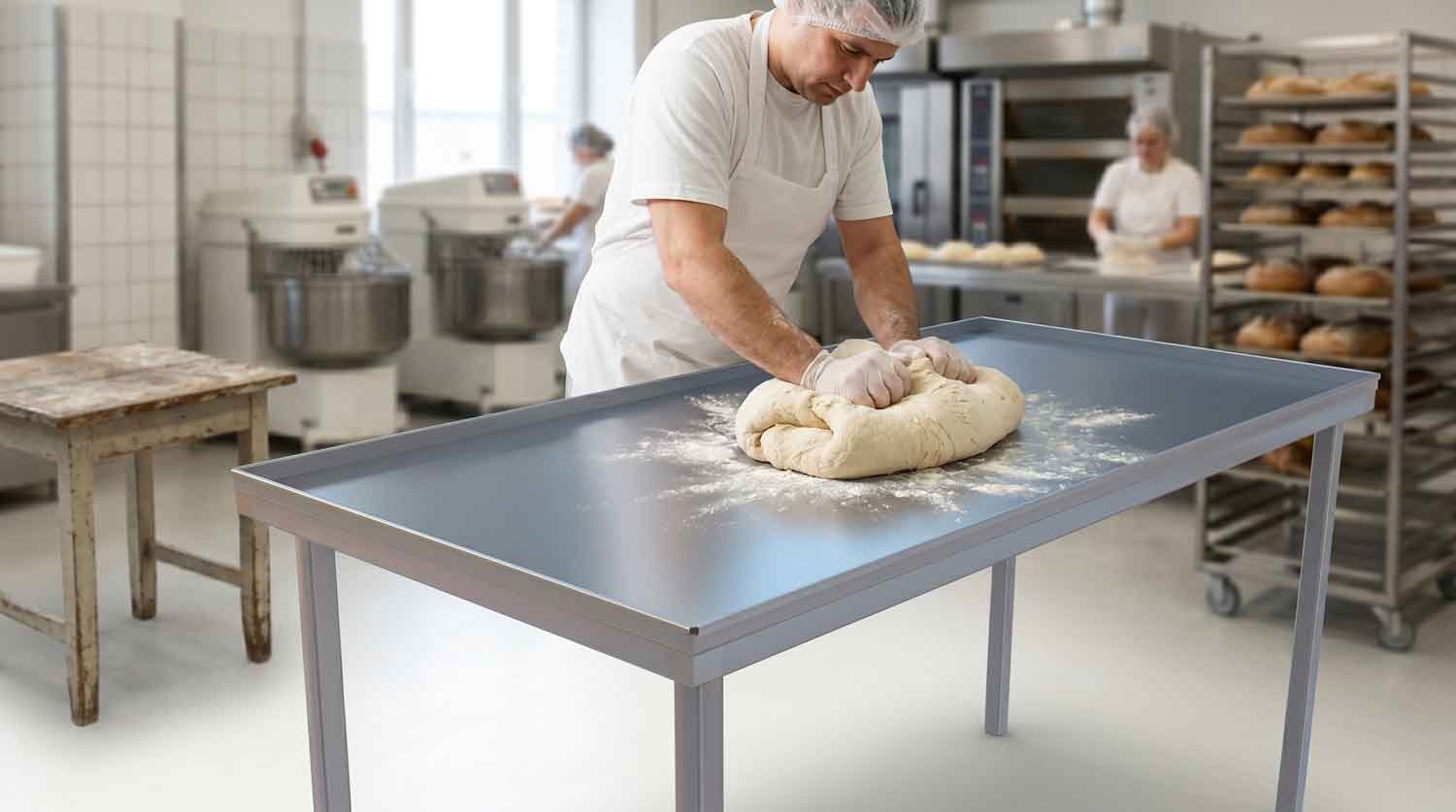
According to MBICO’s internal baking chamber and production floor trials, structural vibration in prep tables does more than just annoy your staff. It actually contributes to rapid baker fatigue and can even subtly impact the dough itself. When a table wobbles or vibrates, the baker must subconsciously exert extra muscular force to stabilize their own body and control the dough. Over an eight-hour shift, this leads to micro-strain in the wrists, shoulders, and lower back, dramatically reducing manual shaping speed and precision. Furthermore, a vibrating surface makes it difficult to use precise tabletop portioning scales, leading to weight variations in your loaves and buns.
The science of kinetic force dissipation in dough handling
To understand why rigidity matters, we must look at the physics of manual dough manipulation. When a baker kneads, they apply both vertical and lateral forces. High-hydration doughs, such as those used for traditional rustic sourdoughs or local premium flatbreads like Barbari, require vigorous slapping and folding techniques to build gluten strength. This action puts a high-impact load on the table surface. A high-quality industrial table must be engineered to transfer these forces down through its legs directly to the floor, without any lateral sway. This is achieved through heavy-gauge stainless steel tops reinforced with internal structural channels, robust leg gussets, and solid, adjustable feet that can be bolted or leveled perfectly on uneven tiled bakery floors.
Selecting the right grade of stainless steel is critical for hygiene and longevity
Not all stainless steel is created equal, and choosing the wrong alloy for your dough table can lead to premature surface pitting, corrosion, and catastrophic health inspection failures. In the industrial food service sector, the two most common grades of stainless steel used for worktables are AISI 304 and AISI 430. Understanding the metallurgical differences between these two materials is the single most important step in protecting your long-term capital investment.
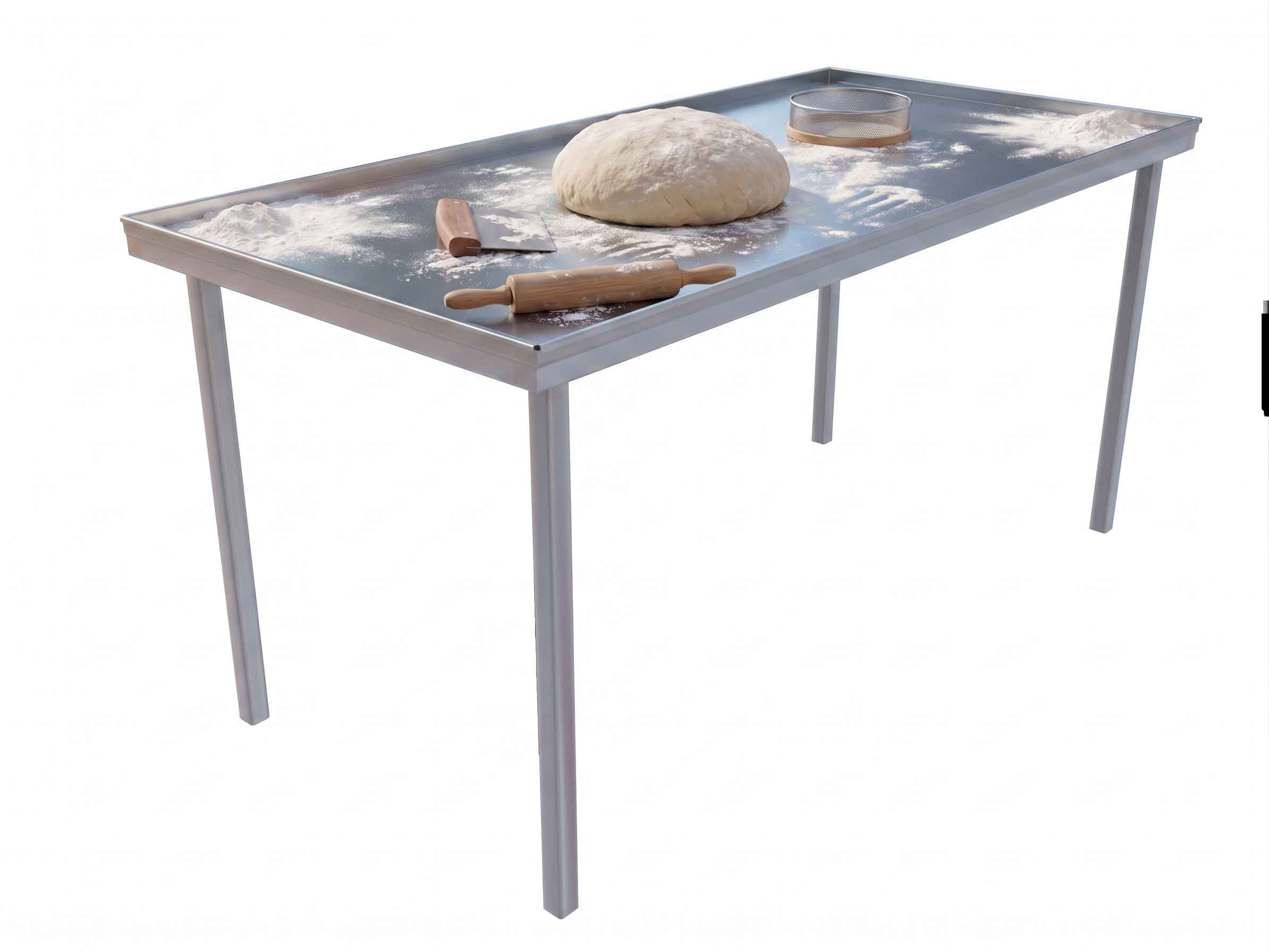
Understanding the metallurgical differences between AISI 304 and AISI 430
The primary differentiator between these two steel grades lies in their chemical composition, specifically the presence of nickel. AISI 304 stainless steel is an austenitic alloy containing approximately 18% chromium and 8% nickel. The inclusion of nickel alters the crystalline structure of the steel, making it highly resistant to organic acids, moisture, and chlorine-based sanitizing agents. It is non-magnetic and highly ductile, allowing for seamless welds and polished finishes that prevent yeast, mold, and bacteria from finding micro-crevices to colonize.
In contrast, AISI 430 is a ferritic stainless steel that contains chromium but no nickel. While it is more affordable and magnetic, it has significantly lower resistance to corrosion. In a high-humidity bakery environment—where yeast is constantly active, water is frequently sprayed, and acidic sanitizers are used daily—an AISI 430 table will eventually develop micro-rust spots (pitting) along the seams, welds, and under-shelves. Once pitting begins, the table becomes impossible to truly sanitize, posing a severe risk of cross-contamination.
Analyzing the role of surface finish in dough release and sanitation
The roughness of the stainless steel surface, measured as Surface Roughness Average (Ra), directly influences how easily dough releases from the table and how quickly it can be cleaned. A standard brushed finish (often called a No. 4 finish) is the industry standard for food preparation. It provides a smooth surface that minimizes dough adhesion while allowing just enough texture for flour to hold when dusting is required. In our years of experience setting up industrial baking lines, we have found that cheaper, poorly polished steels possess microscopic ridges. These ridges act like tiny hooks, grabbing onto sticky doughs and requiring bakers to use excessive dusting flour, which can dry out the outer skin of the dough and alter the final bake quality.
| Material / Alloy Grade | Chemical Composition (Key Elements) | Corrosion Resistance Level | Best Suited For | Relative Cost & Lifespan |
|---|---|---|---|---|
| AISI 304 Stainless Steel | 18% Chromium, 8% Nickel | Excellent (High resistance to organic acids & sanitizers) | High-humidity zones, direct dough contact, heavy shaping, wash-down areas | Higher initial cost / Exceptionally long lifespan (15+ years) |
| AISI 430 Stainless Steel | 16-18% Chromium, 0% Nickel | Moderate (Prone to pitting in highly humid or acidic environments) | Dry ingredient storage tables, packaging zones, non-contact utility carts | Lower cost / Moderate lifespan (requires dry environment) |
| Premium Maple / Beech Wood | Natural Hardwood Fibers | Low (Requires meticulous oiling and dry scraping) | Traditional artisan bakery shops, manual rolling, pastry lamination | Moderate to high cost / Medium lifespan (requires resurfacing) |
Ergonomic table design prevents baker fatigue and increases daily output
One of the most common challenges our customers face is maintaining consistent worker productivity during long, demanding shifts. Baking is a physically intense profession. The repetitive motions of portioning, rolling, and shaping dough put immense strain on the musculoskeletal system. If your dough table is even a few centimeters too high or too low, your bakers will compensate by hunching their shoulders or bending their wrists at unnatural angles. This leads to Repetitive Strain Injuries (RSI), increased absenteeism, and a noticeable slowdown in production as the shift progresses.
Calculating the optimal working height for manual dough shaping
There is no single “perfect” height for an industrial dough table because different baking tasks require different physical leverage, and bakers vary in height. For light tasks like portioning with a bench scraper or decorating pastries, a table height close to elbow level (typically 95 to 105 centimeters from the floor) is ideal because it allows for high visual precision and keeps the neck upright. However, for heavy manual kneading and rolling of dense doughs, the baker needs to leverage their upper body weight to press downward. For these heavy-duty kneading tasks, the table should sit lower, around 85 to 90 centimeters, allowing the baker to keep their elbows slightly bent and use their core muscles rather than relying solely on arm strength.
At MBICO, we highly recommend integrating adjustable-height legs or utilizing custom-fabricated tables that match the average height of your primary shaping team. A simple investment in adjustable bullet feet can yield up to a 5-centimeter range of movement, which is often enough to transition a table from a generic, uncomfortable prep surface into a highly specialized ergonomic workspace.
The importance of edge profiles and corner designs for safety and comfort
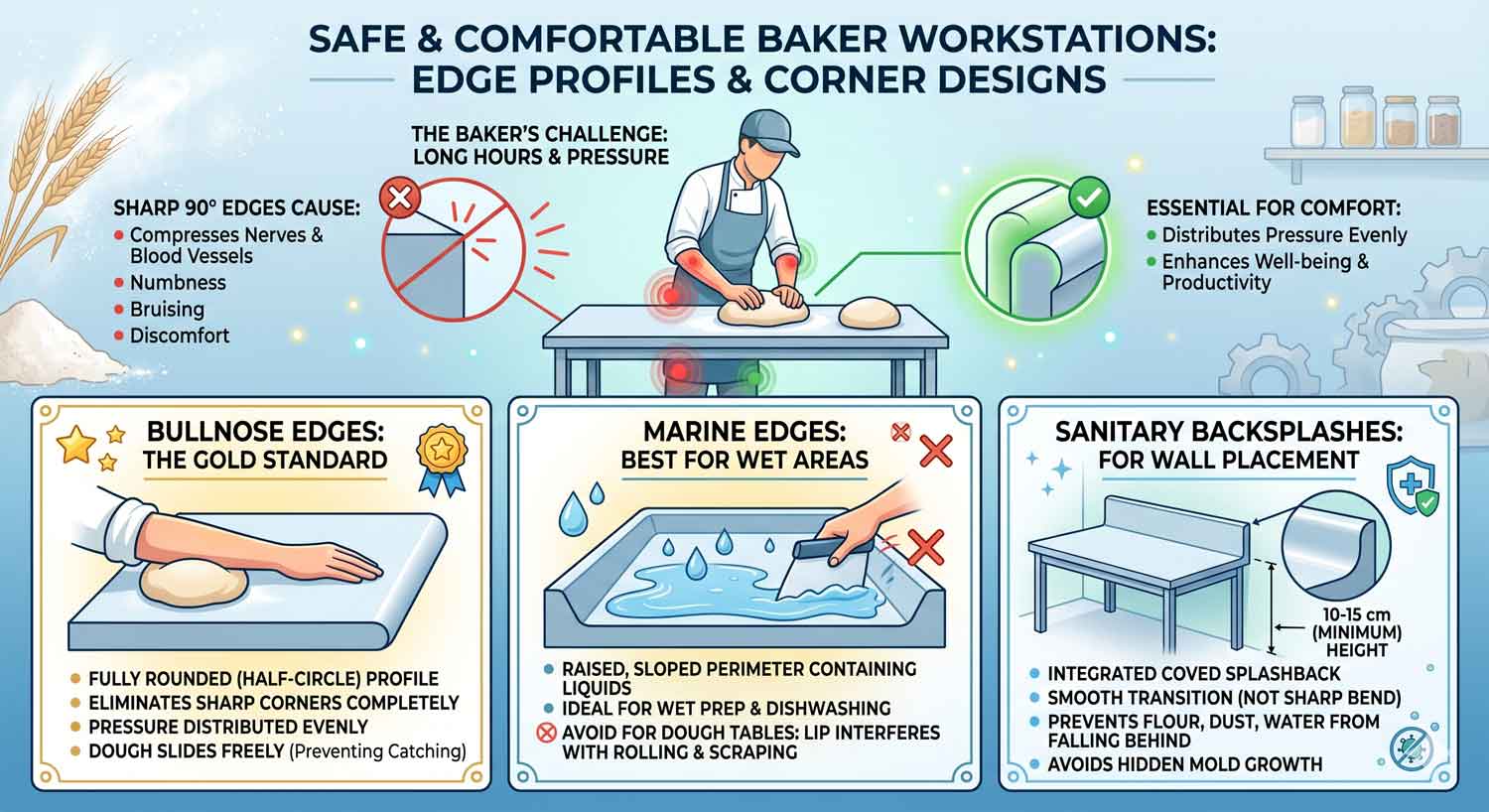
When bakers work at a dough table for hours, they constantly lean their hips, thighs, and forearms against the table’s edges. A sharp, 90-degree square edge will compress blood vessels and nerves, causing numbness, bruising, and discomfort. For this reason, professional dough kneading tables must feature rounded edge profiles.
- Bullnose Edges: This fully rounded edge (resembling a half-circle) is the gold standard for dough prep tables. It eliminates sharp corners entirely, distributing pressure evenly across the baker’s forearms as they lean in to knead. It also prevents the dough from catching on a sharp metal edge during rapid sliding maneuvers.
- Marine Edges: Featuring a raised, sloped perimeter, marine edges are designed to contain liquids. While highly useful for wet prep areas or dishwashing tables, they are generally avoided for dough tables because the raised lip interferes with flat dough rolling and makes thorough scraping of flour residue difficult.
- Sanitary Backsplashes: If your dough table is positioned against a wall, a integrated, coved backsplash (at least 10 to 15 centimeters high) is non-negotiable. The transition between the table surface and the backsplash must be a smooth, coved curve rather than a sharp 90-degree bend. This prevents flour dust, water, and dough scrapings from falling behind the table where mold can grow undetected.
High-load capacity tables endure the relentless force of automated dividers and manual kneading
In an industrial baking environment, a table must be rated for both static loads (such as storing heavy containers of flour or liquid ingredients) and dynamic loads (the forces exerted during kneading, pounding, or the operation of tabletop equipment like manual dough sheeters and heavy-duty scales). To guarantee the table will not bow, warp, or fail over time, you must pay close attention to the sheet metal gauge and the internal reinforcement systems.
Deciphering sheet metal gauges and under-table support structures
In the stainless steel fabrication industry, the thickness of the metal is measured in gauges. Crucially, a lower gauge number indicates a thicker, stronger sheet of steel. For light-duty commercial kitchens, 18-gauge steel (approx. 1.2 mm thick) is common, but it is completely inadequate for industrial dough handling. An 18-gauge table will loudly drum and flex the moment any real pressure is applied to it.
For professional industrial bakeries, we recommend a minimum of 14-gauge (approx. 1.9 mm) or heavy-duty 16-gauge (approx. 1.5 mm) stainless steel for the tabletop. A 14-gauge top provides a solid, rock-hard feel that mimics a heavy wooden butcher block but with all the sanitary advantages of premium stainless steel.
However, even the thickest steel plate requires structural reinforcement underneath to prevent bowing. Look for tables built with welded-in “hat channels.” These are U-shaped steel channels welded to the underside of the table surface running lengthwise. High-quality manufacturers like MBICO fill these channels with polyurethane foam or sound-deadening tape. This serves a dual purpose: it structurally reinforces the table against high weight loads and absorbs sound waves, preventing the annoying, metallic clanging noise that can make a busy bakery floor incredibly loud and stressful for your workforce.
Selecting the right base construction for stability and storage
The design of the table base directly impacts both its structural stability and its utility within your bakery’s daily workflow. You must choose between open-base frames, under-shelf designs, or fully enclosed cabinet systems.
- Open-Base Tables with H-Frames: These tables feature cross-braces running between the legs near the floor, forming an “H” or “U” shape. This design offers maximum legroom for seated bakers and allows you to roll mobile ingredient bins directly underneath the table, keeping flour and sugar within arm’s reach.
- Under-Shelf Tables: Featuring a solid stainless steel shelf positioned about 25 centimeters above the floor, this style provides immense storage space for proofing baskets, baking pans, and hand tools. However, you must ensure the under-shelf is also made of high-grade steel and is fully welded to prevent flour dust from accumulating in screw threads.
- Enclosed Cabinet Tables: For the ultimate in hygiene and organization, enclosed cabinets feature sliding or hinged doors that protect stored items from airborne flour dust. This is highly recommended for storing sensitive electronic scales, custom dough cutters, and clean linen liners.
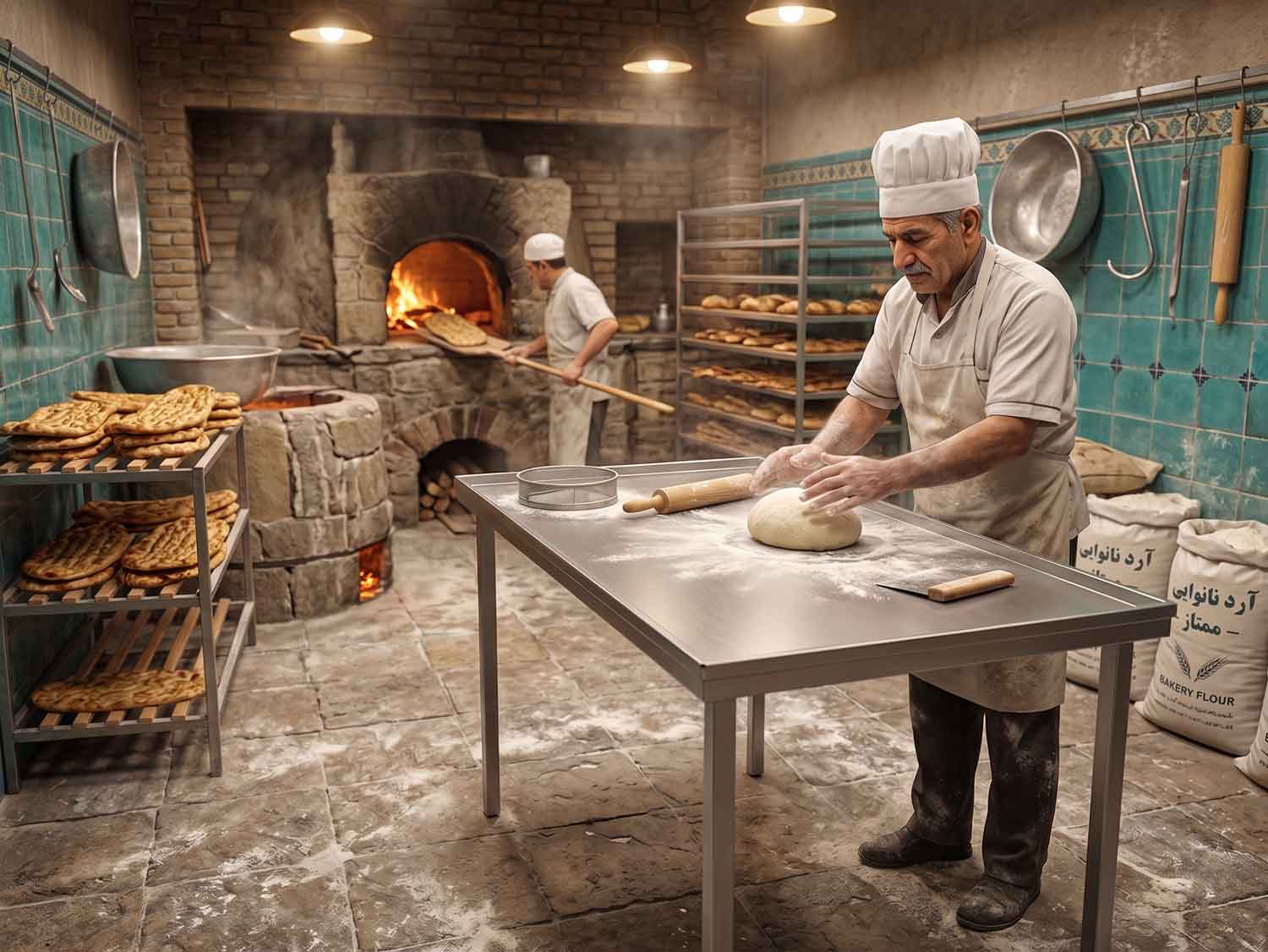
Different dough types require specialized table surfaces and integrated accessories
One of the most exciting aspects of commercial baking is the sheer variety of baked goods produced, from highly hydrated, long-fermented artisanal sourdoughs to dense, laminated pastries and traditional regional flatbreads. Each of these dough types interacts differently with the workspace surface. Therefore, your choice of table must align with the specific physical properties of your product range.
Matching table surface materials to dough hydration and characteristics
If your bakery specializes in classic continental pastries, croissants, and puff pastry, temperature control is your primary concern. Butter-rich doughs must remain cold during rolling and lamination to prevent the fat from melting into the flour layers. For these applications, a traditional stainless steel table can sometimes transfer ambient room heat too quickly. Many premium pastry kitchens prefer tables fitted with thick, polished marble or granite slabs, which naturally retain a cool surface temperature and resist sticking.
On the other hand, traditional artisan bread bakers often prefer high-quality, oil-treated hardwood worktops (such as rock maple or beech). Wood is naturally porous; it absorbs a tiny amount of moisture from the outer layer of the dough, helping to create a delicate tension that is highly beneficial when hand-rounding boules and batards. However, wood requires intense maintenance, including daily scraping and food-grade oil treatments to prevent drying and cracking. For high-volume industrial operations, a finely polished AISI 304 stainless steel table remains the gold standard for its absolute hygiene, wash-down compatibility, and indestructible nature.
Customizing your table with integrated flour troughs and waste chutes
To maximize efficiency, a dough kneading table should function as a complete workstation. In our years of analyzing workflow optimization, we have seen bakeries save dozens of labor hours per week simply by choosing tables with integrated, smart accessories.
- Integrated Flour Troughs: Rather than having bakers constantly reach for external flour bins, high-efficiency tables feature built-in, recessed flour wells or small, slidable troughs filled with dusting flour. This keeps the workspace clean and keeps the baker’s focus entirely on the dough.
- Waste and Scraping Chutes: As bakers shape dough, they naturally generate small off-cuts, dried skin, and excess flour dust. A table designed with a flush-mounted waste chute allows the baker to quickly scrape debris directly into a trash bin positioned under the table, eliminating the need to stop and carry waste across the room.
- Integrated Scale Platforms: A recessed platform that holds a digital portioning scale level with the tabletop surface allows bakers to slide dough pieces onto the scale rather than lifting them. This seemingly minor feature dramatically reduces wrist strain and accelerates the portioning process.
Seamless workflow integration connects your kneading table with mixers and ovens
When selecting your industrial dough table, you must look beyond the table itself and consider how it integrates into the physical flow of your bakery. A common mistake is treating the table as an isolated island. In reality, it is a vital bridge connecting your mixing zone, your proofing cabinets, and your baking ovens.
Optimizing floor space and layout patterns for peak efficiency
In a lean industrial bakery layout, the movement of ingredients and staff should follow a logical, non-overlapping path. The dough table should be positioned so that once dough is discharged from your commercial spiral mixer, it can be easily transferred to the table with minimal lifting or rolling distance.
If your bakery operates a linear production line, your tables should be arranged in a continuous row parallel to the flow of product. For artisan bakeries where multiple bakers work on a single batch, a large, central “island” table allows for collaborative working, where one team member portions, another shapes, and a third transfers the shaped loaves directly onto proofing trays. Always ensure there is a minimum clearance of 1.2 to 1.5 meters around the table to allow staff pushing heavy rack trolleys to pass safely without disrupting the shaping team.
Mobility vs. permanent stability in heavy-duty production lines
Should your dough table be permanently fixed to the floor, or should it roll on wheels? This is a crucial operational decision. Fixed tables with adjustable bullet feet offer the absolute highest levels of stability and load-bearing capacity. They are perfect for heavy manual kneading stations where lateral forces are extreme.
However, modern industrial bakeries prioritize flexibility. Choosing tables fitted with heavy-duty, locking polyurethane casters allows you to reconfigure your baking floor as your product mix changes. For example, you can roll the dough tables together to create a massive assembly line for holiday specials, and then separate them later for daily sanitation. If you choose mobile tables, ensure the casters are industrial grade, feature double-locking brakes (which lock both the wheel rotation and the swivel mechanism), and are rated to handle at least twice the expected weight of the table and ingredients combined.
Conclusion
Investing in the right industrial dough kneading table is not merely a purchase of steel and legs; it is a foundational decision that directly impacts your bakery’s daily hygiene, operational efficiency, product consistency, and workforce morale. By selecting high-grade, non-corrosive AISI 304 stainless steel, prioritizing ergonomic bullnose edges and proper working heights, and ensuring a robust 14-gauge structural build with sound-dampening reinforcements, you transform a simple prep surface into a high-performance culinary tool. At MBICO, we understand that every bakery has a unique story, a distinct product line, and specific layout requirements. Do not let a poorly designed workspace limit your growth. Contact MBICO’s industrial layout and equipment design team today to custom-tailor the perfect stainless steel workstations for your facility, and take the first step toward a more efficient, ergonomic, and profitable baking operation.
Frequently Asked Questions about Choosing the Right Industrial Dough Kneading Table: A Buyer’s Guide
Why should I choose AISI 304 stainless steel over AISI 430 for a dough table?
AISI 304 contains nickel, which makes it highly resistant to corrosion, rust, and the harsh chemical sanitizers used daily in commercial kitchens. AISI 430 does not contain nickel; while cheaper, it is highly prone to micro-rusting and pitting in humid bakery environments, which can harbor dangerous bacteria and lead to health inspection failures.
What is the ideal sheet metal gauge thickness for a heavy-duty kneading table?
For professional and industrial baking environments, a 14-gauge (approx. 1.9 mm) or at least a 16-gauge (approx. 1.5 mm) stainless steel top is highly recommended. Thicker steel prevents the table surface from flexing, bowing, or making loud metallic noises when bakers apply heavy force during kneading and portioning.
Can I use a wooden table for kneading and shaping dough in a commercial bakery?
Yes, premium hardwoods like maple or beech are excellent for artisan bakeries because they naturally absorb excess moisture, helping build tension in the dough skin. However, wood requires intensive maintenance, daily manual scraping, and periodic oiling. It is also not suitable for high-humidity wash-down zones where stainless steel remains the sanitary standard.
How does table height affect my bakery’s overall production output?
If a table is too high or too low, bakers must bend or strain their wrists, shoulders, and backs to work. This rapid physical fatigue slows down their shaping speed as the shift progresses. Choosing an ergonomic height (typically 85-90 cm for heavy kneading and 95-105 cm for light portioning or pastry work) keeps workers comfortable, consistent, and highly productive.
Explore MBICO's categories
Bakery equipment
13 Products
bulk and semi-bulk bread baking ovens
3 Products
Bulk Breads Baking equipment
14 Products
Confectionery equipment
7 Products
Mini ovens
3 Products
Pizza and food ovens
4 Products
Baking equipment
25 Products
Bakery oven
5 Products
Tafton baking ovens
3 Products
Barbari baking ovens
4 Products
Sangak bakery ovens
3 Products
Lavash baking ovens
3 Products
Pastry and confectionery ovens
3 Products
Baking ovens
10 Products
Mobile baking machines
4 Products
Explore MBICO's products
Portable Rotary Semi-Automatic Oven for Baking Sangak Bread
Conveyor Pizza Oven
Fixed Rotary Semi-Automatic Oven for Baking Traditional Breads
Pastry Dough Sheeter
Deck Oven
2-Roll Dough Sheeter (2-Roll Tabletop Dough Sheeter)
Rimok Bakery
Dough pouring machine