



Articles
bread Baking equipment list
20
Jun
Jun
The Critical Importance of a Scientifically Aligned Bread Baking Equipment List
Setting up or upgrading a commercial bakery is similar to designing a high-precision chemical processing plant. Every machine, from the initial flour sifter to the final packaging line, plays a direct role in the biological and physical transformation of simple ingredients into premium baked goods. Whether you are scaling an artisanal sourdough micro-bakery or designing a fully automated baking production line, your choice of machinery dictates your bread’s final crumb structure, crust thickness, volume, and shelf life. Selecting mismatched machinery not only compromises product quality but also creates operational bottlenecks that erode profit margins.
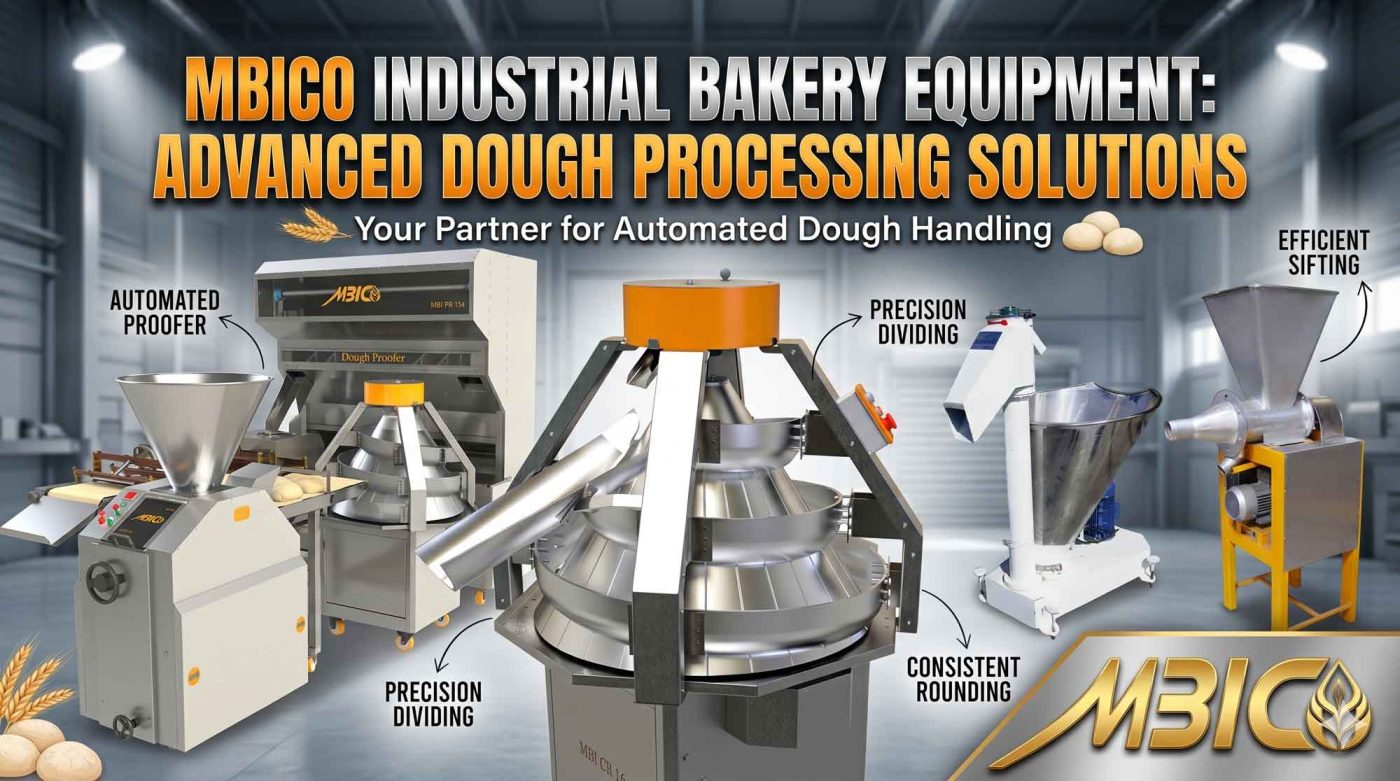
In our years of experience setting up industrial baking lines, we have witnessed how even a minor imbalance in equipment capacity can disrupt the entire workflow. Imagine a high-performance spiral dough mixer delivering perfectly hydrated dough, only to have it sit and over-ferment because your dough divider cannot process it fast enough. This guide bridges the gap between mechanical engineering and baking science, drawing on decades of experience from MBICO Industrial Bakery Systems in Mashhad. We will dissect each piece of equipment through the lens of dough rheology, thermodynamics, and industrial efficiency. By the end of this guide, you will not only understand the complete bread baking equipment list, but also learn how to apply it effectively in your baking process.
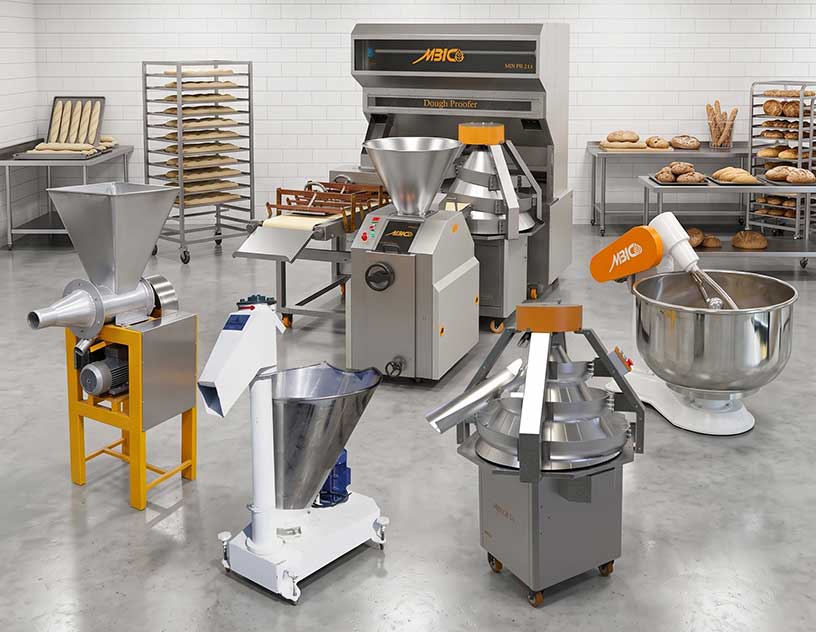
The Foundation of Flour Handling and Dough Mixing Technology
The baking process does not begin when the mixer starts; it begins when dry ingredients are prepared and conditioned. In industrial baking, flour behaves as a dynamic powder that is highly sensitive to compaction, moisture, and temperature. Proper handling before mixing is essential to achieve a homogenous dough matrix. Without uniform raw material preparation, even the most advanced commercial baking ovens cannot compensate for the resulting inconsistencies in the final bread.
The Role of Spiral Dough Mixers in Gluten Developmentfkn
Mixing is the most critical phase of dough development. During this stage, the two primary proteins in wheat flour—glutenin and gliadin—absorb water and align to form disulfide bonds, creating the viscoelastic gluten network. This network acts as a gas-retaining membrane, trapping the carbon dioxide produced by yeast during fermentation.
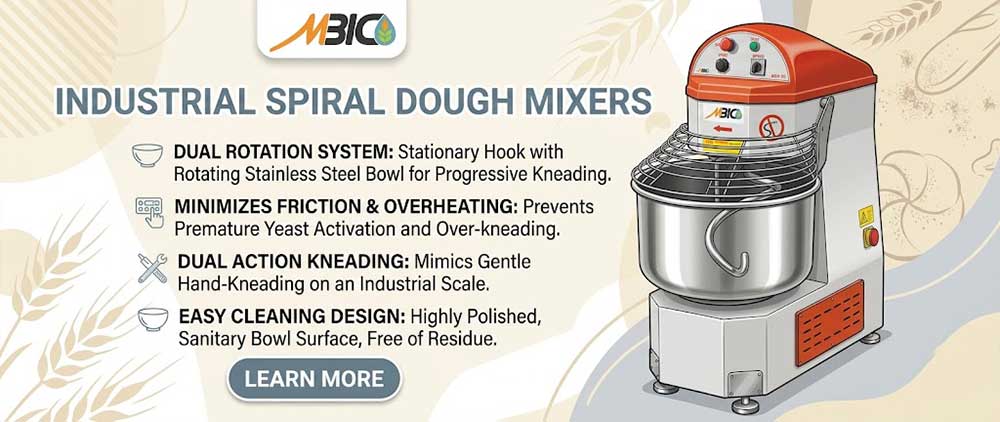
For most bread types, spiral dough mixers are the industry standard. Unlike planetary mixers, which move an agitator through a stationary bowl, a spiral mixer features a rotating bowl while the spiral hook kneads the dough. This dual-rotation system applies gentle, progressive shear forces to the dough. This action mimics hand-kneading on kneading table but operates on an industrial scale, minimizing mechanical friction and preventing the dough from overheating. Keeping the dough within its optimal temperature range (typically 24°C to 26°C) is vital to prevent premature yeast activation and maintain gluten strength.
How Flour Sifters and Water Chillers Support Dough Hydration and Temperature Control
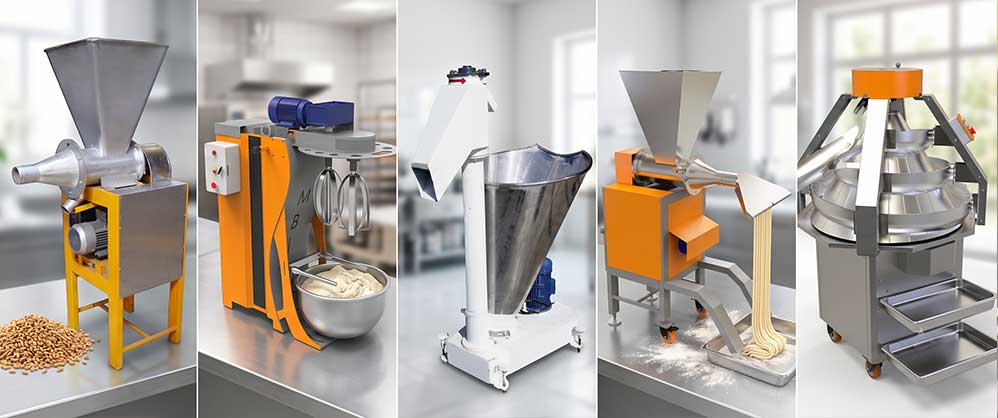
To support the mixing process, two auxiliary machines are critical in any professional bread baking equipment list: flour sifting machines and water chillers.
- Flour Sifting Machines: Industrial flour sifters do more than just remove physical impurities. By passing flour through a vibrating or centrifugal mesh, they aerate the particles, breaking up clumps caused by compaction during transport or silo storage. This increased surface area allows for immediate, uniform water absorption during the first stage of mixing, preventing the formation of dry flour pockets (often called “fish eyes”) in the dough.
- Water Chillers for Baking: Controlling dough temperature is one of the most common challenges our customers face, particularly in regions with hot summers. Because the mechanical action of mixing generates friction heat (known as the mixer’s friction factor), using tap water can easily push the dough temperature past 28°C, leading to wild, uncontrolled fermentation. Industrial water chillers maintain a constant supply of water at 2°C to 4°C, allowing bakers to offset friction heat and precisely control dough hydration and temperature.
“In our years of experience setting up industrial baking lines, we have found that installing a dedicated water chiller is the single most effective way to eliminate seasonal variations in bread volume and texture.”
Comparing Spiral Mixers and Horizontal Mixers for Commercial Production
Choosing the right mixing technology depends on your product range, dough hydration levels, and daily output requirements. While spiral mixers are highly versatile, horizontal mixers are often preferred for specific high-volume, highly standardized products.
| Operational Feature | Spiral Dough Mixers | Horizontal Mixers |
|---|---|---|
| Mechanical Action | Gentle stretching, folding, and kneading via a rotating bowl and hook. | High-shear, aggressive blending using heavy-duty horizontal beaters. |
| Gluten Development | Progressive and gentle, preserving the delicate carotenoid pigments in flour. | Extremely rapid and intense, ideal for high-speed gluten development. |
| Friction Heat Generation | Low to moderate; easily managed with chilled water. | High; typically requires jacketed bowls cooled by glycol or direct ice addition. |
| Best Suited For | Artisanal breads, baguettes, high-hydration sourdoughs, and croissants. | Toast bread, sandwich loaves, hamburger buns, and high-volume, stiff doughs. |
| Batch Size Flexibility | Highly flexible; can efficiently mix batches as small as 10% of maximum capacity. | Requires at least 50% to 60% of maximum capacity to mix effectively. |
In summary, if your bakery focuses on high-quality variety, artisanal hydration, and delicate crumb structures, a spiral mixer from the MBICO industrial systems line is the superior choice. If your goal is high-speed, continuous production of uniform sandwich loaves with minimal ingredient variation, a horizontal mixer may better suit your factory layout.
The Mechanics of Dough Makeup Systems and Portioning Efficiency
Once the dough is fully developed and has undergone its initial bulk fermentation, it must be portioned and shaped. The transition from a single mass of dough to individual, precisely weighted pieces is called the dough makeup phase. At this stage, the dough is highly delicate; its gas-cell structure is easily damaged by excessive mechanical stress.
How Dough Dividers and Rounders Maintain Crumb Structure
A dough divider must portion dough with high weight accuracy while preserving its gas-retaining properties. There are three primary types of commercial dividers: volumetric, vacuum-assisted, and stress-free (extrusion) dividers.
- Volumetric and Vacuum Dividers: These systems draw dough into a cylinder using suction or a piston, cutting it to a specific volume. While highly accurate and fast, they apply significant pressure to the dough. This pressure can degas highly hydrated doughs. They are best suited for traditional white pan breads and buns with a tight, uniform crumb structure.
- Stress-Free Dividers: These modern systems sheet the dough into a continuous band of uniform thickness and cut it using rotating knives. This method avoids compressing the dough, making it essential for ciabatta, baguettes, and high-hydration sourdoughs where an open, irregular alveoli (gas cell) structure is desired.
Directly following the divider is the dough rounder (usually a conical or belt rounder). The rounder rolls the freshly cut dough piece against a spiral track, forming a smooth, spherical shape. This mechanical rolling action creates a thin, tense outer skin (the gluten cloak) over the dough ball. This skin seals the cut surfaces, prevents carbon dioxide from escaping, and ensures the dough rises uniformly during subsequent proofing and baking.
The Importance of Intermediate Proofing and Shaping in Moulding Machines
Rounding stretches the gluten network, leaving the dough elastic but highly tense. If you try to shape a dough ball immediately after rounding, it will resist deformation, tear, or snap back. To prevent this, the dough must rest in an intermediate proofer.
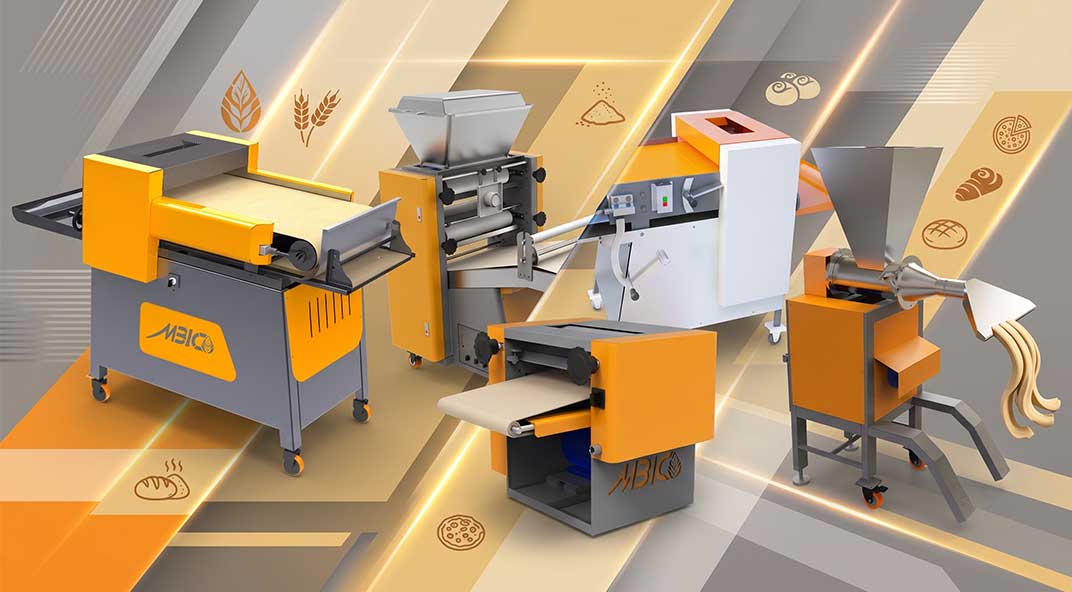
An intermediate proofer is a mechanized cabinet containing moving pockets or trays. The dough balls travel through this temperature-controlled environment for 6 to 15 minutes. This brief rest allows the gluten proteins to relax and recover their extensibility, making the dough pliable enough for the next step: the Dough moulder.
The moulder takes the relaxed dough balls and processes them through a series of adjustable rollers and pressure boards. For sandwich loaves, the moulder sheets the dough into a flat disc, rolls it into a tight cylinder, and seals the seam. For baguettes, specialized multi-roller moulders progressively elongate the dough without tearing the delicate gluten skin. Proper moulding is crucial; if the roll is too loose, the baked bread will have large, uneven voids at the top; if it is too tight, the dough will tear during the final proof.
The Thermodynamic Science of Modern Proofer Chambers
After shaping, the dough pieces are placed into their final baking pans or onto loading peels and moved to the proofer chamber. This stage is where biology takes over. The primary goal of a proofer is to provide the optimal microclimate for yeast activity, allowing the dough to reach its final volume before entering the oven.
Yeast (Saccharomyces cerevisiae) is highly sensitive to its environmental conditions. The optimal temperature for commercial yeast fermentation ranges from 35°C to 38°C, while the relative humidity (RH) must be maintained between 80% and 85%. Maintaining these conditions requires a sophisticated control system.
“According to MBICO’s internal baking chamber trials, keeping relative humidity precisely at 82% prevents the formation of a dry skin on the dough surface, allowing the loaf to expand to its maximum potential during the initial oven spring.”
If the humidity drops too low, moisture quickly evaporates from the dough’s surface, creating a dry, inelastic skin. This skin resists expansion in the oven, leading to misshapen loaves and unsightly crust tears. Conversely, if the humidity is too high, condensation forms on the dough. This condenses surface sugars, resulting in a rubbery crust, excessive spotting, and a leathery texture after baking. Advanced proofer chambers use ultrasonic humidifiers and integrated air circulation systems to distribute heat and humidity evenly throughout the chamber, ensuring every loaf proofs at the exact same rate.
Commercial Baking Ovens and the Mechanisms of Heat Transfer
The baking oven is the heart of any bakery. It is where the complex physical, chemical, and biological changes of baking occur. When dough enters the oven, it undergoes three distinct phases: oven spring, starch gelatinization/protein denaturation, and crust coloration via the Maillard reaction and caramelization.
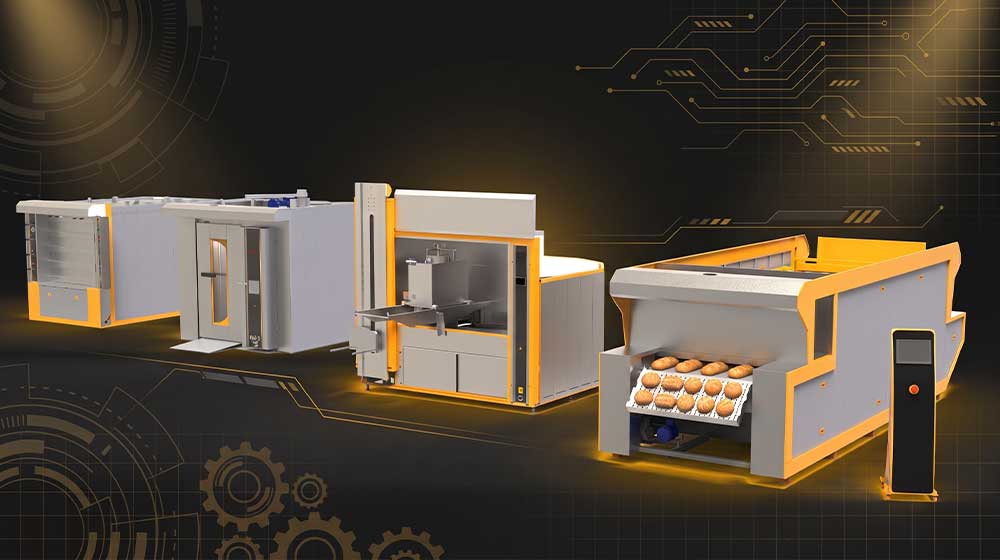
Comparing Deck Ovens and Rotary Rack Ovens for Diverse Bread Types
The choice of commercial baking oven depends on your product mix. The two primary designs used in modern bakeries are deck ovens and rack ovens, each utilizing different primary heat transfer mechanisms.
| Oven Type | Primary Heat Transfer Mechanism | Crust and Crumb Characteristics | Best Applications |
|---|---|---|---|
| Deck Ovens | Conduction (direct contact with ceramic or stone soles) and Radiation (infrared heat from top and bottom elements). | Thick, crisp bottom crust; open, airy crumb structure; excellent volume expansion. | Artisanal hearth breads, sourdoughs, traditional baguettes, and flatbreads. |
| Rotary Rack Ovens | Convection (forced circulation of hot air through a rotating rack of trays). | Thin, uniform crust; consistent crumb density; even color across all trays. | Sweet buns, sandwich loaves, pastry, croissants, and high-volume pan breads. |
Deck ovens excel at baking rustic, high-hydration breads. The intense conductive heat from the stone sole instantly vaporizes moisture at the base of the dough, creating a rapid upward surge of steam that maximizes “oven spring.” Rotary rack ovens, on the other hand, offer exceptional capacity and labor efficiency. The entire rack of dough is rolled directly into the baking chamber and rotates during the bake cycle, ensuring uniform exposure to the heated airflow.
The Role of Steam Injection in Crust and Crumb Development
Regardless of whether you use a deck oven or a rack oven, high-quality steam injection is essential for bread baking. When raw dough enters the hot baking chamber, a burst of low-pressure steam must be injected immediately.
This steam condenses on the cold dough surface, releasing latent heat. This condensation keeps the outer skin of the dough moist and flexible during the first few minutes of baking, allowing the loaf to expand fully without tearing. Furthermore, the moisture dissolves surface starches, turning them into a thin, liquid paste. As the bake continues and the surface temperature rises past 100°C, this starch paste dries out and gelatinizes, forming a thin, glassy, and exceptionally crispy crust. Without steam, bread crusts will be dull, thick, leathery, and pale.
Post-Bake Handling and Packaging Equipment
The baking process does not end when the bread leaves the oven. In fact, post-bake cooling and handling are just as critical to food safety, shelf life, and slice quality as the baking stage itself.
How Proper Cooling Systems Prevent Bread Spoilage
Freshly baked bread leaves the oven with an internal temperature of around 95°C to 98°C and a high moisture content. As the bread cools, moisture migrates from the hot crumb (interior) to the dry crust (exterior), while the starch molecules begin to realign and crystallize—a process known as starch retrogradation.
Bread must be cooled to an internal temperature of 30°C to 35°C before it can be sliced or packaged. If bread is packaged while still warm, the escaping moisture will condense on the inside of the plastic wrapping. This liquid water creates the perfect environment for mold spores to grow, drastically reducing the product’s shelf life. In industrial facilities, automated cooling spirals or clean-room cooling conveyors are used to lower the bread’s temperature under controlled humidity conditions, protecting it from airborne contaminants.
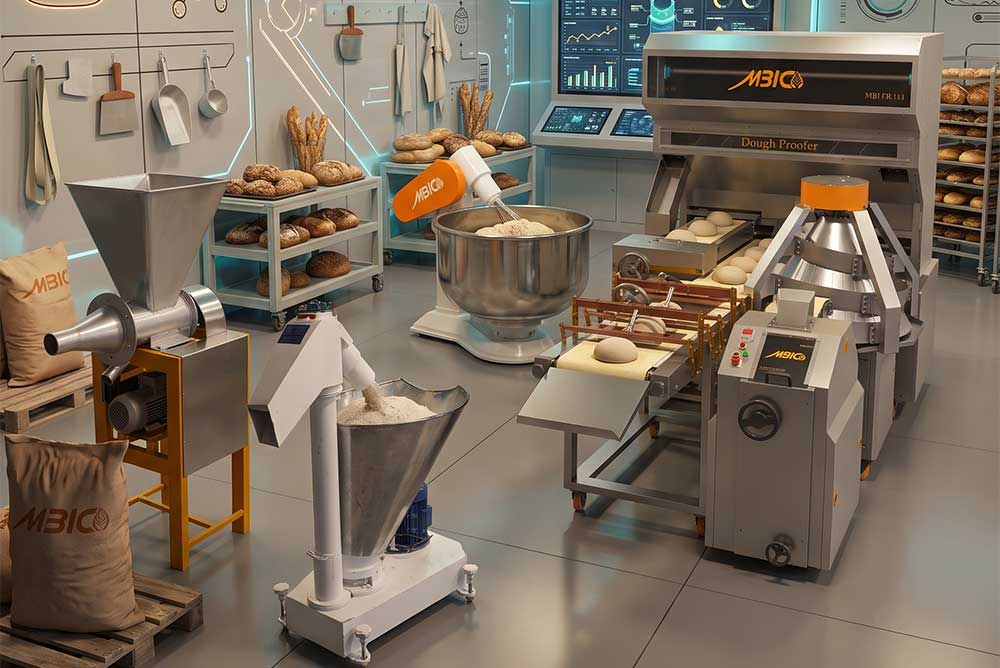
Selecting Commercial Bread Slicers and Packaging Lines
Once cooled, sandwich loaves and specialty breads are sent to the slicing and packaging line. Slicing warm or poorly cooled bread can cause the crumb to tear and compress, ruining the loaf’s internal structure.
- Reciprocating Blade Slicers: These machines use a series of high-speed, vertically oscillating blades to slice through loaves quickly. They are ideal for standard toast and sandwich breads.
- Band Slicers: For high-volume industrial lines, continuous band slicers are preferred. These systems use endless, rotating loop blades mounted on drums, providing exceptionally clean cuts and high throughput with minimal maintenance.
- Automated Packaging Lines: The sliced bread is immediately guided into a bagger and sealed using quick-twist ties, clips, or heat-seal bands. Modern packaging lines often inject a food-grade gas mixture (modified atmosphere packaging or MAP) to displace oxygen, further extending the bread’s mold-free shelf life.
A Step-by-Step Guide to Designing Your Bread Baking Production Line
Setting up a balanced baking production line requires careful planning, deep technical knowledge, and an understanding of dough rheology. Below is a structured, step-by-step approach to selecting and integrating your bread baking equipment list into a highly efficient workflow.
- Define Your Product Mix and Capacity Targets:Before buying any machinery, detail your daily production goals. Calculate the weight of flour and water required per hour. If you produce 1,000 loaves of 500-gram bread per hour, your line must process 500 kg of dough hourly. This target determines the capacity of your mixer, divider, and oven.
- Match Equipment to Dough Hydration and Rheology:Dough with 80% hydration (like ciabatta) requires stress-free dough dividers and stone-sole deck ovens. Conversely, stiff dough with 50% hydration (like bagels) requires heavy-duty spiral mixers with robust motors and high-pressure volumetric dividers.
- Optimize the Floor Layout for Hygienic and Linear Workflow:Design your layout to prevent cross-contamination and minimize unnecessary dough handling. The workflow must follow a strict linear path: Raw Material Storage → Mixing → Makeup → Proofing → Baking → Cooling → Slicing → Packaging. Avoid layouts where raw flour handling occurs near the cooling or packaging areas.
- Coordinate Utility Requirements and Infrastructure:Ensure your facility has the infrastructure to support your equipment list. Industrial deck and rotary ovens require high-pressure gas lines or heavy-duty three-phase electrical connections. Similarly, water chillers and proofer steam generators require dedicated water filtration systems to prevent scale buildup.
- Conduct Recipe Calibration and Pilot Runs:Once the machinery is installed, run test batches using your exact flour and water sources. Calibrate the mixer’s friction factor, adjust the divider’s stroke pressure to prevent tearing, tune the proofer’s relative humidity, and program the oven’s steam injection duration. Fine-tune these settings until you achieve a consistent product that meets your standards.
Why MBICO Industrial Systems Represent the Pinnacle of Baking Engineering
At MBICO, we believe that bakery machinery should be more than just stainless steel and motors; it should be an extension of the baker’s craft. Based in the industrial hub of Mashhad, MBICO designs, engineers, and manufactures state-of-the-art baking equipment tailored to the unique demands of global markets. Our systems are built using premium, food-safe materials and advanced thermal insulation to deliver outstanding energy efficiency and long-term reliability.
Our R&D team continuously refines our designs based on feedback from master bakers and process engineers. Whether you need a highly precise water chiller to manage dough temperatures in hot climates, a high-capacity spiral mixer engineered for optimal gluten development, or a custom-designed proofer chamber, MBICO provides end-to-end solutions. We do not just sell machines; we partner with you to design, calibrate, and optimize your entire baking production line, ensuring your bakery delivers consistent, high-quality products day after day.
Frequently Asked Questions about bread Baking equipment list
What is the difference between a spiral mixer and a planetary mixer for bread dough?
A spiral mixer features a rotating bowl while the spiral hook kneads the dough. This dual-rotation system applies gentle, progressive shear forces, making it perfect for developing strong gluten networks in heavy bread doughs without overheating them. A planetary mixer uses a stationary bowl with an agitator that rotates on an offset shaft (like a planet orbiting the sun). While planetary mixers are highly versatile for whipping creams, mixing batters, and handling light cookie doughs, they generate significant friction heat and mechanical stress when used for dense bread doughs, which can easily damage the gluten structure and strain the motor.
Why is steam injection so important in commercial baking ovens?
Steam injection is critical during the first few minutes of the baking process. When steam condenses on the cold dough surface, it releases latent heat, keeping the dough’s outer skin moist and elastic. This flexibility allows the bread to expand fully (the “oven spring”) without premature cracking. Additionally, the moisture gelatinizes the starches on the dough’s surface, creating a thin, glossy, and crispy crust after the moisture evaporates. Without steam, the crust becomes thick, dull, leathery, and pale, and the loaf’s volume is significantly reduced.
How does a water chiller improve the consistency of my dough?
Water chillers maintain water temperatures between 2°C and 4°C, which is essential for controlling the final dough temperature after mixing. The mechanical action of mixing generates friction heat, which raises the dough’s temperature. If the dough gets too warm (above 28°C), the yeast will ferment prematurely and uncontrollably, weakening the gluten network and resulting in inconsistent crumb structures and sour off-flavors. Using chilled water allows you to offset this friction heat, ensuring consistent fermentation rates regardless of seasonal room temperature changes.
Can I use a volumetric dough divider for high-hydration artisanal sourdough?
Generally, traditional volumetric and vacuum-assisted dividers are not recommended for high-hydration artisanal doughs (above 70% hydration) like sourdough or ciabatta. These dividers use tight pistons and high pressure to portion the dough, which collapses the delicate gas pockets (alveoli) created during bulk fermentation, leading to a dense, uniform crumb. For highly hydrated, long-fermented doughs, a “stress-free” or gravity-fed sheeting and cutting divider is the ideal choice, as it portions the dough using gentle cutting rollers without compressing its structure.
Explore MBICO's categories
Bakery equipment
13 Products
bulk and semi-bulk bread baking ovens
3 Products
Bulk Breads Baking equipment
14 Products
Confectionery equipment
7 Products
Mini ovens
3 Products
Pizza and food ovens
4 Products
Baking equipment
25 Products
Bakery oven
5 Products
Tafton baking ovens
3 Products
Barbari baking ovens
4 Products
Sangak bakery ovens
3 Products
Lavash baking ovens
3 Products
Pastry and confectionery ovens
3 Products
Baking ovens
10 Products
Mobile baking machines
4 Products
Explore MBICO's products
Verticsl Dough Bowl Lift
Convection Oven
Bakery & Pastry Trolley
Dough Kneading Table
Fermentation Chamber
Dough Bowl
Deck Oven
Dough Divider Machine