



Articles
The Ultimate Guide to Tunnel Ovens for Industrial Bakeries
06
Jun
Jun
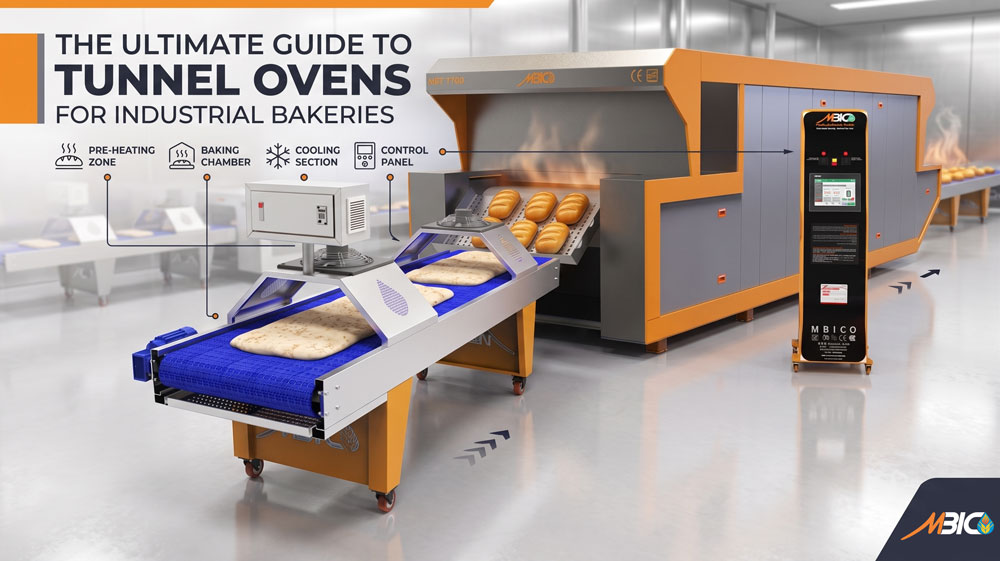
To scale a commercial bakery successfully, you must eventually move past the limitations of batch baking. When production demands grow from a few hundred loaves a day to thousands of units per hour, the continuous tunnel oven becomes the indispensable heart of the production line. A tunnel oven is not merely a larger heating chamber; it is a highly engineered thermodynamic machine designed to apply precise heat profiles to a moving river of dough. By understanding the intricate mechanics of these systems, industrial bakers can achieve unmatched product consistency, reduce energy costs, and maximize their yield.
Imagine standing at the discharge end of a thirty-meter-long continuous baking system. Every single second, perfectly golden, uniformly risen loaves emerge, smelling of rich yeast and caramelized crust. There are no variations between the first loaf and the ten-thousandth loaf of the day. This absolute uniformity is the result of precise heat transfer, controlled moisture, and continuous movement. Achieving this level of baking perfection requires moving away from guesswork and adopting a deep, engineering-focused approach to thermal processing.
By the end of this guide from MBICO, you will not only understand The Ultimate Guide to Tunnel Ovens for Industrial Bakeries, but also learn how to apply it effectively in your baking process.
How heat transfer dynamics shape the crumb and crust in continuous baking
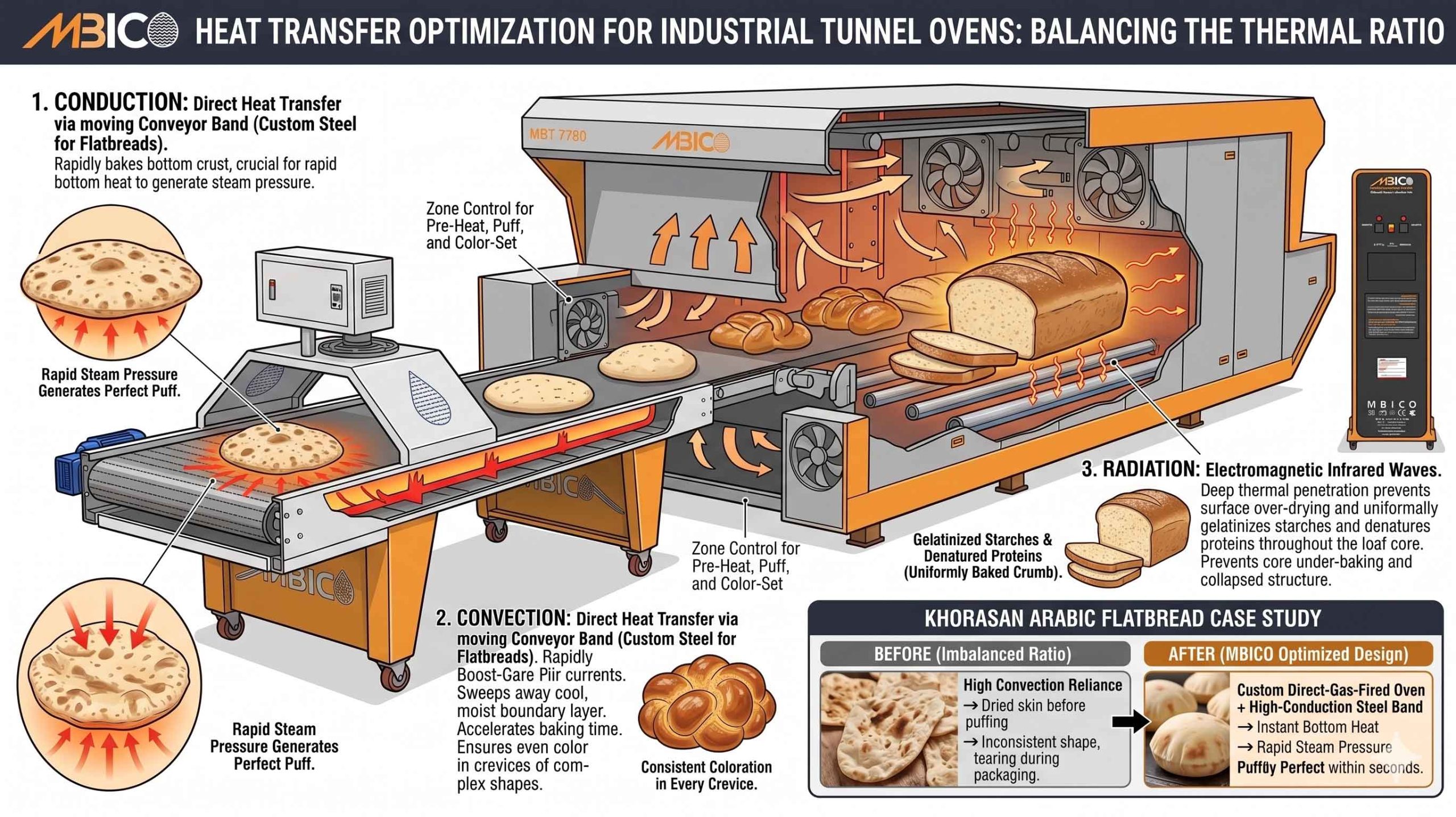
Every baking process relies on three primary modes of heat transfer: conduction, convection, and radiation. In a continuous tunnel oven, these three physical phenomena must be carefully balanced along the entire length of the baking chamber. If any of these modes is out of balance, the dough will either bake too quickly on the outside while remaining raw in the center, or it will dry out completely before achieving a proper oven spring.
Conduction occurs through direct contact between the dough and the moving conveyor belt. If you are using a heavy wire mesh or a solid steel band, thermal energy transfers directly into the bottom of the dough piece. This rapid transfer is vital for flatbreads, pizzas, and pan bread, where a strong bottom crust is required to support the rising structure of the crumb.
Convection involves the movement of hot air currents across the surface of the baking products. By utilizing forced-convection fans, industrial tunnel ovens sweep away the cool, moist boundary layer of air that naturally surrounds cold dough. This accelerated energy transfer speeds up baking times and ensures that complex shapes, such as braided brioche or rustic baguettes, receive even coloration in every crevice.
Radiation is the transfer of heat via electromagnetic infrared waves emitted by the hot interior walls of the oven chamber and burner tubes. Radiation penetrates deep into the dough matrix without drying out the surface prematurely. This deep thermal penetration is essential for gelatinizing starches and denaturing proteins uniformly throughout the loaf, preventing the collapsed structures often caused by under-baking the core.
“During our years of designing industrial baking lines at MBICO, we have learned that the perfect bake is not about maximizing raw heat. It is about balancing the thermal ratio between conduction, convection, and radiation to match the specific hydration level of your dough.”
To illustrate, a large Arabic flatbread bakery in Khorasan recently approached our engineering team. Their bread was puffing inconsistently, and the pockets were tearing during packaging. By analyzing their heat transfer profile, we discovered that their existing oven relied too heavily on convection, which dried out the top skin of the dough before it could puff. We redesigned their line with a custom direct-gas-fired tunnel oven featuring a high-conduction steel band. This modification allowed for instant bottom heat, generating the rapid steam pressure needed to puff the flatbread perfectly within seconds.
Choosing between direct and indirect heating methods determines your product versatility
When selecting a tunnel oven, one of the most fundamental design choices you will face is whether to use a direct-fired system or an indirect-fired system. This decision fundamentally dictates how heat is generated, how combustion gases interact with your products, and how much fuel your facility will consume on a daily basis.
In a direct-fired tunnel oven, burners are mounted directly inside the baking chamber, both above and below the conveyor belt. The combustion gases come into direct contact with the dough. This setup offers incredibly rapid temperature adjustments and high thermal efficiency, making it the preferred choice for products that require high temperatures and short bake times, such as crackers, pita, and various flatbreads.
Conversely, an indirect-fired tunnel oven isolates the combustion process entirely from the baking chamber. Burners fire into a highly durable heat exchanger system, and a system of recirculation tubes channels the clean, heated air through the baking zones. Because no combustion byproducts enter the baking chamber, this system is ideal for delicate pastries, sponge cakes, and gluten-free breads, where combustion chemistry could alter the flavor profiles or delicate structures.
| Operational Feature | Direct-Fired Tunnel Oven (DFO) | Indirect-Fired Tunnel Oven (IFO) |
|---|---|---|
| Heat Source Interaction | Burner flame and combustion gases contact the product directly. | Heat is transferred via closed-circuit heat exchangers. |
| Temperature Response Time | Extremely fast; changes are felt within seconds. | Slower; requires heating up the mass of the heat exchanger. |
| Product Suitability | Crackers, flatbreads, pizzas, and crispy cookies. | Sponge cakes, pan bread, soft buns, and delicate pastries. |
| Fuel Efficiency | Higher thermal efficiency due to zero exchange losses. | Slightly lower efficiency; energy is lost through exhaust stacks. |
| Maintenance Complexity | High; dozens of individual burner nozzles require cleaning. | Low; single central burner with simple ductwork inspection. |
One of the most common challenges our customers face is determining which system matches their expansion plans. A bakery producing only sandwich bread might be tempted by the high efficiency of direct-fired systems, but if they decide to expand into delicate butter croissants or sweet brioche in the future, the sulfur dioxide and moisture byproducts of direct combustion could negatively affect their glazes and crust lamination. Our role as copywriters and food engineers is to guide producers toward the technology that secures their future growth.
Selecting the right conveyor band is critical to heat distribution and product footprint
The conveyor band, or hearth, is the mechanical foundation of any continuous baking system. It is the surface that physically transports your product through the intense environment of the baking chamber. The thermal mass, conductivity, and physical texture of the band directly influence how the bottom of your bread bakes and releases from the conveyor.
There are four main types of conveyor bands utilized in industrial tunnel ovens today, each tailored to distinct baking applications:
- Solid Carbon Steel Bands: These heavy steel belts provide exceptional conductive heat. They are perfectly flat, making them ideal for soft, liquid batters, cookies, and thin crackers. The solid surface prevents dough from dripping and creates a beautifully uniform, flat bottom crust.
- Wire Mesh Bands: Constructed from woven steel wires, these bands are highly breathable. They allow hot air to circulate freely around the entire product, making them perfect for pan bread, buns, and high-volume rolls where uniform convective baking is preferred.
- Stone or Ceramic Tile Hearth Bands: These bands are made of heavy ceramic or natural stone segments mounted on a heavy-duty chain drive. They mimic the thermal profile of a traditional brick deck oven, retaining a massive amount of heat to bake high-hydration rustic sourdoughs, artisanal baguettes, and authentic pizzas.
- Link Grid Belting: A compromise between wire mesh and heavy plates, these grids offer high durability and excellent air circulation, frequently used in heavy tin bread lines where baking pans must travel smoothly without slipping.
In our years of experience setting up industrial baking lines, we have seen that choosing the incorrect band material is a primary cause of premature band fatigue and uneven baking. For instance, putting a high-water-content rye dough directly onto a cold solid steel band will cause the dough to stick, resulting in tearing at the discharge end. Conversely, placing small cookies on a wide-mesh wire band causes them to sag and lose their shape. Understanding these physical interactions is what separates a standard equipment supplier from a true baking partner.
Zoned temperature control and precise steam delivery create the perfect gelatinized crust
Baking is not a single thermal event; it is a sequence of precise physical and chemical changes that happen as the dough heats up. To manage these changes, a high-quality tunnel oven is split into multiple independent temperature zones, typically ranging from three to eight zones depending on the overall length of the oven.
In the first zone, often called the steaming or oven-spring zone, the dough enters a relatively cool environment (around 160°C to 180°C) saturated with low-pressure steam. This steam condensation is critical. When steam hits the cold dough, it condenses into water, releasing latent heat that quickly warms the dough surface without drying it out. This moisture keeps the dough outer skin elastic, allowing the gases inside to expand fully. Without this step, the crust would set too early, causing the loaf to tear open in random, unattractive ways.
In the middle zones, the temperature is increased to around 200°C to 220°C. Here, the yeast is inactivated (thermal death occurs at around 55°C), starches gelatinize, and proteins denature to form the stable crumb structure of the bread. This is where the structural integrity of your loaf is established.
In the final zone, the humidity is kept low, and the temperature is raised to its highest level (often up to 240°C) to promote the Maillard reaction and caramelization. The natural sugars in the dough react with amino acids to produce the deep golden color, rich aromas, and crispy texture that make baked goods irresistible.
Our R&D team at MBICO recently conducted a series of tests on steam distribution systems. We discovered that traditional static steam pipes often create cold spots inside the entry zone, leading to uneven crust shine. To resolve this, we engineered an active steam distribution manifold with adjustable nozzles that ensure every millimeter of the conveyor band receives a uniform blanket of steam. This advancement has allowed our clients to achieve a brilliant, glassy crust on their artisan baguettes without having to use expensive dough conditioners.
Comparing tunnel ovens with rotary and deck systems clarifies your operational scaling needs
Many bakeries reach a crossroads where they must decide whether to purchase multiple rotary ovens, invest in a larger multi-deck oven, or make the leap to a continuous tunnel oven. Making the right decision requires looking beyond the initial purchase price and evaluating long-term labor costs, energy consumption, and product consistency.
Rotary ovens are highly versatile and have a small footprint. They are excellent for bakeries that produce dozens of different product types in small batches throughout the day. However, they require significant manual labor to load and unload racks, and the constant opening of doors leads to substantial heat loss, which increases fuel bills.
Multi-deck ovens excel at baking heavy, artisanal crusty breads, offering exceptional bottom heat. But like rotary ovens, they are batch-based systems that require skilled operators to load and unload loaves using peel boards or manual setters. This limits your throughput and introduces human error into the baking profile.
Tunnel ovens remove the human element from the baking cycle. Once the dough is deposited onto the conveyor, it is baked automatically according to a highly precise, pre-programmed thermal curve. This continuous flow drastically reduces labor costs, saves floor space by removing the need for hundreds of baking racks, and ensures that every single product is baked under identical conditions.
| Oven Category | Throughput Level | Labor Requirements | Energy Efficiency per Kg | Product Uniformity |
|---|---|---|---|---|
| Rotary Rack Oven | Low to Medium (Batch) | High (Manual rack loading) | Moderate (Heat lost during door cycles) | Good (Rotational compensation) |
| Multi-Deck Oven | Medium (Batch) | Very High (Manual peeling needed) | High (Excellent thermal retention) | Very High (Consistent deck contact) |
| Continuous Tunnel Oven | High to Ultra-High | Minimal (Fully automated lines) | Exceptional (Continuous thermal equilibrium) | Absolute (Every loaf follows the same path) |
If your daily production exceeds 5,000 loaves of a single product type, continuing to use rack ovens is likely costing you thousands of dollars in wasted labor and excessive energy consumption. Transitioning to a continuous tunnel oven streamlines your workflow, allowing your baking team to focus on ingredient quality and product development rather than managing heavy racks and oven doors.
Diagnosing and resolving common thermal distribution and conveyor tracking errors
Operating an industrial tunnel oven requires proactive maintenance and a solid understanding of how to troubleshoot common issues. Because these machines run continuously, even a small technical problem can quickly ruin large quantities of dough if it is not resolved right away.
One of the most common issues operators face is uneven baking across the width of the conveyor belt. If the loaves on the left side of the belt emerge perfectly baked while those on the right side are pale and undercooked, you are dealing with a lateral heat imbalance. This is often caused by clogged burner nozzles, unbalanced extraction dampers, or air leaks around the oven inspection doors.
Another common mechanical issue is conveyor belt mistracking. Over time, the heavy steel or wire mesh band can drift to one side, causing it to rub against the internal structural frame of the oven. This can damage the edges of the belt and lead to costly production stops.
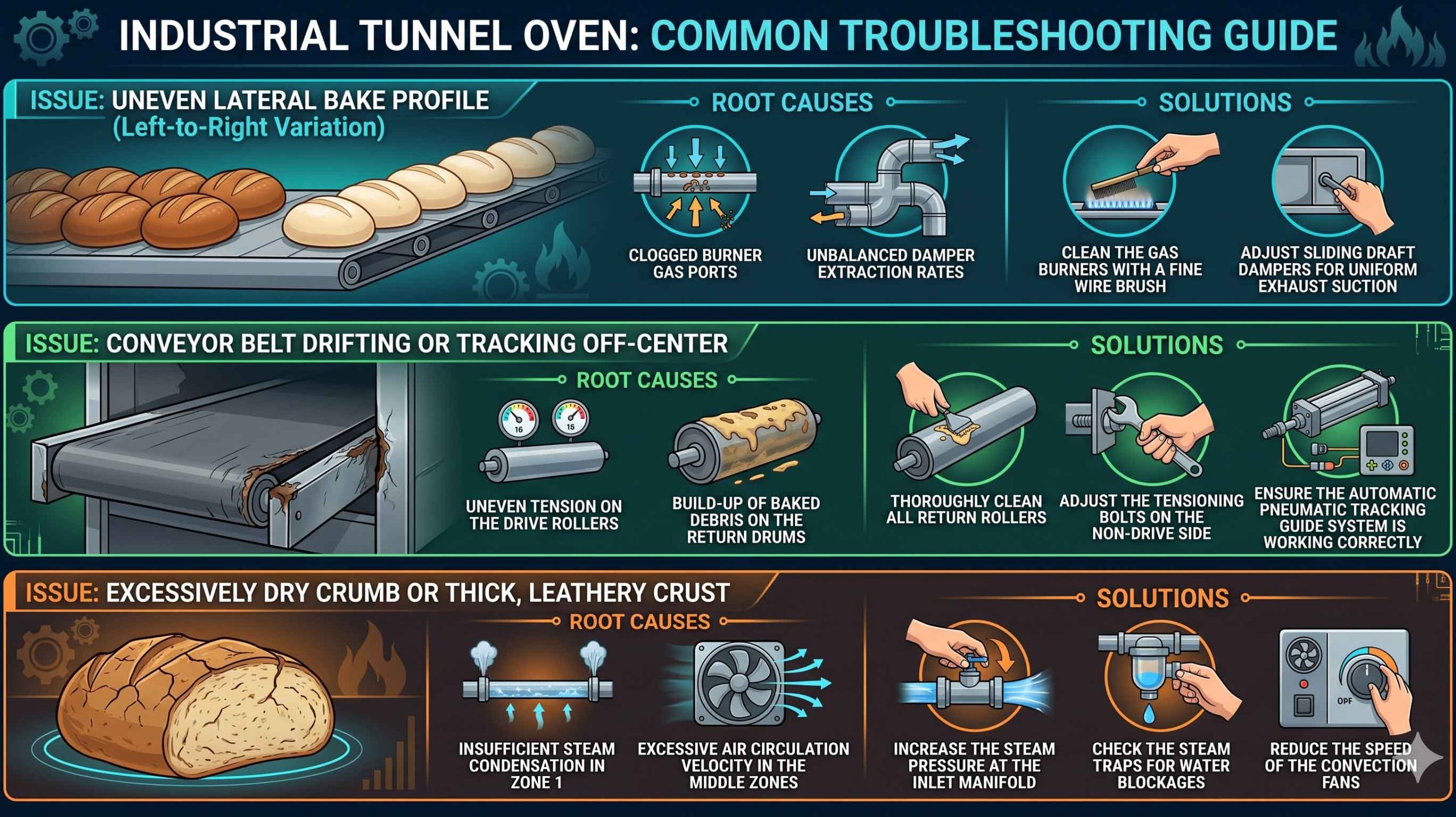
To help your team quickly identify and resolve these issues, we have compiled a straightforward troubleshooting guide based on our field service experiences:
- Issue: Uneven lateral bake profile (left-to-right variation)Root Cause: Clogged burner gas ports or uneven damper extraction rates.
Solution: Clean the gas burners with a fine wire brush, inspect the gas-to-air ratio valves, and adjust the sliding draft dampers until the exhaust suction is uniform across the entire width of the chamber.
- Issue: Conveyor belt drifting or tracking off-centerRoot Cause: Uneven tension on the drive rollers or a build-up of baked debris on the return drums.
Solution: Thoroughly clean all return rollers, adjust the tensioning bolts on the non-drive side, and ensure the automatic pneumatic tracking guide system is working correctly.
- Issue: Excessively dry crumb or thick, leathery crustRoot Cause: Insufficient steam condensation in Zone 1 or excessive air circulation velocity in the middle zones.
Solution: Increase the steam pressure at the inlet manifold, check the steam traps for water blockages, and reduce the speed of the convection fans to prevent moisture from stripping off the dough surface too early.
According to MBICO’s internal baking chamber trials, setting up a weekly maintenance routine that includes cleaning the burners and checking the belt alignment pneumatics can extend the lifespan of your conveyor band by up to 40%. Taking care of your equipment prevents unscheduled downtime and ensures your facility runs smoothly year after year.
Integrating waste heat recovery systems minimizes environmental impact and operating costs
In today’s competitive industrial baking market, managing energy consumption is essential for maintaining healthy profit margins. Tunnel ovens consume a significant amount of natural gas, LPG, or electricity. A substantial portion of this energy is lost through the exhaust stacks as hot air and steam are vented out of the building.
To address this waste, modern industrial tunnel ovens can be equipped with waste heat recovery systems (WHRS). These systems use high-efficiency heat exchangers installed directly inside the exhaust stacks. As hot exhaust gases (often exceeding 280°C) flow out of the oven, the heat exchanger captures this thermal energy and transfers it to a secondary fluid or air loop.
This recovered heat can be utilized in several highly beneficial ways within your bakery facility:
- Preheating Combustion Air: Feeding hot air back into the burners reduces the fuel needed to reach your target baking temperature, saving up to 15% in gas consumption.
- Generating Hot Water: The captured heat can warm the water used for mixing dough or sanitation cycles, reducing the load on your facility’s primary boilers.
- Heating the Proofing Chamber: You can route the recovered thermal energy to the final proofer, eliminating the need for a separate heating system.
During a recent project for a large-scale baking facility in Mashhad, MBICO’s engineering team installed a customized heat recovery loop on a thirty-meter indirect-fired tunnel oven. This system successfully reduced the client’s overall monthly fuel consumption by 22%. By investing in smart, sustainable energy solutions, you protect both your bottom line and the environment, showing your customers that your brand values modern, responsible manufacturing practices.
Achieving industrial baking excellence requires a perfect balance of engineering and baking artistry
Investing in a continuous tunnel oven is a transformative step for any growing bakery. It is a decision that shifts your operation from labor-intensive manual processes to highly efficient, automated food engineering. By understanding the details of heat transfer, choosing the right burner configuration, selecting the ideal conveyor band, and utilizing multi-zone temperature and steam control, you can produce consistently high-quality baked goods on a massive scale. Managing these technical elements correctly ensures that every loaf of bread, pastry, or flatbread that leaves your facility is baked to perfection.
At MBICO, we believe that the best baking systems are built on collaboration, precise engineering, and a deep appreciation for the baker’s art. Our team of experienced food process engineers and technical designers is ready to help you analyze your current production lines, design custom tunnel ovens tailored to your exact recipes, and integrate advanced automation systems that simplify your daily operations. We invite you to contact the MBICO engineering department today to schedule a comprehensive technical consultation and take the first step toward optimizing your industrial bakery production.
Frequently Asked Questions about The Ultimate Guide to Tunnel Ovens for Industrial Bakeries
How long does an industrial tunnel oven typically last under continuous operation?
With a proper maintenance routine, a high-quality industrial tunnel oven has an operational lifespan of 20 to 30 years. The critical mechanical components, such as the conveyor band, burner assemblies, and drive chains, will need periodic servicing or replacement. However, the insulated main oven body and structural frame are designed to withstand decades of continuous thermal cycling without warping or degrading.
Can you bake multiple different products in a single tunnel oven line?
Yes, modern tunnel ovens are highly versatile thanks to advanced PLC control systems. These systems allow operators to save distinct recipes with unique temperature profiles, conveyor belt speeds, and steaming levels. While you cannot bake items with wildly different thermal requirements at the exact same moment, you can easily switch production from sandwich bread to soft buns by adjusting the oven parameters during a short changeover period.
What is the typical energy source used to power industrial tunnel ovens?
Most industrial tunnel ovens are powered by natural gas or liquefied petroleum gas (LPG) due to the high heating value and cost-effectiveness of these fuels. However, in regions where natural gas is less accessible or where electricity rates are favorable, fully electric tunnel ovens are an excellent alternative. Electric systems offer exceptionally clean operation, precise temperature control, and a smaller overall carbon footprint when connected to renewable energy sources.
How do you calculate the required length of a tunnel oven for a bakery?
The length of a tunnel oven is calculated based on your target hourly production output, the weight of each product unit, and the required baking time. The formula is: Oven Length = (Required Hourly Throughput / Product Width-wise Capacity) * (Baking Time in Minutes / 60) * Product Pitch. MBICO’s engineering team performs these calculations for each project to ensure your new oven matches your upstream make-up equipment and downstream cooling systems perfectly.
Explore MBICO's categories
Bakery equipment
13 Products
bulk and semi-bulk bread baking ovens
3 Products
Bulk Breads Baking equipment
14 Products
Confectionery equipment
7 Products
Mini ovens
3 Products
Pizza and food ovens
4 Products
Baking equipment
25 Products
Bakery oven
5 Products
Tafton baking ovens
3 Products
Barbari baking ovens
4 Products
Sangak bakery ovens
3 Products
Lavash baking ovens
3 Products
Pastry and confectionery ovens
3 Products
Baking ovens
10 Products
Mobile baking machines
4 Products
Explore MBICO's products
Conveyor Pizza Oven
Tunnel Baking Oven
Mobile Kitchen Container
Dough Bowl
Dough Rounder
Mobile Bakery Container
Bakery & Pastry Trolley
Dough Proofing Machine