





Articles
Sourdough or no-knead bread? Which is better?
25
Nov
Nov
Sourdough vs. No-Knead: A Head-to-Head Comparison for Home Bakers
For the home baker, the pursuit of truly artisan bread often leads down two distinct, well-trodden paths: the deeply flavorful, biologically complex world of sourdough, and the miraculously simple, high-hydration universe of the no-knead loaf. This decision point—which path offers the best balance of effort, flavor, and nutritional reward—is one of the most common dilemmas we encounter, whether speaking to hobbyists or guiding semi-industrial startups looking for efficient bread processes. While commercial bakeries rely on high-tech mixers and precise temperature controls, the heart of great bread, even on your countertop, remains fermentation and technique. It is easy to assume that because both methods result in a beautiful crusty loaf, the differences are minimal, but nothing could be further from the truth. The choice between sourdough and no-knead dictates everything, from the structure of the gluten network to the final flavor profile and the ultimate digestibility of the bread you pull from your baking oven.
We understand that juggling a busy life while striving for nutritional excellence and flavor depth is challenging. You want the taste of a bakery loaf without the intensive time commitment often associated with professional baking. This head-to-head comparison is designed not just to point out the differences in technique, but to peel back the curtain on the underlying chemistry, empowering you to select the process that aligns best with your goals, whether those goals are maximum flavor, peak efficiency, or superior gut health.
By the end of this guide, you will not only understand Sourdough vs. No-Knead, but also learn how to apply it effectively in your baking process, transforming your approach to homemade bread.
The Core Philosophy of Sourdough and No-Knead Baking
Though both methods celebrate the marriage of flour, water, and salt, their approach to leavening and structuring the dough is fundamentally different. Understanding these core philosophies is the first step toward mastering either technique.
Defining the essence of sourdough: Time and biology
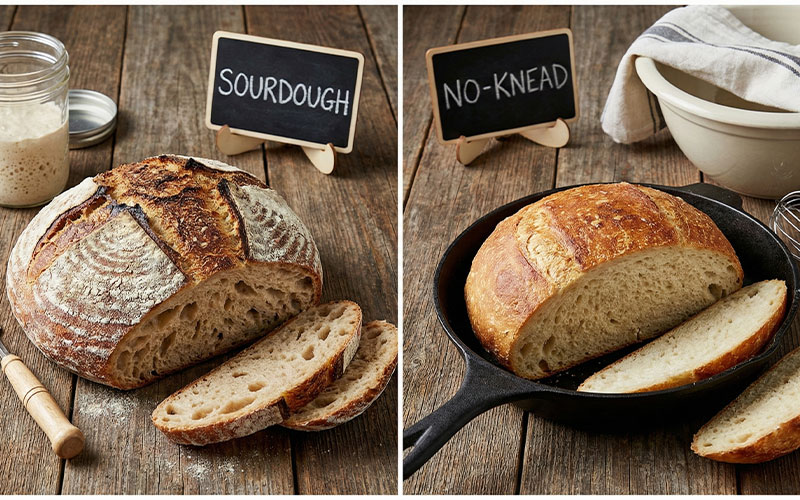
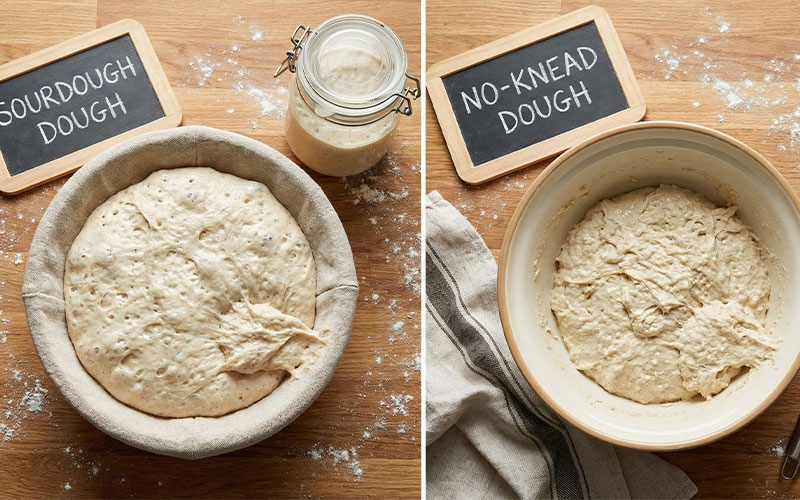
Sourdough is defined by its use of a symbiotic culture of wild yeast and bacteria—specifically Lactobacilli—known as the sourdough starter maintenance. This microbial community is the engine of the loaf, responsible for both leavening (rising) and flavor development. The core philosophy of sourdough is patience and control. By utilizing a natural leavening agent instead of commercial baker’s yeast, the baker subjects the dough to a mandatory long fermentation period.
The crucial scientific insight here is the production of organic acids (lactic and acetic) during this slow fermentation. These acids do far more than just impart the characteristic tangy flavor; they interact with the flour proteins, fundamentally changing how the dough behaves. According to MBICO’s internal baking chamber trials, sourdough doughs exhibit greater stability in the oven due to this acid interaction, leading to better oven spring and a more open, yet sturdy, crumb structure compared to straight yeast breads.
“In our years of experience setting up industrial baking lines, the most demanding process is always sourdough. It requires not just temperature control, but an intimate relationship with the biological activity of the starter. This same dedication applies to the home baker seeking that complex, deep flavor.”
Defining the essence of no-knead: Minimal intervention, maximal hydration
The no-knead method, popularized by Jim Lahey, is the definition of efficiency. Its core philosophy is to substitute mechanical action (kneading) with chemical action (hydration and time). It relies heavily on high hydration levels—often 75% water or more relative to the flour—combined with a small amount of commercial yeast and an extremely long fermentation period, usually 12 to 18 hours at room temperature.
The science behind this is elegant: time allows the water to fully hydrate the flour proteins, and the high moisture content encourages the protein strands to move and align themselves naturally. This process is essentially a slow, gentle form of gluten development without physical manipulation. When the dough is highly hydrated and allowed to rest, enzymes break down starches into simpler sugars, which the yeast consumes, producing gas and creating a network of tiny bubbles. The resulting crumb structure tends to be exceptionally open and irregular, often softer than a traditional sourdough, but lacking the acidic complexity.
Process Analysis A Comparative Look at Technique and Time
While both methods rely on extended rest periods, the nature of the active work required at various stages differs dramatically, impacting the scheduling for the home baker.
The crucial role of starter maintenance in sourdough
The single greatest commitment in sourdough baking is the starter itself. This is a living organism that requires feeding (refreshing) and careful monitoring. Successful sourdough baking starts weeks before the first loaf is baked, requiring daily *starter maintenance*. This routine can be daunting for beginners.
The process of mixing the final dough also requires attention:
- Mixing and Autolyse (Optional but recommended): A brief period where flour and water mix before the starter is added, allowing initial hydration.
- Adding Starter and Salt: Incorporation and initial folding.
- Bulk Fermentation with Folding: Requires 3–5 sets of “stretch and folds” over 3–5 hours to manually build strength and initiate gluten development. This is the active management phase.
- Shaping and Cold Proofing: Typically 12–18 hours in the refrigerator for flavor development and structure setting.
- Baking: Often in a preheated bekery oven for maximum steam and crust development.
The sourdough process demands the baker be present and attentive during the bulk fermentation phase, though the total elapsed time is shorter than the no-knead method’s main rest period.
Why the autolyse technique is key to no-knead success
In contrast, the no-knead method minimizes active intervention, relying on the phenomenon of autolyse, though often the full process is done in a single mix.
The typical no-knead workflow is remarkably simple:
- Initial Mix: Flour, water, yeast, and salt are barely combined—just enough to ensure no dry streaks of flour remain.
- Ambient Fermentation: The dough is left untouched for 12–18 hours at room temperature (around 70°F/21°C). This is the passive development phase.
- Minimal Shaping: The highly sticky dough is lightly folded once or twice, then shaped and proofed briefly (1–2 hours).
- Baking: Always baked hot, usually in a oven to create the necessary steam required to set the high-hydration crust.
The key here is the initial high hydration and the minimal effort required. While the total time elapsed is long, the hands-on time might only be 15 minutes across the entire 18-hour process.
Analyzing bulk fermentation time in both methods
The time dedicated to long fermentation is the defining factor for both flavor and digestibility.
In sourdough, the bulk fermentation (the first rise) is generally shorter (3–6 hours), but the flavor development is deepened by the subsequent cold proofing (12+ hours). The microbial activity is slower and more complex throughout the cold proofing stage.
In the no-knead method, the bulk fermentation *is* the 12–18 hour room temperature rest. This rapid, uncontrolled fermentation leads to quick CO2 production (thanks to the commercial yeast) and a high level of gluten relaxation, resulting in the characteristic soft interior.
One of the most common challenges our customers face is learning to read their dough’s fermentation—especially how temperature affects the timeline. For no-knead, a cold day might require 24 hours, whereas a warm kitchen might be done in 10. Sourdough offers slightly more predictable results if the starter is consistently strong, but requires constant monitoring of the ambient temperature.
Understanding Gluten Development and Crumb Structure
The structural integrity of any great bread—the chew, the height, the gaping holes—comes down to how the gluten network is formed and strengthened.
How kneading differs from long fermentation
Gluten development is the creation of a mesh-like structure formed when the two main proteins in flour, gliadin and glutenin, combine in the presence of water and mechanical force.
In traditional baking (including sourdough’s active folding), this structure is built through physical manipulation—stretching, folding, or kneading. This tightens the network, allowing it to hold gases more efficiently.
In the no-knead method, the physical force is replaced by enzymatic action and time. The water allows the proteins to slowly align themselves without being forcibly tangled. While the resulting gluten structure is adequate for holding gas, it tends to be more extensible (stretchier) and less elastic (snappier) than a well-kneaded sourdough.
This difference explains the typical results: Sourdough often yields a loaf that is chewier and has a more defined structure due to the tension created by folding. No-knead yields a softer, more pillowy loaf with an often dramatic, but weaker, open cell structure.
The unique crumb structure achieved by natural leavening
The crumb structure of a sourdough loaf is significantly influenced by the acidic environment created by the wild culture. Lactic and acetic acids actually tighten and strengthen the gluten network, making it more resilient. This allows the dough to withstand the rigors of shaping and achieve maximum volume in the oven, leading to the sought-after “irregular open crumb.” The strong network can stretch thin without tearing, forming large, defined alveoli (holes).
Conversely, the no-knead loaf achieves an open crumb primarily through high hydration and extended enzymatic activity, rather than acidic strength. The crumb tends to be less uniform, often featuring very large, irregular voids separated by softer walls.
“According to MBICO’s internal baking chamber trials focusing on dough rheology, sourdough consistently shows a higher Resistance to Extension value than high-hydration no-knead doughs fermented with commercial yeast, confirming its greater structural integrity for complex shaping.”
To simplify: Sourdough builds a resilient steel structure; No-knead builds a sturdy concrete structure. Both stand tall, but they handle stress differently.
Health, Nutrition, and Digestibility
For many home bakers, the switch to artisan bread is driven by health consciousness. This is where the sourdough method truly gains a strategic advantage, largely due to the mandatory presence of natural leavening and long fermentation.
Phytic acid breakdown and enhanced digestibility
The superior digestibility of sourdough bread is not anecdotal; it is a proven function of the long, acidic fermentation. Grains, especially whole wheat, contain phytic acid (or phytate), which is an anti-nutrient that binds to minerals (iron, zinc, calcium) in the gut, making them unavailable for absorption.
The unique blend of bacteria and yeast in a sourdough starter produces phytase, an enzyme that effectively breaks down phytic acid during the long, slow, acidic fermentation period.
While the no-knead process also utilizes a long rest, the high proportion of commercial yeast and lack of Lactobacilli means that significantly less phytase is produced. Therefore, mineral bioavailability is generally higher in true sourdough bread. For those prone to gluten sensitivity (not celiac disease), the complex breakdown of gluten proteins during the long fermentation process also aids digestibility, reducing the burden on the digestive system.
Glycemic response differences
Studies indicate that sourdough bread tends to have a lower glycemic index (GI) compared to breads made quickly with commercial yeast. This is again attributed to the organic acids produced by the lactic acid bacteria. These acids, particularly acetic acid, appear to modify the way the body digests starch, leading to a slower release of glucose into the bloodstream.
While a long fermentation no-knead loaf is certainly better than a quick 2-hour yeast bread, the superior acidic environment of sourdough provides a clearer advantage for managing blood sugar response.
Head-to-Head Comparison Table: Sourdough vs. No-Knead
To summarize the operational differences and outcomes, here is a detailed breakdown for quick reference:
| Feature | Sourdough (Natural Leavening) | No-Knead (Commercial Yeast) |
|---|---|---|
| Leavening Agent | Wild Yeast & Lactic Acid Bacteria (Sourdough Starter) | Commercial Baker’s Yeast (Instant or Active Dry) |
| Fermentation Time (Total) | 18–30 hours (3–5 hr bulk + 12–24 hr cold proof) | 14–24 hours (12–18 hr room temp rest + 1–2 hr final proof) |
| Hands-On Time | Moderate (Requires folding, shaping, and starter maintenance) | Minimal (5–15 minutes across the entire process) |
| Gluten Development Method | Folding/Coiling combined with acidic strengthening | Autolysis/Time (High hydration alignment) |
| Flavor Profile | Complex, tangy, acidic, deeply nutty (Dependent on time/temperature) | Mild, yeasty, slightly sweet, clean finish |
| Digestibility/Nutrition | Excellent (Superior phytic acid breakdown, potentially lower GI) | Good (Long fermentation aids starch digestion, but less phytase activity) |
| Crumb Structure | Strong, chewy, defined, irregular open crumb | Soft, pillowy, highly irregular and often cavernous |
| Required Skill Level | Intermediate to Advanced (Need to “read” the starter and the dough) | Beginner (Highly forgiving process) |
MBICO’s Practical Verdict When to Choose Which Method
The ultimate decision rests on your personal baking goals: are you prioritizing efficiency and accessibility, or are you prioritizing flavor complexity and optimal health benefits?
Choosing Sourdough for Flavor Depth and Nutrition
If your primary goal is to maximize flavor complexity, achieve a distinct chewiness, and attain the highest nutritional benefit, sourdough is the undisputed choice. The extended microbial interactions are irreplaceable for producing those deep, sophisticated flavors.
We often advise professional bakers, even those using modern spiral mixers, to slow down their fermentation programs to mimic the effects of natural leavening. This principle holds true at home. Sourdough requires discipline and a commitment to starter maintenance, but the reward is a loaf that surpasses nearly all commercially produced breads.
Choosing No-Knead for Convenience and Consistency
If you are a beginner, have an unpredictable schedule, or simply want reliable, delicious crusty bread with minimal effort, the no-knead method is superior. It is the perfect gateway into high-hydration baking.
One of the greatest benefits of the no-knead approach is its resilience. Since it uses commercial yeast, it is far less sensitive to minor temperature fluctuations or missed feedings. It is the ultimate method for achieving that beautiful, rustic look using simple tools like a bowl and a good mini deck oven, while requiring almost no understanding of active gluten development techniques like folding or coiling.
“One of the most common challenges our customers face is scaling up quality production. At the home level, no-knead offers near-perfect consistency with minimal knowledge investment. It’s reliable, which is the most powerful tool for building confidence.”
Conclusion
The journey into artisan bread baking is deeply rewarding, and both the sourdough and no-knead paths offer fantastic results when approached with respect for the process. Sourdough provides a truly complex, scientifically superior loaf that requires commitment to biological timing and technique, ensuring maximum digestibility and flavor depth through natural leavening and active gluten development. The no-knead method provides an accessible miracle: high-quality bread achieved through minimal effort and long, passive fermentation, making it the ideal choice for busy schedules. Neither method is objectively “better”—they simply serve different purposes. Your choice should reflect your time budget and your flavor ambition. Now that you understand the mechanics of long fermentation and crumb structure in both contexts, you are equipped to make an informed decision and master your kitchen.
If you are ready to apply these technical insights and perhaps upgrade your home baking setup, we encourage you to explore the science of controlled heat. Mastering the oven environment is crucial for both methods. Visit the MBICO Resource Center for deep dives into oven steaming techniques and heat retention principles that maximize your crust development, regardless of whether you choose a microbial or purely time-based approach. Take the next step: perfect your bake today.
Frequently Asked Questions about Sourdough vs. No-Knead: A Head-to-Head Comparison for Home Bakers
Is sourdough always healthier than no-knead bread?
Sourdough bread is generally considered nutritionally superior due to the presence of lactic acid bacteria, which actively break down phytic acid (improving mineral absorption) and partially hydrolyze gluten proteins, enhancing digestibility. While a long fermentation no-knead loaf is better than quickly baked bread, it lacks the necessary microbial profile for the comprehensive nutritional benefits provided by true natural leavening.
Can I make a no-knead bread using sourdough starter instead of commercial yeast?
Yes, this hybrid approach combines the minimal intervention of the no-knead process with the flavor benefits of a sourdough starter. You substitute the commercial yeast with an equal weight of active starter and proceed with a very long fermentation (usually 8–12 hours at room temperature, depending on temperature). This method still requires high hydration to achieve the necessary gluten development without kneading.
Do I need a Dutch oven for both sourdough and no-knead bread?
While you can technically bake either bread on a stone with added steam, using a Deck oven is highly recommended for both. The lidded pot traps the dough’s own moisture during the crucial first 20 minutes of baking. This trapped steam keeps the crust soft, allowing the loaf to expand fully (oven spring) before the crust sets, which is vital for achieving the desired crumb structure and a beautiful, golden crust.
Which method is better for using whole grain flours?
Sourdough is significantly better suited for baking with high percentages of whole grain flours. Whole grains contain more phytic acid and their denser structure benefits greatly from the acidic strength provided by the natural leavening culture. The extended, slow fermentation helps ensure maximum digestibility and better structural support in the final loaf, compensating for the shorter, weaker gluten strands found in whole grain flour.
How do I manage starter maintenance if I only bake occasionally?
For the home baker who bakes infrequently, the best strategy for starter maintenance is cold storage. Feed your starter, let it rest at room temperature for 1–2 hours, then place it in the refrigerator. It can usually last 1–2 weeks without feeding. To bake, take it out 12–24 hours beforehand and feed it 2–3 times to restore full activity before mixing the final dough.
Explore MBICO's categories
Bakery equipment
13 Products
bulk and semi-bulk bread baking ovens
3 Products
Bulk Breads Baking equipment
14 Products
Confectionery equipment
7 Products
Mini ovens
3 Products
Pizza and food ovens
4 Products
Baking equipment
25 Products
Bakery oven
5 Products
Tafton baking ovens
3 Products
Barbari baking ovens
4 Products
Sangak bakery ovens
3 Products
Lavash baking ovens
3 Products
Pastry and confectionery ovens
3 Products
Baking ovens
10 Products
Mobile baking machines
4 Products
Explore MBICO's products
Dough Divider Machine
Portable Rotary Semi-Automatic Oven for Baking Sangak Bread
Bakery & Pastry Trolley
Deck Oven
Confectionery Rack Oven for Baking Pastry
Pastry Dough Sheeter
Convection Oven
Mobile Bakery Container